 16MnCr5 vs 8620: Comparing Two Popular Case Hardening Alloy Steels
Carburizing steels play a critical role in modern manufacturing because they provide a combination of high surface hardness and a tough core. Among the most widely used grades are 16MnCr5 and AISI 8620. Engineers frequently compare 16mncr5 vs 8620 when selecting materials for gears, shafts, and heavy-duty mechanical components.
Both steels belong to the family of low-carbon alloy steels designed for case hardening applications. They perform well in environments that require high wear resistance and excellent fatigue strength. However, differences in alloy composition and mechanical properties can influence material selection for specific industrial uses.
This article explains the difference between 16MnCr5 and 8620 steel, including chemical composition, mechanical properties, heat treatment behavior, and common applications.
🔍 Overview of 16MnCr5 and 8620 Alloy Steels
16MnCr5 is a European standard carburizing steel defined by EN 10084. Manufacturers commonly use it in automotive transmissions and heavy-duty mechanical systems.
AISI 8620 is an American alloy steel widely used for case-hardening components. It contains nickel, chromium, and molybdenum, which improve hardenability and toughness.
Both steels perform well in carburizing processes. However, understanding which is better 16MnCr5 or 8620 steel depends on the specific requirements of strength, toughness, and cost.
Because both materials belong to the carburizing steel category, engineers often evaluate the 16MnCr5 vs 8620 carburizing steel characteristics before making a final decision.
⚙️ Chemical Composition Comparison
The 16MnCr5 vs 8620 chemical composition comparison reveals the key differences in alloying elements that influence performance.
| Element | 16MnCr5 (%) | AISI 8620 (%) |
|---|---|---|
| Carbon (C) | 0.14 – 0.19 | 0.18 – 0.23 |
| Manganese (Mn) | 1.00 – 1.30 | 0.70 – 0.90 |
| Chromium (Cr) | 0.80 – 1.10 | 0.40 – 0.60 |
| Nickel (Ni) | — | 0.40 – 0.70 |
| Molybdenum (Mo) | — | 0.15 – 0.25 |
| Silicon (Si) | ≤0.40 | 0.15 – 0.35 |
| Phosphorus (P) | ≤0.025 | ≤0.035 |
| Sulfur (S) | ≤0.035 | ≤0.040 |
The presence of nickel and molybdenum in 8620 improves toughness and hardenability. Meanwhile, the higher chromium and manganese content in 16MnCr5 enhances wear resistance and surface hardness.
These differences form the basis of the difference between 16MnCr5 and 8620 steel.
📊 Mechanical Properties Comparison
Engineers often evaluate the 16MnCr5 vs 8620 mechanical properties when selecting materials for high-load components.
Typical properties in quenched and tempered condition include:
| Property | 16MnCr5 | AISI 8620 |
|---|---|---|
| Tensile Strength | 800 – 1000 MPa | 760 – 980 MPa |
| Yield Strength | 500 – 700 MPa | 450 – 650 MPa |
| Elongation | 10 – 15% | 12 – 18% |
| Core Hardness | 200 – 300 HB | 180 – 280 HB |
These values indicate that 16MnCr5 often offers slightly higher strength, while 8620 generally provides better toughness due to the presence of nickel.
This comparison helps engineers determine which is better 16MnCr5 or 8620 steel depending on the operating environment.
🔧 Case Hardening Performance
Both steels are specifically designed for carburizing heat treatment. The 8620 vs 16MnCr5 case hardening steel comparison focuses on how each material performs during carburizing.
During carburizing, the surface absorbs carbon at high temperatures, creating a hard wear-resistant layer while maintaining a tough core.
Typical carburized properties include:
| Property | 16MnCr5 | 8620 |
|---|---|---|
| Case Hardness | 58 – 62 HRC | 58 – 62 HRC |
| Case Depth | 0.8 – 1.5 mm | 0.8 – 1.5 mm |
| Core Strength | High | Very High |
Because 8620 contains nickel and molybdenum, it often provides superior core toughness after carburizing.
However, 16MnCr5 can achieve excellent surface hardness and wear resistance, making it highly effective in gear applications.
🔥 Heat Treatment Characteristics
Proper heat treatment ensures optimal performance for both steels.
| Heat Treatment Process | Temperature Range |
|---|---|
| Carburizing | 880 – 940°C |
| Quenching | 780 – 850°C |
| Tempering | 150 – 200°C |
During carburizing, carbon diffuses into the surface layer. Quenching transforms the surface into hard martensite, while tempering stabilizes the microstructure.
Both materials respond well to carburizing, which is why they are widely used as 16MnCr5 vs 8620 carburizing steel in heavy mechanical components.
🏭 Industrial Applications
Manufacturers commonly use both steels in high-wear mechanical systems.
Typical 16MnCr5 vs 8620 applications include:
16MnCr5 Applications
- Automotive gears
- Transmission shafts
- Worm gears
- Camshafts
- Industrial gear systems
AISI 8620 Applications
- Aerospace gears
- Automotive differential gears
- Heavy-duty shafts
- High-load gearboxes
- Oil and gas equipment
16MnCr5 is extremely common in European automotive manufacturing, while 8620 is widely used in North American engineering industries.
⚖️ Selection Guidelines
When selecting materials, engineers evaluate performance requirements, availability, and cost.
| Requirement | Recommended Steel |
|---|---|
| Higher wear resistance | 16MnCr5 |
| Better core toughness | 8620 |
| Automotive gears | 16MnCr5 |
| Heavy load applications | 8620 |
Understanding the difference between 16MnCr5 and 8620 steel helps manufacturers optimize durability and performance.
🌟 Company Advantages
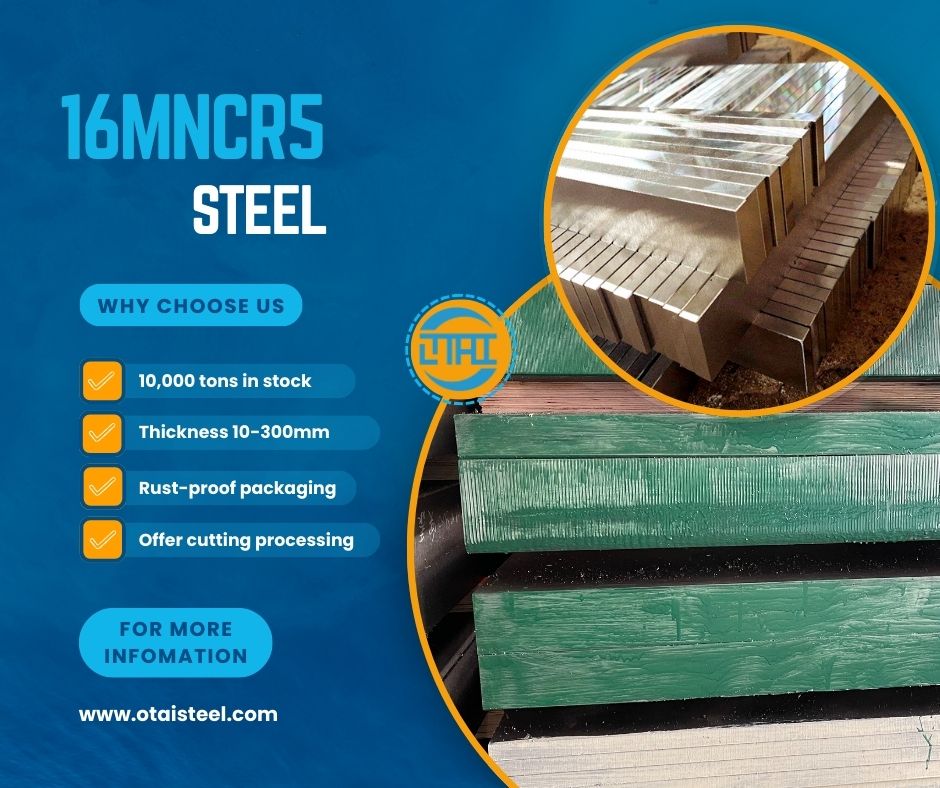
At Otai Special Steel, we supply high-quality alloy steels including 16MnCr5 and AISI 8620 for global engineering industries.
Our advantages include:
- Over 10,000 tons of alloy steel inventory available year-round
- Plate thickness range from 6 mm to 300 mm
- Precision custom cutting services for different dimensions
- Strict ultrasonic testing (UT) quality inspection
- Complete chemical composition testing
- Long-term supply partnerships with international companies such as Thyssenkrupp, Borealis, and Schlumberger
Our extensive experience allows us to provide reliable materials for demanding industrial applications.
❓ FAQ
1. What is the main difference between 16MnCr5 and 8620 steel?
The main difference lies in alloy composition. 8620 contains nickel and molybdenum, which improve toughness and hardenability.
2. Which steel is better for carburizing applications?
Both steels perform well, but the 16MnCr5 vs 8620 carburizing steel comparison shows that 8620 often provides better core toughness, while 16MnCr5 offers excellent surface hardness.
3. Are 16MnCr5 and 8620 equivalent materials?
They are similar carburizing steels used for similar applications, but they are not exact equivalents due to differences in alloy composition.
4. Why do automotive manufacturers often use 16MnCr5?
Automotive manufacturers prefer 16MnCr5 because it offers excellent wear resistance, good strength, and reliable carburizing performance for gears and transmission components.