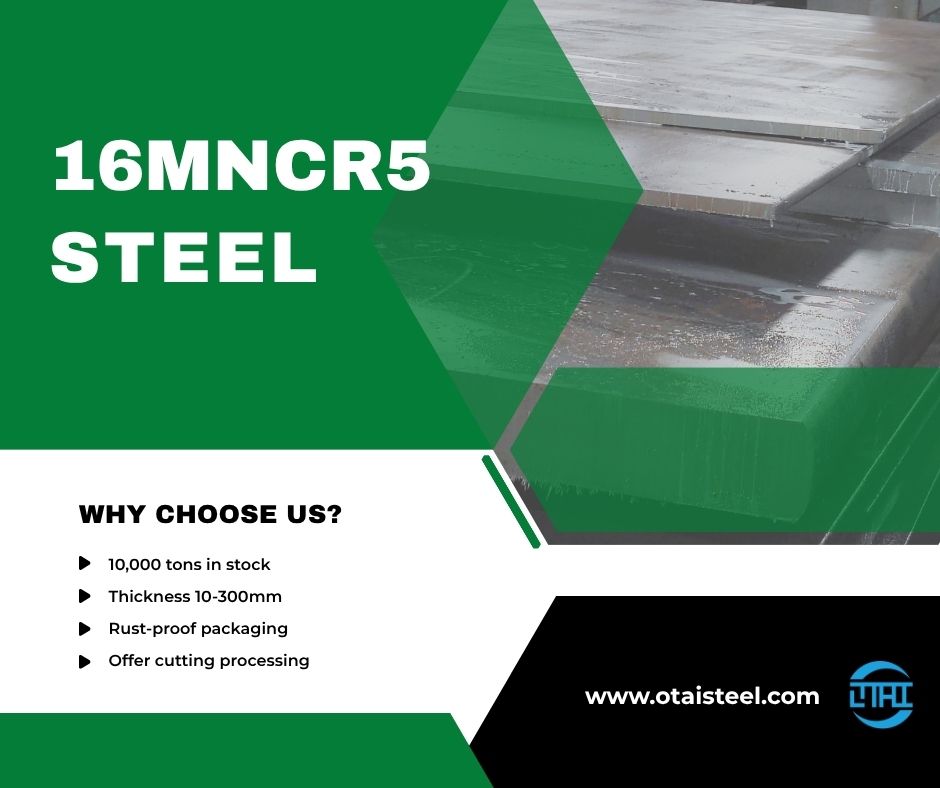
 16MnCr5 Material Hardness in HRC: Values, Distribution, and Engineering Applications
Understanding 16MnCr5 material hardness in HRC is essential for engineers working with case-hardening steels. This material offers a unique combination of a hard surface and a tough core, which makes it highly suitable for demanding mechanical components such as gears, shafts, and transmission parts.
The hardness of 16MnCr5 steel is not fixed. It varies depending on heat treatment, especially carburizing, quenching, and tempering. This flexibility allows engineers to tailor performance according to specific application needs.
🛠️ What Influences 16MnCr5 Material Hardness in HRC?
Several key factors determine 16MnCr5 material hardness in HRC:
- Heat treatment process: The most critical factor affecting hardness
- Surface carbon content: Increased through carburizing
- Cooling rate: Faster quenching leads to higher hardness
- Tempering temperature: Adjusts hardness and toughness balance
- Material section size: Larger sections may reduce uniform hardness
Because 16MnCr5 steel is designed for case hardening, its hardness distribution differs significantly between the surface and the core.
⚙️ Typical 16MnCr5 Material Hardness in HRC
The 16MnCr5 material hardness in HRC varies under different conditions:
| Condition | Hardness | Notes |
|---|---|---|
| Annealed | 140 – 180 HB | Soft, easy to machine |
| Normalized | 170 – 220 HB | Improved structural uniformity |
| Quenched & Tempered | 28 – 45 HRC | Balanced mechanical properties |
| Carburized Surface | 58 – 62 HRC | High wear resistance |
| Core (after treatment) | 30 – 45 HRC | Tough and impact-resistant |
In most industrial uses, engineers rely on carburized 16MnCr5 steel to achieve optimal hardness and durability.
🔬 Hardness Distribution: Surface vs Core
A defining feature of 16MnCr5 material hardness in HRC is its gradient structure:
| Layer | Hardness (HRC) | Function |
|---|---|---|
| Surface Case | 58 – 62 | Resists wear and abrasion |
| Transition Zone | 45 – 55 | Distributes stress |
| Core | 30 – 45 | Provides toughness and shock resistance |
This hardness gradient allows components made from 16MnCr5 steel to withstand both surface wear and internal stress.
🔧 Heat Treatment Impact on Hardness
The 16MnCr5 material hardness in HRC depends heavily on the heat treatment route:
| Process | Temperature Range | Effect on Hardness |
|---|---|---|
| Carburizing | 880 – 930°C | Increases surface carbon content |
| Diffusion | 820 – 860°C | Ensures uniform carbon distribution |
| Quenching | Oil cooling | Forms hard martensitic structure |
| Tempering | 150 – 200°C | Reduces brittleness, stabilizes hardness |
Lower tempering temperatures result in higher hardness but reduced ductility, so engineers must balance these properties carefully.
🧰 Recommended Hardness for Different Applications
Selecting the correct 16MnCr5 material hardness in HRC is crucial for performance:
| Application | Recommended HRC | Engineering Reason |
|---|---|---|
| Automotive Gears | 58 – 62 | Maximum wear resistance |
| Transmission Shafts | 30 – 40 | Strength with good toughness |
| Bearings | 58 – 62 | Surface durability under friction |
| Industrial Machinery | 28 – 45 | Balanced performance |
Matching hardness with application requirements improves service life and reduces failure risk.
💡 Common Challenges in Achieving Target Hardness
Achieving stable 16MnCr5 material hardness in HRC requires careful process control. Common issues include:
| Problem | Cause | Solution |
|---|---|---|
| Uneven Hardness | Poor furnace temperature control | Improve temperature uniformity |
| Distortion | Rapid or uneven cooling | Optimize quenching method |
| Surface Cracks | Excessive stress after quenching | Apply proper tempering |
| Shallow Case Depth | Insufficient carburizing time | Extend carburizing duration |
Monitoring these factors helps maintain consistent hardness across batches.
🌍 Advantages of 16MnCr5 Hardness Characteristics
The flexibility of 16MnCr5 material hardness in HRC offers multiple advantages:
- High surface hardness for wear resistance
- Tough core for shock absorption
- Excellent fatigue performance under cyclic loads
- Adjustable properties through heat treatment
- Reliable operation in heavy-duty environments
These advantages make 16MnCr5 steel one of the most widely used case-hardening steels in modern industry.
🏆 Company Advantages
At Otai Special Steel, we provide 16MnCr5 steel with precise hardness control and stable performance for global customers:
- Large Inventory: Over 10,000 tons available for immediate delivery
- Customized Heat Treatment: Carburizing, quenching, and tempering tailored to your requirements
- Strict Quality Control: UT testing and hardness inspection for every batch
- Global Supply Experience: Reliable export service with consistent standards
- Competitive Pricing: Cost-effective solutions without compromising quality
🤔 FAQ
Q1: What is the typical 16MnCr5 material hardness in HRC after carburizing?
A1: The typical 16MnCr5 material hardness in HRC reaches 58–62 HRC on the surface after carburizing.
Q2: What is the core hardness of 16MnCr5 steel?
A2: The core hardness is generally 30–45 HRC, ensuring good toughness and resistance to impact.
Q3: Can hardness be adjusted in 16MnCr5 steel?
A3: Yes, the 16MnCr5 material hardness in HRC can be adjusted by modifying heat treatment parameters such as tempering temperature and carburizing time.