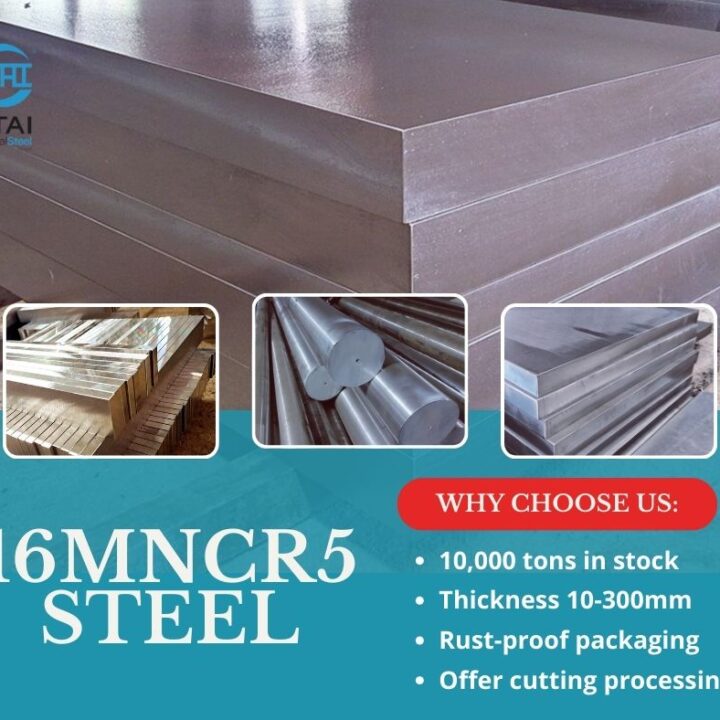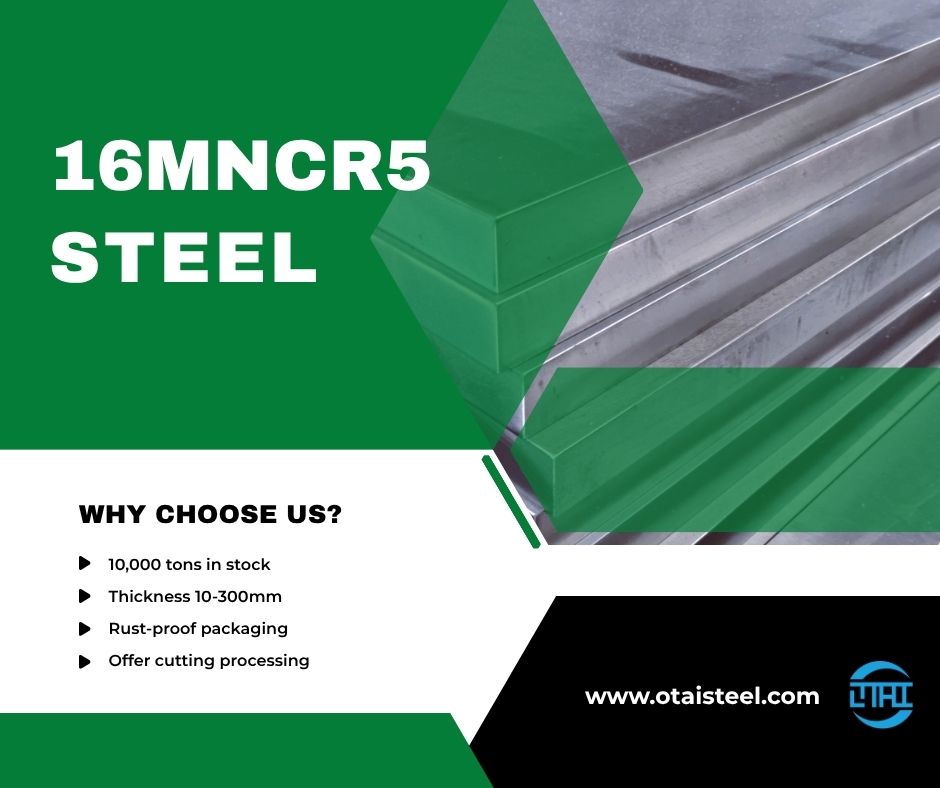
The 16MnCr5 hardening process is essential for achieving a hard, wear-resistant surface while maintaining a tough core. As a case-hardening steel, 16MnCr5 steel responds exceptionally well to carburizing and quenching, making it a top choice for gears, shafts, and high-load components.
🛠️ What is 16MnCr5 Hardening?
16MnCr5 hardening typically refers to a carburizing-based heat treatment process. During this process, carbon diffuses into the surface layer, followed by quenching and tempering.
This method creates:
- A hard outer case for wear resistance
- A tough inner core for impact resistance
This combination makes 16MnCr5 steel ideal for dynamic and high-stress applications.
⚙️ 16MnCr5 Hardening Process Steps
The standard 16MnCr5 hardening process includes several controlled steps:
| Step | Temperature Range | Purpose |
|---|---|---|
| Carburizing | 880 – 930°C | Enrich surface with carbon |
| Diffusion | 820 – 860°C | Even carbon distribution |
| Quenching | Oil cooling | Increase surface hardness |
| Tempering | 150 – 200°C | Reduce brittleness |
You must control each step precisely to achieve consistent results.
🔬 Surface Hardness After 16MnCr5 Hardening
The 16MnCr5 hardening process produces high surface hardness:
| Property | Typical Value |
|---|---|
| Surface Hardness | 58 – 62 HRC |
| Core Hardness | 30 – 45 HRC |
| Case Depth | 0.8 – 1.5 mm (typical) |
This hardness profile provides excellent wear resistance and fatigue strength.
🔧 Factors Affecting Hardening Results
Several factors influence the outcome of 16MnCr5 hardening:
- Carburizing Time: Longer time increases case depth
- Temperature Control: Ensures uniform carbon diffusion
- Quenching Medium: Oil quenching reduces distortion
- Component Size: Larger parts require longer soaking time
- Surface Condition: Clean surfaces improve carbon absorption
Proper control of these factors ensures consistent hardness and performance.
🧰 Common Hardening Defects and Solutions
During 16MnCr5 hardening, some issues may occur:
| Problem | Cause | Solution |
|---|---|---|
| Distortion | Uneven cooling | Improve fixturing and quenching |
| Cracking | Excessive hardness or stress | Optimize tempering process |
| Uneven Hardness | Poor temperature control | Ensure uniform furnace conditions |
| Shallow Case Depth | Insufficient carburizing time | Increase carburizing duration |
You should monitor process parameters carefully to avoid defects.
🔩 Applications of 16MnCr5 Hardened Steel
The 16MnCr5 hardening process makes the material suitable for:
- Automotive gears and transmission parts
- Shafts and pinions
- Bearings and bushings
- Heavy-duty machinery components
These applications require high surface hardness combined with core toughness.
💡 Advantages of 16MnCr5 Hardening
Using the 16MnCr5 hardening process offers several advantages:
- Excellent wear resistance
- High fatigue strength
- Strong core toughness
- Good dimensional stability
- Reliable performance under cyclic loads
🏆 Company Advantages
At Otai Special Steel, we supply high-quality 16MnCr5 steel with professional hardening and heat treatment support. Our advantages include:
- Large Inventory: Over 10,000 tons available for fast delivery.
- Custom Heat Treatment Services: Carburizing, quenching, and tempering tailored to your needs.
- Strict Quality Control: UT testing and hardness inspection for every batch.
- Global Supply Experience: Reliable export service worldwide.
- Competitive Pricing: Cost-effective solutions with consistent quality.
🤔 FAQ
Q1: What is the typical hardness after 16MnCr5 hardening?
A1: It is typically achieves 58–62 HRC on the surface.
Q2: What is the best quenching method for 16MnCr5?
A2: Oil quenching is commonly used to reduce distortion and achieve uniform hardness.
Q3: Why is carburizing important for 16MnCr5?
A3: Carburizing increases surface carbon content, allowing the steel to achieve high hardness while maintaining a tough core.