Skip to Content

Blog Archives

What Is the Ultimate Tensile Strength of 4140 Steel?

What Is the What Is the <yoastmark class=Ultimate Tensile Strength of 4140 Steel?

When engineers, machinists, or manufacturers evaluate a steel grade for a project, one of the most critical factors is ultimate tensile strength (UTS). For 4140 steel, known for its outstanding strength and toughness, UTS is a key performance indicator.

Ultimate tensile strength of 4140 steel typically falls in the range of 655–1080 MPa (95,000–157,000 psi) depending on the heat treatment condition. This strength makes it a go-to choice in demanding industries like automotive, oil & gas, and tooling.


📐 4140 Steel UTS Values by Condition

Below is a detailed table showing how the ultimate tensile strength of 4140 steel varies under different heat-treated or quenched & tempered conditions:

Condition UTS (MPa) UTS (psi) Yield Strength (MPa) Hardness (HRC)
As-rolled (annealed) 655 95,000 ~415 ~20
Quenched & tempered @ 315°C 1080 157,000 ~930 ~50
Quenched & tempered @ 540°C 930 135,000 ~800 ~40
Normalized 850 123,000 ~655 ~28–32

These values illustrate that 4140 steel’s strength can be tailored significantly via heat treatment, which allows engineers to optimize performance for specific applications.


🔍 Why UTS Matters for 4140 Steel Applications

The ultimate tensile strength of 4140 steel isn’t just a number—it’s directly related to how well the steel performs under maximum stress before breaking. That’s crucial for:

  • Axles and shafts in automotive components

  • Forged parts under cyclic loading

  • Heavy-duty gears and crankshafts

  • High-performance tools and dies

If you’re working on parts that will undergo bending, torque, or tensile loads, UTS helps determine whether 4140 is strong enough to survive the stress.


🧱 Mechanical Properties Overview

Here’s a quick snapshot of key mechanical properties of 4140 steel in typical quenched and tempered condition (at 540°C):

Property Value
Ultimate Tensile Strength 930 MPa (135,000 psi)
Yield Strength 800 MPa
Modulus of Elasticity 205 GPa
Elongation @ break 20%
Impact Toughness (Charpy) 54 J

These numbers make it clear that 4140 balances strength with ductility, which is why it’s widely used in dynamic applications.


🔧 Heat Treatment and Its Impact on UTS

The beauty of 4140 alloy steel lies in its responsiveness to heat treatment. Here’s how heat treatment affects UTS:

  • Quenching & tempering drastically increases both yield strength and UTS, making the material more suitable for wear-resistance.

  • Annealing lowers the UTS but improves machinability and ductility, suitable for forming or machining before hardening.

  • Normalization creates a balanced structure with moderate UTS and good machinability.

This is why heat treated 4140 steel mechanical properties are often customized for each client’s application.


🛠️ How Does 4140 Compare with Other Steels?

Steel Grade UTS (MPa) Comment
1045 Carbon Steel ~570 Lower strength, higher machinability
4340 Alloy Steel ~1080–1250 Higher toughness, more expensive
A36 Structural ~400 Not suitable for high-strength uses

4140 offers the best strength-to-cost ratio, especially in medium carbon alloy steels, making it a top pick in many industries.


📌 Use Cases Requiring High UTS

Below are common applications where high ultimate tensile strength is a must:

  • Oil & gas drill collars

  • High-stress automotive components

  • Forged brackets and structural parts

  • Tool bodies for heavy-duty machining

In these scenarios, high UTS and toughness help resist cracking, fatigue, and deformation.


🌟 Why Customers Love 4140’s Strength

Whether you need 4140 quenched and tempered bar stock, high-strength forged rings, or precision machined components, its versatile tensile performance keeps your application safer and more durable.

Some clients even ask, “Is 4140 steel good for pressure vessels?” While it’s not ASME-certified for all pressure uses, its mechanical strength and temperability make it a strong contender for many related parts.


🏢 Company Advantages – Why Choose Otai Special Steel?

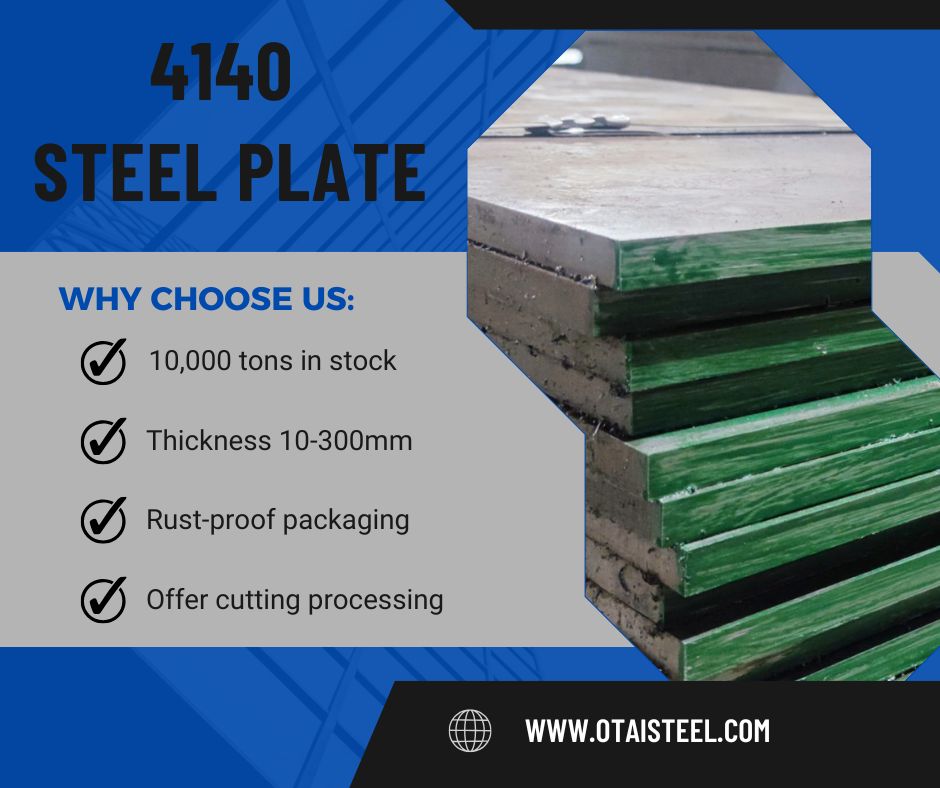
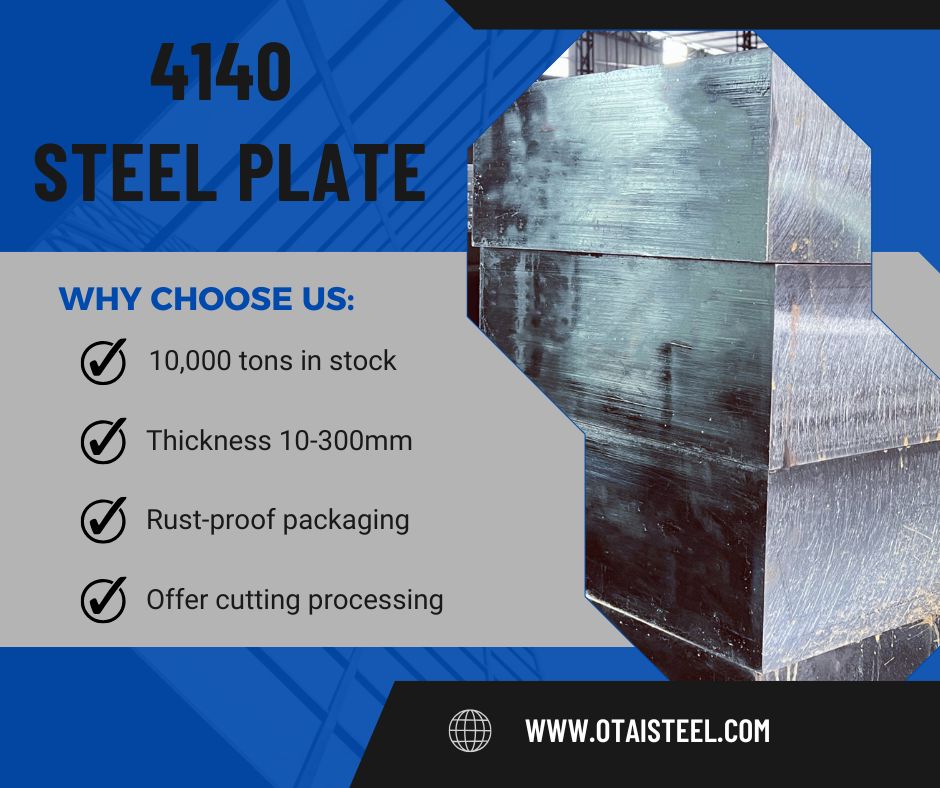
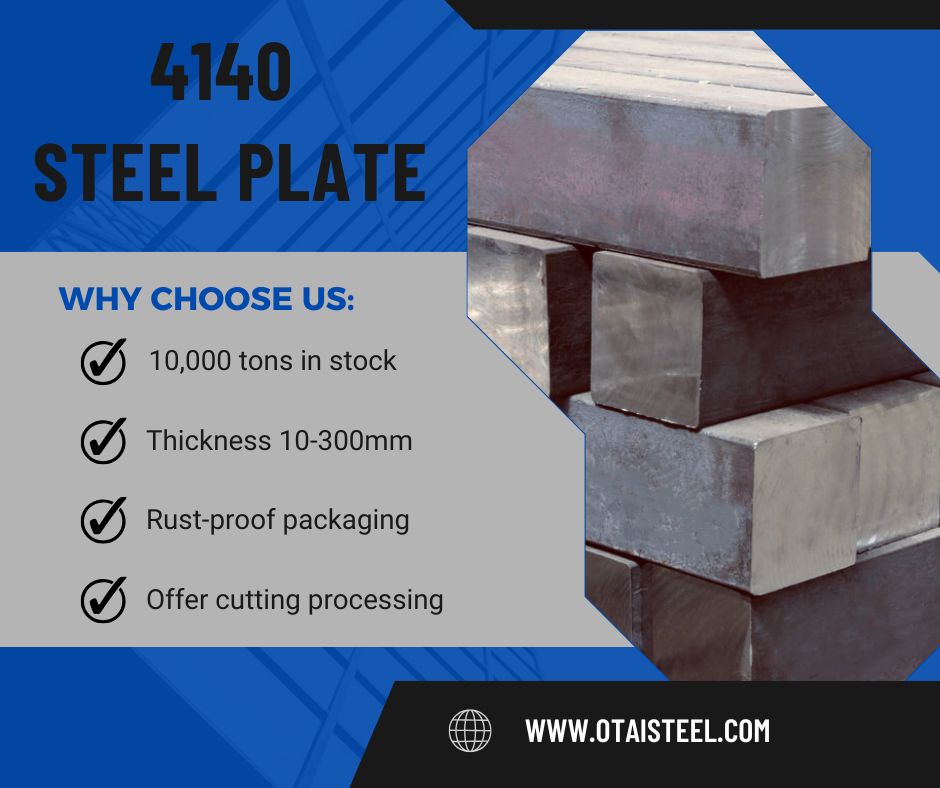
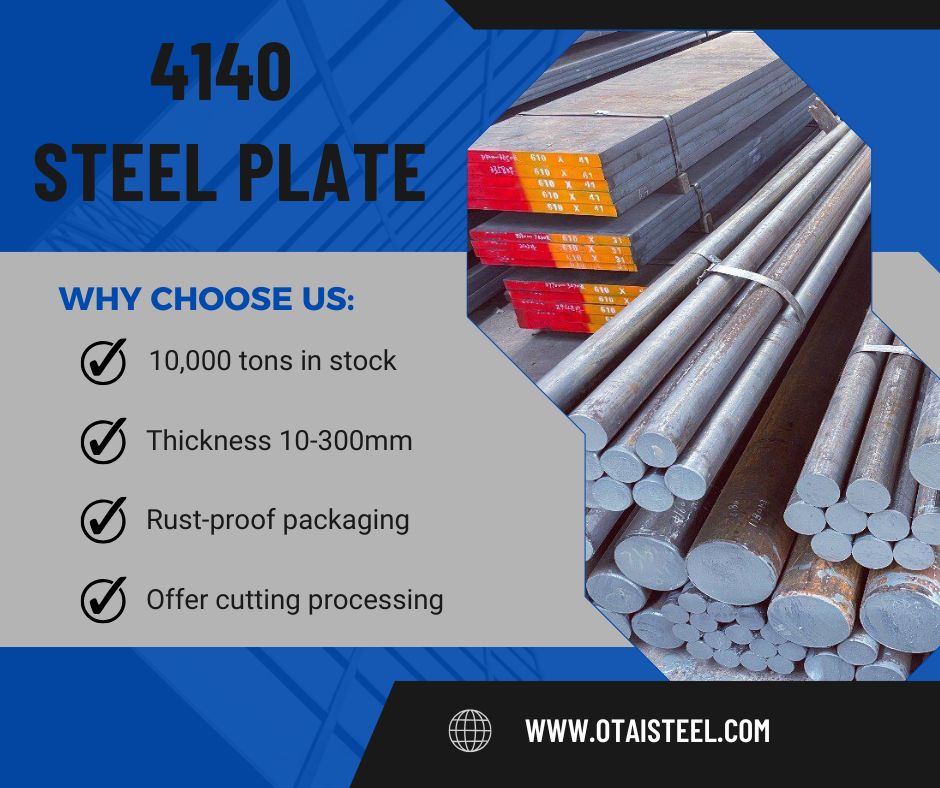
At Otai Special Steel, we specialize in delivering high-performance 4140 steel plates, bars, and blocks in various conditions—annealed, normalized, or quenched & tempered. Here’s why clients choose us:

  • Inventory over 10,000 tons of 4140 and similar grades

  • Custom heat treatment and hardness adjustment available

  • UT testing, chemical composition reports, and third-party inspection support

  • Cutting, machining, and export packaging services

  • ✅ Global clients in aerospace, automotive, oil & gas, and tooling industries

Need 4140 steel with specific tensile strength requirements? We deliver precision and performance—fast.


❓FAQ – Ultimate Tensile Strength of 4140 Steel

Q1: Can I increase the UTS of 4140 steel further?
Yes. You can increase UTS through more aggressive quenching & tempering at lower tempering temperatures, but beware of reduced ductility.

Q2: How does hardness relate to UTS in 4140 steel?
Generally, higher hardness correlates with higher UTS. For instance, ~50 HRC corresponds to ~157,000 psi UTS.

Q3: What’s the difference between yield strength and UTS?
Yield strength is the point where permanent deformation begins. UTS is the maximum stress the material can withstand before breaking.

Q4: Is UTS the same for 4140 bar and 4140 plate?
Not necessarily. Manufacturing process (forged vs rolled), section size, and heat treatment method affect the final UTS.

Q5: Is 4140 good for fatigue resistance?
Yes, especially in Q&T condition, where its combination of high strength and toughness improves fatigue performance.

 

Jack Tan


📧 jack@otaisteel.com

📱 WhatsApp: +8676923190193

0 0 Continue Reading →

4140 Steel Yield Strength vs Hardness: The Real Performance Story 

4140 Steel Yield Strength vs Hardness: The Real Performance Story 

4140 Steel Yield Strength vs Hardness: The Real Performance Story 

When choosing 4140 steel for critical parts, two numbers matter most: yield strength and hardness. They’re related, but they don’t mean the same thing—and knowing the difference can help you make smarter choices for machining, heat treating, and design.

Let’s break down exactly what 4140 steel yield strength vs hardness means in the real world, with data, heat treatment tips, and industry examples.


📌 Yield Strength vs Hardness – What’s the Difference?

  • Yield Strength: The stress level (force per area) at which the steel starts to deform permanently. It’s measured in MPa or ksi and tells you how much load it can handle before bending for good.

  • Hardness: A measure of resistance to indentation or scratching, often measured in Rockwell C (HRC) or Brinell Hardness Number (BHN). It correlates with wear resistance but not directly with flexibility or toughness.

In 4140 alloy steel, both values change depending on heat treatment. Increasing hardness usually increases yield strength—up to a point—but can also reduce ductility.


🧪 Typical Mechanical Properties of 4140 Steel

Here’s a quick reference for 4140 steel yield strength and hardness in different conditions:

Condition Yield Strength (MPa) Yield Strength (ksi) Hardness (HRC) Notes
Annealed 415–550 60–80 ~20 Soft, easy to machine
Normalized 655–725 95–105 22–28 Balanced properties
Q&T @ 500°C 850–900 123–131 28–32 Common industrial grade
Q&T @ 300°C 1100+ 160+ 40–45 Very high strength, lower toughness
Nitrided (surface) Core same as Q&T Core same as Q&T Surface ~55–60 Wear-resistant skin, tough core

🔥 How Heat Treatment Affects Yield Strength and Hardness

4140 chromium-molybdenum steel responds extremely well to heat treatment:

  • Annealing → lowers hardness, improves machinability.

  • Normalizing → increases both yield strength and hardness slightly.

  • Quenching & Tempering (Q&T) → main method to boost both strength and hardness to target levels.

  • Nitriding → boosts surface hardness dramatically without changing core yield strength.

💡 Tip: For high-stress applications like 4140 steel shafts or gear components, you often want a hardness of 28–32 HRC for a balance of toughness and wear resistance.


🆚 Yield Strength vs Hardness – Why the Balance Matters

If you push hardness too high in 4140 steel, yield strength can increase—but impact toughness drops. This is dangerous in parts exposed to shock loads (e.g., 4140 steel drive shafts).

Hardness (HRC) Approx. Yield Strength (MPa) Toughness Rating Best Use
20–25 500–700 High Bending/forming parts
28–32 800–950 Medium-High Shafts, gears, couplings
35–40 950–1100 Medium Tooling, wear parts
45+ 1200+ Low Cutting tools, not for impact loads

🛠 Industry Example – Oilfield Coupling Failures

A drilling company used 4140 Q&T steel couplings at 40 HRC for better wear life. The hardness gave great abrasion resistance, but in service, the parts cracked after repeated torque shocks.

The fix? Dropping to 30–32 HRC reduced yield strength slightly but doubled service life because the steel absorbed more impact without cracking.


📐 Practical Guidelines for Choosing 4140 Hardness vs Yield Strength

  1. Heavy Load + Shock → Medium hardness (28–32 HRC) for high yield strength and good ductility.

  2. Wear-Critical Parts → Higher hardness (35–40 HRC) if shock loads are minimal.

  3. Machining Before Heat Treat → Keep in annealed state (~20 HRC) for easy cutting.

  4. Nitriding Applications → Core kept at 28–32 HRC, surface hardened to 55–60 HRC.


🏭 Applications Where the Balance Matters

  • Oil & Gas: drill collars, couplings

  • Automotive: axles, crankshafts, transmission gears

  • Aerospace: landing gear, high-load linkages

  • Industrial Tooling: dies, molds with balanced hardness for wear and strength


🏭 Company Advantages – Why Choose Otai Special Steel

At Otai Special Steel, we stock 4140 alloy steel in all common heat-treated states, ready to meet your yield strength and hardness requirements.

  • ✅ 10,000+ tons of 4140 steel in stock (6–300 mm thick)
  • ✅ Supply in annealed, normalized, Q&T, or nitrided condition
  • ✅ Precision cutting for custom sizes
  • ✅ Full mechanical and chemical testing
  • ✅ Heat treatment and surface hardening services
  • ✅ SGS/BV inspection available
  • ✅ Global clients: Thyssenkrupp, Borealis, Schlumberger

❓ FAQ – 4140 Steel Yield Strength vs Hardness

Q1: Does higher hardness always mean higher yield strength?
A: Generally yes, but excessive hardness can reduce toughness.

Q2: What is the ideal hardness for high fatigue strength?
A: Around 28–32 HRC for most load-bearing applications.

Q3: Can 4140 steel be too hard?
A: Yes—over 45 HRC it can become brittle for impact loads.

Q4: How do I adjust hardness without losing yield strength?
A: Proper tempering after quenching, or surface hardening like nitriding.

Q5: Is there a direct formula between yield strength and hardness?
A: There’s a correlation, but the exact relationship depends on microstructure and heat treatment.

Jack Tan


📧 jack@otaisteel.com

📱 WhatsApp: +8676923190193

0 0 Continue Reading →

Is 4140 an Alloy Steel? Everything You Need to Know

Is 4140 an Alloy Steel? Everything You Need to KnowIs 4140 an Alloy Steel? Everything You Need to Know

If you’ve worked in machining, manufacturing, or metal fabrication, you’ve probably heard of 4140 steel. But one question still pops up from time to time: Is 4140 an alloy steel? The short answer is—yes, it is. But the real story is far more interesting, especially when you look at its composition, properties, and why so many industries rely on it.

Let’s break it down into practical, shop-floor-level knowledge.


🌟 What Makes 4140 an Alloy Steel?

4140 steel is indeed a chromium-molybdenum alloy steel, meaning it contains significant amounts of alloying elements in addition to iron and carbon. These alloying elements—primarily chromium and molybdenum—are intentionally added to improve strength, toughness, and wear resistance.

Here’s the typical chemical composition of 4140 steel:

Element Percentage (%) Function
Carbon (C) 0.38–0.43 Strength, hardness potential
Chromium (Cr) 0.80–1.10 Wear resistance, hardenability
Molybdenum (Mo) 0.15–0.25 High-temperature strength, toughness
Manganese (Mn) 0.75–1.00 Strength, hardness, machinability
Silicon (Si) 0.15–0.35 Deoxidizer, improves toughness
Phosphorus (P) ≤0.035 Kept low to avoid brittleness
Sulfur (S) ≤0.040 Improves machinability in small amounts

These alloying elements set 4140 apart from plain carbon steels like 1045 steel, making it far more versatile for demanding applications.


🏋️‍♂️ Mechanical Properties – Why It’s Trusted in Industry

4140 alloy steel properties are the reason it’s so widely used. It delivers a combination of strength, ductility, and fatigue resistance that’s hard to beat.

Property Typical Range (Q&T)
Tensile Strength 850–1000 MPa (123–145 ksi)
Yield Strength 655–850 MPa (95–123 ksi)
Hardness (HRC) 28–32
Elongation (%) 18–25
Impact Toughness High
Fatigue Resistance Excellent

This balance means it can handle shock loads, cyclic stresses, and abrasion without breaking or wearing out quickly.


🔥 Heat Treatment and Hardenability

One of the biggest advantages of 4140 chromium molybdenum steel is its excellent response to heat treatment. It can be:

  • Annealed for easier machining

  • Quenched and tempered for high strength and toughness

  • Nitrided for exceptional surface hardness without sacrificing core ductility

Thanks to the chromium and molybdenum, 4140 steel hardenability is much higher than that of plain carbon steels, allowing for deep, uniform hardening even in thicker sections.


🔄 4140 Alloy Steel vs Carbon Steel

Feature 4140 Alloy Steel 1045 Carbon Steel
Alloying Elements Cr, Mo, Mn, Si Mn only
Hardenability High Moderate
Wear Resistance High Medium
Toughness High Medium
Heat Treat Flexibility Excellent Limited

If you need higher performance for demanding parts—especially those under high stress or wear—4140 is almost always the better choice.


🏭 Common Applications of 4140 Alloy Steel

Because of its strength, toughness, and machinability, 4140 steel uses span across:

  • Oil & Gas: drill collars, couplings, valve bodies

  • Automotive: crankshafts, gear shafts, axles

  • Aerospace: landing gear components

  • Heavy Machinery: pins, shafts, bushings

  • Defense: firearm barrels, armor components

Its versatility comes from being able to adapt to various heat treatments and surface finishes.


🧰 Machining and Fabrication Notes

4140 alloy steel machinability is good in the annealed condition, but it becomes more challenging after hardening. Use sharp tools, adequate lubrication, and slower speeds for best results. It also welds well if preheated to 200–300°C to avoid cracking.


🌍 Why 4140’s Alloy Nature Matters

Because 4140 is an alloy steel, it delivers more consistent performance across large cross-sections, resists wear better, and can achieve a wider range of properties through heat treatment than plain steels. This makes it ideal for industries where downtime costs money and reliability is essential.


🏭 Company Advantages – Why Choose Otai Special Steel

At Otai Special Steel, we supply 4140 alloy steel in plate, bar, and cut-to-size formats, tailored to your project needs.

  • ✅ 10,000+ tons of stock (thickness 6mm–300mm)
  • ✅ Annealed, normalized, quenched & tempered, or nitrided supply
  • ✅ Precision cutting for fast production
  • ✅ Full chemical and mechanical testing for guaranteed quality
  • ✅ SGS/BV inspection available
  • ✅ Global export to 50+ countries
  • ✅ Trusted by Thyssenkrupp, Borealis, Schlumberger

❓ FAQ – Is 4140 an Alloy Steel?

Q1: What type of alloy is 4140 steel?
A: It’s a chromium-molybdenum alloy steel with medium carbon content.

Q2: Is 4140 better than carbon steel?
A: Yes, in terms of hardenability, wear resistance, and toughness.

Q3: Can you weld 4140 steel?
A: Yes, with proper preheat and post-weld heat treatment.

Q4: Does 4140 rust?
A: Yes, it’s not stainless—protective coatings or oiling are recommended.

Q5: What industries use 4140?
A: Oil & gas, automotive, aerospace, defense, and heavy machinery.


Jack Tan


📧 jack@otaisteel.com

📱 WhatsApp: +8676923190193

0 0 Continue Reading →

Is 4140 Steel Good for Knives? The Complete Guide

Is 4140 Steel Good for Knives? The Complete GuideIs 4140 Steel Good for Knives? The Complete Guide

When it comes to knife making, choosing the right steel is crucial. Many machinists, hobbyists, and even custom knife makers have wondered: Is 4140 steel good for knives? The short answer is—yes and no—it depends entirely on the type of knife, the heat treatment, and the intended use.

Let’s break this down so you can decide whether 4140 steel for knife making is the right choice for you.


🌟 What Is 4140 Steel?

4140 is a chromium-molybdenum alloy steel, originally designed for mechanical components that require strength, toughness, and wear resistance. Its typical composition gives it a unique balance of properties:

Element Percentage (%)
Carbon (C) 0.38–0.43
Chromium (Cr) 0.80–1.10
Molybdenum (Mo) 0.15–0.25
Manganese (Mn) 0.75–1.00
Silicon (Si) 0.15–0.35
Phosphorus (P) ≤0.035
Sulfur (S) ≤0.040

This chemistry gives it better toughness than many higher-carbon steels, but also limits maximum hardness—something important to keep in mind when making knives.


🔍 Hardness and Edge Retention

4140 steel blade hardness after proper quenching and tempering typically reaches 28–32 HRC. This is lower than what you’d find in high-carbon knife steels (which are often in the 55–62 HRC range).

Property 4140 Steel (Q&T) High Carbon Knife Steel (e.g., 1095)
Hardness (HRC) 28–32 55–62
Edge Retention Low–Moderate High
Toughness High Moderate
Corrosion Resistance Low Low–Moderate (depends on alloy)

This means that 4140 steel edge retention is not exceptional compared to dedicated knife steels. However, its high toughness makes it suitable for impact tools, machetes, or survival knives that endure heavy abuse.


🛠️ Heat Treating 4140 Steel for Knives

To get the most out of heat treating 4140 steel for knives, you’ll need to optimize hardness without sacrificing toughness:

  1. Normalize at ~870°C (1600°F) to refine grain structure.

  2. Quench in oil at ~850°C (1560°F) to achieve maximum hardness.

  3. Temper between 400–600°C (750–1100°F) depending on desired hardness/toughness balance.

⚠️ Even with optimal treatment, the hardness won’t reach that of premium knife steels—so it’s not ideal for fine-edged kitchen knives.


🍴 Is 4140 Steel Good for Kitchen Knives?

For kitchen applications, 4140 steel for kitchen knives isn’t the best choice. Why?

  • Corrosion resistance is poor compared to stainless steels.

  • Lower hardness means more frequent sharpening.

  • Acidic foods can discolor and pit the blade.

It’s better suited for outdoor, survival, or large chopping knives than for precision culinary tools.


🥊 Pros and Cons of 4140 Steel Knives

Pros 👍 Cons 👎
High toughness — resists chipping and breaking Low edge retention — needs frequent sharpening
Easy to machine and shape before heat treatment Prone to rust without maintenance
Affordable and widely available Lower hardness than dedicated knife steels
Good for large blades, machetes, and impact tools Not suitable for fine slicing blades

🔄 4140 Steel vs Stainless Steel for Knives

Feature 4140 Alloy Steel Stainless Steel (e.g., 440C)
Hardness Potential Medium (28–32 HRC) High (56–60 HRC)
Toughness High Medium
Corrosion Resistance Low High
Edge Retention Low–Moderate High
Ease of Sharpening Easy Moderate

If your knife needs to withstand impacts, pry work, or repeated abuse, 4140 steel toughness for knives makes it a better option than brittle high-hardness stainless. But for food prep or decorative blades, stainless wins.


🪒 Sharpening 4140 Steel Knives

Because of its relatively low hardness, sharpening 4140 steel knives is easy with standard whetstones or diamond sharpeners. However, the edge will dull faster, so maintenance will be more frequent.


📌 When to Use 4140 Steel for Knives

Best suited for:

  • Outdoor survival knives

  • Machetes

  • Bushcraft tools

  • Throwing knives (toughness over sharpness)

Avoid for:

  • Fine kitchen cutlery

  • Hunting knives requiring long-lasting sharpness

  • Display knives where corrosion resistance is key


🏭 Company Advantages – Why Choose Otai Special Steel

At Otai Special Steel, we supply top-quality 4140 alloy steel in various forms, perfect for custom knife projects requiring toughness and durability.

  • ✅ Over 10,000 tons of alloy steel in stock (6mm–300mm thickness)
  • ✅ Cut-to-size, heat-treated, or annealed supply options
  • ✅ Full chemical composition and mechanical property testing
  • ✅ Optional surface treatments (black oxide, nitriding)
  • ✅ Export-ready with SGS/BV inspection available
  • ✅ Global supply to over 50 countries
  • ✅ Trusted by Thyssenkrupp, Borealis, Schlumberger

❓ FAQ – Is 4140 Steel Good for Knives?

Q1: Is 4140 steel good for knife making?
A: Yes, for tough, impact-resistant blades—no, for fine cutting edges.

Q2: How hard can 4140 steel get for knives?
A: Up to about 32 HRC with oil quenching and tempering.

Q3: Does 4140 steel rust?
A: Yes, it has low corrosion resistance—needs oiling and care.

Q4: Can you make kitchen knives from 4140?
A: Technically yes, but performance will be inferior to stainless or high-carbon steels.

Q5: Is 4140 steel easy to sharpen?
A: Yes, but it will need sharpening more often than high-hardness steels.

Jack Tan


📧 jack@otaisteel.com

📱 WhatsApp: +8676923190193

0 0 Continue Reading →

4140 Steel Density: The Facts You Need to Know

4140 Steel Density: The Facts You Need to Know4140 Steel Density: The Facts You Need to Know

When working with alloy steels, knowing their density isn’t just trivia—it’s a critical factor in material selection, weight calculations, and cost estimation. For engineers, machinists, and buyers, understanding 4140 steel density can mean the difference between a balanced design and weighty, underperforming component.

Today, we’ll break down the exact numbers, how to calculate the weight of 4140 steel per meter, and why density matters for machining, shipping, and structural performance.


🧪 What Is 4140 Steel?

4140 steel is a chromium-molybdenum alloy steel known for its excellent strength, toughness, and wear resistance. It’s used in applications ranging from gears and shafts to drill collars and tooling equipment.

While its mechanical properties are often the focus, the density of 4140 alloy steel plays a key role in determining its mass-to-strength ratio—especially in industries like aerospace, automotive, and oil & gas, where weight directly impacts performance and cost.


📏 Exact 4140 Steel Density

In most reference standards, 4140 steel material density is listed as:

Unit of Measurement Density Value Notes
g/cm³ 7.85 g/cm³ Common engineering reference
kg/m³ 7,850 kg/m³ Used for bulk weight calculations
lb/in³ 0.284 lb/in³ Common in U.S. manufacturing
lb/ft³ 490 lb/ft³ For larger volume estimates

This value can vary slightly depending on heat treatment, alloy variation, and impurity levels, but in practice, engineers use the nominal density of 7.85 g/cm³.


⚖️ Why Density Matters in 4140 Steel Applications

The 4140 steel specific gravity directly impacts:

  • Weight per Part – Essential for load-bearing applications.

  • Transportation Costs – Heavier materials cost more to ship.

  • Structural Balance – Prevents imbalance in rotating machinery.

  • Cost per Unit – Price is often linked to material volume × density.

For example, knowing the 4140 steel weight per cubic inch helps CNC shops determine whether a part will exceed machine capacity before production begins.


🔢 How to Calculate 4140 Steel Weight

Here’s the formula to determine 4140 steel weight per cubic foot or per meter:

Weight = Volume × Density

Example for a round bar:

  • Diameter: 50 mm (0.05 m)

  • Length: 1 m

  • Volume = π × (0.025 m)² × 1 m = 0.001963 m³

  • Weight = 0.001963 m³ × 7,850 kg/m³15.4 kg


📊 Quick Reference – 4140 Steel Weight per Meter

Shape Size Example Volume (m³) Weight (kg/m)
Round Bar Ø 25 mm 0.000491 3.85
Round Bar Ø 50 mm 0.001963 15.4
Square Bar 50 × 50 mm 0.0025 19.6
Plate 10 mm thick, 1 m wide 0.01 78.5

Knowing how to calculate 4140 steel weight makes it easier for procurement teams to price bulk orders and for engineers to assess load capacity.


🔍 Does Heat Treatment Affect 4140 Steel Density?

Heat treatment changes microstructure, hardness, and toughness, but its effect on 4140 steel density g/cm3 is minimal. The atomic packing doesn’t shift enough to cause a measurable density change. That means you can use the standard value for density of 4140 alloy steel regardless of whether it’s annealed, normalized, or quenched & tempered.


🏭 Real-World Example – Oilfield Component

An oilfield supplier in Texas needed to estimate the weight of 4140 steel per meter for long drill shafts to ensure the total load wouldn’t exceed rig capacity. Using the formula above, they calculated shipping weight within 0.5% accuracy, avoiding costly overloading penalties.


💡 Key Takeaways for Engineers and Buyers

  • Standard Density: ~7.85 g/cm³ (490 lb/ft³)

  • Weight Calculation: Volume × Density

  • Applications: Critical in load, cost, and transport analysis

  • Long Pieces: Use 4140 steel kg/m3 for quick per-meter weight estimation

  • Heat Treatment: Does not significantly affect density


🏢 Company Advantages – Why Buy 4140 Steel from Otai Special Steel

  • 📦 Massive Inventory – Over 10,000 tons in stock (6mm–300mm thickness)

  • ⚙️ Custom Cutting & Machining – To your exact specifications

  • 🔥 Heat Treatment Services – Annealed, normalized, quenched & tempered

  • 📜 Full QC Reports – Chemical & mechanical testing included

  • 🌍 Global Delivery – Fast shipping to over 50 countries

  • 🤝 Trusted by Industry Leaders – Thyssenkrupp, Borealis, Schlumberger

📧 Email: jack@otaisteel.com
📱 WhatsApp: +8676923190193


❓ FAQ – 4140 Steel Density

Q1: What is the exact density of 4140 steel?
A1: Approximately 7.85 g/cm³ or 490 lb/ft³.

Q2: Does heat treatment change 4140 steel density?
A2: Not significantly—it stays very close to the nominal value.

Q3: How do I calculate 4140 steel weight per cubic foot?
A3: Multiply the volume in ft³ by 490 lb/ft³.

Q4: Can density vary between suppliers?
A4: Slightly, due to alloying variations, but usually within ±1%.

Q5: Is 4140 steel heavier than mild steel?
A5: The density is nearly the same, but 4140 offers far superior strength.

0 0 Continue Reading →

Annealing 4140 Steel: The Complete Heat Treatment Guide

Annealing 4140 Steel: The Complete Heat Treatment GuideAnnealing 4140 Steel: The Complete Heat Treatment Guide

If you work with alloy steels in machining, fabrication, or heat treatment, you’ve probably come across annealing 4140 steel. This process is one of the most effective ways to soften the steel, improve machinability, and prepare it for further forming or heat treatment. But to get it right, you need to understand the temperatures, cooling rates, and metallurgical changes that happen during annealing.

In this guide, we’ll break down what annealing does to 4140 steel, why it’s essential for certain projects, and how to perform it step by step—backed with technical data and practical shop tips.


🌟 What Is Annealing 4140 Steel?

4140 steel is a chromium-molybdenum alloy steel known for its high strength, wear resistance, and toughness. In its hardened state, it can be difficult to machine or bend. Annealing is a heat treatment process that reduces hardness, increases ductility, and relieves internal stresses.

When you perform annealing 4140 steel, you heat the material to a specific range (above its critical temperature), hold it to allow transformation, and then cool it slowly—typically in a furnace or insulating medium. This allows the microstructure to convert into a softer, more machinable form called ferrite-pearlite.


🔍 Chemical Composition of 4140 Steel

Before diving into the process, here’s the typical chemical makeup of 4140 alloy steel:

Element Percentage (%)
Carbon (C) 0.38–0.43
Chromium (Cr) 0.80–1.10
Molybdenum (Mo) 0.15–0.25
Manganese (Mn) 0.75–1.00
Silicon (Si) 0.15–0.35
Phosphorus (P) ≤ 0.035
Sulfur (S) ≤ 0.04

This alloy combination gives 4140 pre-annealed steel its balance of strength and hardenability.


🔥 Annealing Process for 4140 Steel – Step by Step

Here’s the typical cycle used by heat treatment shops when annealing 4140 steel:

Step Temperature (°C / °F) Time Cooling Method Purpose
Preheat 400–500°C / 750–930°F Furnace Reduce thermal shock
Full Heat 815–845°C / 1500–1550°F 1 hour per inch thickness Furnace Transform microstructure
Hold Same as full heat As required Furnace Uniform temperature throughout
Controlled Cooling ≤ 28°C/hour to 540°C (≤ 50°F/hour to 1000°F) Furnace or sand bed Prevent hardening during cooling
Final Cool Room temperature Air Complete cycle

📈 Effects of Annealing on Mechanical Properties

Annealing 4140 steel has a significant effect on hardness, tensile strength, and elongation:

Property Before Annealing (Q&T) After Annealing
Hardness (HRC) 28–32 18–22
Tensile Strength (MPa) 850–1100 620–700
Yield Strength (MPa) 650–950 415–500
Elongation (%) 12–18 20–25
Machinability (%) 60 80

💡 The increase in ductility and machinability is why many machinists prefer machining annealed 4140 steel over hardened stock.


🧪 Microstructural Changes During Annealing

When annealing 4140 alloy steel, the structure changes from tempered martensite or bainite to ferrite-pearlite. This transformation:

  • Relieves residual stresses from forging or machining

  • Improves toughness by eliminating brittleness

  • Prepares steel for carburizing or nitriding if needed later

  • Enhances cold forming capability such as bending or rolling


🛠️ When to Anneal 4140 Steel

You should consider annealing 4140 steel in situations like:

  • Before extensive cold forming 4140 steel

  • When high machinability is needed for precision components

  • To remove stresses after heavy welding or forging

  • Before applying surface hardening treatments like nitriding or carburizing


⚠️ Common Mistakes to Avoid

  • Overheating above 870°C (1600°F) – causes grain growth and reduces toughness

  • Cooling too quickly – may result in partial hardening

  • Skipping preheat – can cause thermal shock and cracking in large sections

  • Not holding long enough – results in incomplete transformation


🔍 Annealed 4140 Steel vs Normalized 4140 Steel

Feature Annealed 4140 Normalized 4140
Hardness Lower (softer) Slightly higher
Machinability Higher Lower
Grain Structure Ferrite-pearlite Finer pearlite
Stress Relief Excellent Good
Common Use Machining, cold forming General structural parts

🧠 Pro Tips from the Heat Treatment Floor

  • Always measure core temperature, not just surface, before holding time starts.

  • Use furnace charts to track exact cooling rates.

  • If annealing thick 4140 steel plate, allow extra soak time to avoid uneven properties.

  • Combine annealing with a later quench and temper cycle for optimal strength.


🏭 Company Advantages – Why Choose Otai Special Steel for Annealed 4140

At Otai Special Steel, we specialize in supplying 4140 steel in all heat treatment conditions, including fully annealed stock ready for machining or forming.

Our Advantages:

  • ✅ 10,000+ tons of 4140 steel in stock (6mm–300mm thick)
  • ✅ Available in annealed, normalized, Q&T, and nitrided states
  • ✅ Precision cutting service for your exact sizes
  • ✅ Heat treatment and technical support included
  • ✅ SGS/BV inspection and full material certificates
  • ✅ Global export with on-time delivery
  • ✅ Long-term supply partnerships with Thyssenkrupp, Borealis, Schlumberger

📧 Contact us: jack@otaisteel.com
📱 WhatsApp: +8676923190193


❓ FAQ – Annealing 4140 Steel

Q1: Can I anneal 4140 steel at home?
Yes, small parts can be annealed with a controlled furnace, but precision industrial annealing ensures better results.

Q2: Does annealing reduce strength?
Yes, but it increases ductility and machinability. Strength can be restored with later heat treatments.

Q3: How long should I hold at annealing temperature?
A general rule is 1 hour per inch of thickness after reaching target temperature.

Q4: Can I machine 4140 steel right after annealing?
Yes, in fact, annealed 4140 is much easier to machine.

Q5: What’s the difference between full annealing and subcritical annealing?
Full annealing transforms the entire microstructure; subcritical annealing focuses on stress relief without full softening.

0 0 Continue Reading →

Bending 4140 Steel: Practical Guide for Safe and Effective Forming

Bending 4140 Steel: Practical Guide for Safe and Effective Forming

Bending 4140 Steel: Practical Guide for Safe and Effective Forming

If you work in fabrication, machining, or heavy equipment repair, chances are you’ve come across bending 4140 steel at some point. This high-strength chromium-molybdenum alloy steel is famous for its toughness and wear resistance—but those same qualities can make forming it a real challenge.

In this guide, we’ll break down how to bend 4140 steel without cracking, losing strength, or ruining your part. We’ll look at cold bending 4140 steel, hot forming techniques, correct bend radius guidelines, post-bend heat treatments, and real-world examples from industry.


🌟 Why Bending 4140 Steel Is Different from Mild Steel

4140 steel is far stronger than mild carbon steels like 1018 or 1045. It has higher tensile and yield strength, which makes it resist deformation—but also means that forcing it to bend creates higher stress concentrations.

The difficulty depends heavily on its condition:

Condition Ductility Bendability Notes
Annealed High Easy to bend cold Best for cold bending 4140 steel
Normalized Moderate Needs larger bend radius Slightly stiffer than annealed
Quenched & Tempered (Q&T) Low Hot bending recommended High risk of cracking if bent cold
Nitrided / Surface Hardened Very low Not recommended Brittle surface layer fractures easily

💡 In short: the harder the steel, the less you should attempt to bend it cold.


🔥 Cold vs Hot Bending – Which One Should You Use?

Choosing between hot bending 4140 steel and cold forming depends on the part’s condition and final use.

Method Recommended Condition Risk Level Temperature Range Notes
Cold bending 4140 steel Annealed or normalized ⚠️ Moderate Ambient Requires large bend radius, avoid sharp bends
Hot bending 4140 steel Q&T or hardened ✅ Low 850–900°C (1560–1650°F) Allows tighter bends without cracking
Warm bending As-rolled / normalized ⚠️ Medium 500–650°C (930–1200°F) Improves ductility slightly, but not as safe as full hot bending

📐 Minimum Bend Radius – Avoid Cracks Before They Happen

The minimum bend radius for 4140 steel depends on hardness, thickness, and forming temperature. Using too small a radius is the #1 cause of cracking during bending.

Condition Minimum Bend Radius (× Thickness) Comments
Annealed 2.5–3× Best option for cold bending
Normalized 3–4× Slightly stiffer
Q&T (28–32 HRC) 4–6× Only hot bend
Nitrided Avoid bending Surface layer too brittle

💡 Tip: For parts thicker than 25 mm, increase the radius by at least 25% to reduce stress.


⚙️ Heat Treatment After Bending – Keep the Strength

Bending changes the steel’s internal grain structure and introduces residual stresses. Without proper heat treatment afterward, bent 4140 steel can have reduced fatigue strength.

Post-bend heat treatment steps:

  1. Stress relief – Heat to ~600°C (1110°F) and hold for 1 hour per inch thickness.

  2. Re-tempering – If the steel was quenched and tempered before bending, temper again to restore toughness.

  3. Inspection – Perform ultrasonic or magnetic particle testing to check for hidden cracks.


🧠 Real-World Case Study – Offshore Drilling Components

One of our oil & gas clients in Singapore needed custom 4140 Q&T brackets bent to a precise angle for drilling rigs. Their first attempt at cold bending failed—micro-cracks formed along the bend line.

We recommended hot bending 4140 steel at 870°C, followed by stress relief and re-tempering. The result: zero failures in over 1,000 parts, each passing ultrasonic inspection.


⚠️ Common Mistakes to Avoid

  • Using too tight a bend radius – Always follow radius guidelines.

  • Skipping preheat for hardened steel – Leads to cracking.

  • Bending nitrided 4140 steel – The brittle layer will fracture.

  • Skipping stress relief – Residual stresses reduce fatigue life.

  • Wrong tooling – Use tooling matched to the bend radius and thickness.


🔍 Comparing Bending 4140 Steel vs Other Steels

Steel Type Ease of Bending After Hardening Notes
Mild Steel (1018) ✅ Easy ❌ Loses strength Best for prototypes and simple parts
1045 Carbon Steel ⚠️ Moderate ⚠️ Moderate cracking risk Needs larger bend radius
4140 Alloy Steel ⚠️ Moderate ❌ Hot bending only Stronger but less ductile
4340 Alloy Steel ❌ Difficult ❌ Requires very high heat Higher strength, lower ductility

🛠️ Advanced Tips for Success in Bending 4140 Steel

  • Preheat thicker sections before bending to improve ductility.

  • Use a press brake with precise control for uniform bends.

  • Consider annealing before bending if you start with hardened steel.

  • Plan for springback—4140 steel will “spring” more than mild steel after bending.

  • For parts in fatigue service, always combine bending 4140 steel with stress relief and inspection.


🏭 Company Advantages – Why Choose Otai Steel

At Otai Special Steel, we don’t just supply 4140—we help you bend it right.

  • ✅ 10,000+ tons of 4140 in stock (6mm–300mm thick)

  • ✅ Supply in annealed, normalized, or Q&T condition

  • ✅ Cut-to-size service for bending jobs

  • ✅ Technical guidance on bending 4140 steel without cracking

  • ✅ Optional heat treatment after forming

  • ✅ SGS/BV inspection available for export orders

  • ✅ Trusted by global brands like Thyssenkrupp, Borealis, and Schlumberger

📧 Contact us: jack@otaisteel.com
📱 WhatsApp: +8676923190193


❓ FAQ

Q1: Can you bend quenched and tempered 4140 steel?
Yes, but it must be hot bent, followed by re-tempering to restore mechanical properties.

Q2: What is the best temperature for bending 4140 steel?
Around 850–900°C (1560–1650°F) for hardened or Q&T conditions.

Q3: Can you cold bend 4140 steel?
Yes, but only if annealed or normalized, and with the correct bend radius.

Q4: Do I need heat treatment after bending?
For critical components, yes—stress relief or tempering ensures long-term performance.

Q5: Can you bend nitrided 4140?
Not recommended—the surface will crack.

0 0 Continue Reading →

4140 Steel Distributors: Finding the Right Supplier for Precision Applications

4140 Steel Distributors: Finding the Right Supplier for Precision Applications4140 Steel Distributors: Finding the Right Supplier for Precision Applications

🔍 What Makes 4140 Steel a Sought-After Material?

4140 steel is a chromium-molybdenum alloy steel known for its exceptional strength, toughness, and wear resistance. It’s widely used in high-stress industrial applications, from gears and crankshafts to dies and molds. But selecting the right 4140 steel distributors is just as crucial as selecting the material itself. Not all steel suppliers offer the same quality, service, or inventory variety.


🧱 Key Properties of 4140 Steel

Before choosing a supplier, you must understand what makes this alloy so versatile. Here’s a quick look at its properties:

Property Typical Value
Tensile Strength (MPa) 655 – 1080
Yield Strength (MPa) 415 – 930
Elongation (%) 20 – 25
Hardness (HB) 197 – 269 (annealed)
Heat Treatment Compatibility Annealing, Normalizing, Q&T, Nitriding
Machinability Good in annealed condition
Weldability Fair to Good (requires preheating)

🏭 Choosing Reliable 4140 Steel Distributors: What to Look For

The global market is full of companies claiming to be trusted 4140 steel distributors, but how do you identify the right one for your needs?

⭐ 1. Inventory Variety

Look for distributors who stock multiple 4140 steel bar sizes, 4140 steel flat bars, and 4140 steel round bar options in both hot rolled and cold finished conditions.

⭐ 2. Quality Assurance

Choose suppliers who provide ultrasonic testing for 4140 steel, third-party certification, and full traceability of mill certificates.

⭐ 3. Processing Capabilities

The best 4140 alloy steel stockists offer value-added services like:

  • Precision sawing and cutting

  • CNC machining for pre-shaped blanks

  • Heat treatment per client specs

⭐ 4. Export & Logistics Experience

If you’re an international buyer, your supplier should be familiar with exporting 4140 steel globally, including custom documentation and secure packaging.


🌍 Applications of 4140 Supplied by Top Distributors

Different industries rely on 4140 steel in various heat-treated states. Here’s how it’s used:

Industry Application Example Recommended Condition
Automotive Crankshafts, Axles Quenched & Tempered (Q&T)
Oil & Gas Drill Collars, Tool Joints Nitrided or Induction Hardened
Construction Structural Bolts, Tie Rods Normalized or As-rolled
Tool & Die Making Plastic Molds, Punches Pre-hardened or Annealed
Agriculture & Mining Rock Crusher Shafts, Wear Components Surface Hardened

💡 Why Local and Global 4140 Steel Distributors Matter

Both regional and international buyers should weigh their priorities. A local 4140 steel supplier can offer faster lead times and onsite consultations, while global distributors of 4140 alloy steel often carry a larger, more diverse inventory.

For large projects requiring consistent batches, bulk 4140 steel procurement through experienced exporters is often more cost-effective.


🏆 Company Advantage: Why Choose Otai Special Steel?

At Otai Special Steel, we’re one of China’s leading 4140 steel distributors, trusted by global companies like Thyssenkrupp and Schlumberger. Here’s why buyers choose us:

  • 📦 Over 10,000 tons in stock, including 4140 steel bars, plates, and blocks.

  • 🔬 In-house ultrasonic testing, spectro analysis, and third-party inspections (SGS available).

  • 🛠️ Custom cutting and machining, including heat treatment to your exact specs.

  • 🌍 Export experience to over 35 countries, with all necessary documentation provided.

  • Fast turnaround time and competitive pricing.

📧 Contact us: jack@otaisteel.com
📱 WhatsApp: +8676923190193


❓FAQ About 4140 Steel Distributors

Q1: What certifications should I expect from a 4140 steel distributor?

You should expect mill certificates (EN10204 3.1 or 3.2), ultrasonic testing reports, and sometimes third-party inspection documents.

Q2: Do all distributors offer heat-treated 4140 steel?

Not necessarily. Some only supply annealed 4140 steel, while others specialize in 4140 Q&T steel. Always check their service offerings.

Q3: Is it better to buy from a manufacturer or a stockist?

Manufacturers offer better pricing on large quantities, while stockists have quicker availability and more size options.

Q4: Can I request specific lengths or shapes?

Yes, reputable 4140 steel distributors provide custom cutting, sometimes even machining to near-net shapes.

Q5: What’s the lead time for international orders?

Typically 2–5 weeks depending on processing, quantity, and destination.

0 0 Continue Reading →

4140 Steel Fatigue Strength: What It Means for Your Components

4140 Steel Fatigue Strength: What It Means for Your Components4140 Steel Fatigue Strength: What It Means for Your Components

When it comes to parts subjected to cyclic loading—think axles, crankshafts, gears, or machine tool spindles—fatigue strength is the unsung hero of material selection. And 4140 steel, a versatile chromium-molybdenum alloy, is often chosen precisely because of its excellent performance under repeated stress. But how good is the 4140 steel fatigue strength, and how does it hold up in real-world conditions?

Let’s dive deep into the fatigue resistance of 4140 steel, compare it with other materials, and explore its use in fatigue-sensitive applications. Whether you’re an engineer designing a high-stress part or a buyer looking to select the right steel, this guide has the answers. 💡


🔍 What Is Fatigue Strength?

Fatigue strength refers to the maximum stress a material can endure for a specific number of cycles without failure. It’s typically tested at a million or more cycles and is expressed as a percentage of the tensile strength.

For 4140 alloy steel, the fatigue strength varies depending on heat treatment, surface condition, and loading type.


📊 Fatigue Strength Data for 4140 Steel

Property Condition Value
Ultimate Tensile Strength (UTS) Quenched and Tempered 950–1100 MPa
Yield Strength Quenched and Tempered 655–850 MPa
Fatigue Strength (Rotating Bending) Polished surface (Q&T at 200 HB) ~485 MPa (approx. 50% of UTS)
Fatigue Ratio 0.5–0.6
Cycles Tested 1 million

🧪 Note: Fatigue strength values increase with surface treatments like shot peening or nitriding.


🛠️ What Affects the Fatigue Strength of 4140 Steel?

Several factors can enhance—or reduce—the 4140 steel fatigue strength:

  • Heat Treatment: Normalizing, quenching, and tempering greatly improve fatigue resistance. 4140 Q&T steel shows superior endurance over annealed grades.

  • Surface Finish: A rough machined surface will initiate cracks faster than a polished one. Grinding or polishing can enhance fatigue life.

  • Stress Concentrations: Notches, threads, or sudden changes in section drastically reduce fatigue resistance.

  • Environmental Conditions: Corrosive environments (like salt spray) reduce fatigue performance unless protected by coatings or treatments.


⚙️ Where Is Fatigue Strength of 4140 Steel Critical?

4140 is used in many cyclic load-bearing applications due to its reliable fatigue performance. Here are some real-world use cases:

Application Why 4140 Is Used
Automotive crankshafts Excellent toughness and fatigue strength
Power transmission shafts Withstands repeated torque
Gears and sprockets High wear and stress resistance
Tool holders and spindles Combines strength and endurance
Aerospace landing gear parts Reliable under fluctuating loads

These applications also benefit from 4140 steel’s good machinability and its ability to respond well to nitriding heat treatment.


🔩 Comparison: 4140 Steel vs Other Materials

Material Fatigue Strength (MPa) Heat Treatment
4140 Steel ~485 MPa Q&T (200–300 HB)
1045 Carbon Steel ~300 MPa Normalized
4340 Alloy Steel ~590 MPa Q&T (300–350 HB)
AISI 52100 Bearing Steel ~700 MPa Hardened (60 HRC)

While 4140 isn’t the highest, its cost-to-performance ratio makes it an ideal choice for many industrial uses.


🧠 Design Tip

When designing with 4140 for fatigue applications, consider:

  • Adding fillets at transitions to reduce stress concentrations.

  • Surface treatments like carburizing or shot peening to improve endurance.

  • Use finite element analysis (FEA) to predict and optimize stress distributions.


💼 Otai Special Steel: Why Choose Us?

At Otai Special Steel, we supply 4140 steel with tested fatigue strength, perfect for demanding applications. Here’s what sets us apart:

  • 📦 Massive stock: Over 10,000 tons in stock, including 4140 round bar, 4140 plates, and Q&T material.

  • 🔍 Third-party testing: Fatigue, hardness, UT, and chemical analysis all available.

  • 🔧 Value-added services: Cutting, heat treatment, machining, and more.

  • 🌐 Global expertise: Trusted by clients in aerospace, automotive, and oil & gas sectors worldwide.

  • 💬 Quick response: Quotes and technical support within 24 hours.

📧 Contact us: jack@otaisteel.com
📱 WhatsApp: +8676923190193


❓FAQ: 4140 Steel Fatigue Strength

Q1: Can 4140 steel be used for high-cycle fatigue applications?
Yes, when properly heat treated and surface finished, it performs well for over 1 million cycles.

Q2: How can I improve the fatigue life of 4140 parts?
Use shot peening, nitriding, and avoid sharp transitions in geometry.

Q3: Is there a difference in fatigue strength between annealed and quenched & tempered 4140?
Absolutely. Q&T 4140 offers much higher fatigue strength than annealed grades.

Q4: Does surface finish matter for fatigue?
Yes! A smoother finish can significantly delay crack initiation, thus improving fatigue life.

Q5: Can I request specific fatigue data from Otai?
Of course! Contact us and we’ll provide test reports and certifications as needed.

0 0 Continue Reading →

Forming 4140 Steel: About Its Behavior in Shaping Processes

Forming 4140 Steel: About Its Behavior in Shaping ProcessesForming 4140 Steel: About Its Behavior in Shaping Processes

When it comes to shaping strong and durable alloy steels, forming 4140 steel presents both challenges and exciting opportunities. Whether you’re working in forging, bending, deep drawing, or precision part forming, 4140 alloy steel—known for its excellent toughness and wear resistance—offers significant benefits when formed correctly.

Let’s dive into everything you need to know about forming 4140 steel, including forming conditions, temperature considerations, mechanical behavior, and common industry applications.


🔧 What Is Forming 4140 Steel?

Forming 4140 steel refers to the mechanical process of reshaping this medium-carbon, chromium-molybdenum alloy into desired geometries. The process can involve hot or cold forming techniques depending on the application.

Since 4140 alloy steel has a higher tensile strength and hardness than low-carbon steels, it doesn’t form as easily at room temperature. In many cases, hot forming is preferred to prevent cracking and to reduce required force.


🌡️ Hot vs Cold Forming of 4140 Steel

Forming Type Recommended Temp Range (°C) Notes
Hot Forming 850–1150 °C Preferred for complex shapes, improves formability and reduces cracks
Warm Forming 400–700 °C Used when cold forming is difficult but full hot working isn’t needed
Cold Forming Room Temp (20–25 °C) Only suitable for small deformations, risk of cracking if overworked

🏗️ Key Mechanical Properties Relevant to Forming

Property Value (Annealed) Value (Q&T at 32 HRC) Notes
Yield Strength (MPa) ~415 ~655 Higher yield strength increases forming resistance
Tensile Strength (MPa) ~655 ~850–1000 Affects spring-back during bending
Elongation (%) 20 12–15 Lower elongation in hardened state = limited ductility
Hardness (HB) ~197 ~285–320 High hardness increases die wear in cold forming

🧪 Effects of Heat on Forming Behavior

One of the critical strategies in forming 4140 steel bar or plate is to preheat the material. Preheating between 850–1000°C softens the microstructure, especially when the steel is in the quenched and tempered (Q&T) condition.

  • In annealed condition, forming is easier due to higher ductility.

  • In Q&T condition, forming requires precise heat control and may benefit from post-forming stress relieving.


🧰 Common Forming Techniques for 4140 Steel

  1. Hot Forging: Widely used in automotive and aerospace applications. Forging 4140 at high temperature yields strong, fatigue-resistant components.

  2. Hot Bending: Effective for 4140 steel pipes and bars. Must be done above the recrystallization temperature.

  3. Upset Forging: Great for short-length parts like gear blanks and bolts.

  4. Cold Forming: Limited to light operations like swaging, coining, or pressing with lower deformation ratios.


🏭 Real-World Applications

4140 steel is a workhorse in industries that need formable yet tough materials:

  • Automotive: Axles, crankshafts, and suspension parts that undergo bending and forging

  • Oil & Gas: High-pressure fittings and forged rings using hot formed 4140 steel

  • Manufacturing: Shafts and tooling components that are machined after forming

  • Heavy Equipment: Structural supports and wear plates formed using heat-treated 4140 steel


📋 Chemical Composition of 4140 Steel

Element Content (%)
Carbon (C) 0.38–0.43
Manganese (Mn) 0.75–1.00
Chromium (Cr) 0.80–1.10
Molybdenum (Mo) 0.15–0.25
Silicon (Si) 0.15–0.35
Iron (Fe) Balance

This composition gives 4140 its well-known combination of strength and formability, particularly in industrial forming operations.


📎 Tips for Successful Forming of 4140 Steel

  • Always preheat for hot forming operations to reduce risk of cracking.

  • Use annealed 4140 steel for deep drawing or forming with high deformation ratios.

  • Lubrication is essential in cold forming to minimize die wear.

  • Post-forming stress relieving at 540–650°C is recommended to stabilize microstructure.


🌟 Why Choose Otai Special Steel?

At Otai Special Steel, we supply a wide range of 4140 steel products in multiple conditions (annealed, Q&T, normalized), tailored for forming, machining, or structural use. Our services include:

  • Over 10,000 tons in stock from 6mm to 300mm thick

  • Custom cutting, heat treatment, and packaging

  • Guaranteed quality via UT inspection, chemical analysis, and third-party testing

  • Export expertise trusted by firms like Thyssenkrupp and Schlumberger

  • Fast delivery and technical support worldwide

📧 Contact us: jack@otaisteel.com
📱 WhatsApp: +8676923190193


❓ FAQ

Q1: Can 4140 steel be cold formed without cracking?
A1: Only for minimal deformation and when annealed. Otherwise, hot forming is safer.

Q2: What’s the best condition for forming 4140 steel?
A2: The annealed condition offers the highest ductility and lowest forming resistance.

Q3: Do I need post-forming heat treatment?
A3: Yes, stress relieving is recommended after heavy deformation to improve stability.

Q4: Can I form 4140 after it’s hardened?
A4: It’s not recommended. Once hardened, forming is extremely difficult and risky.

Q5: Is forming better before or after heat treatment?
A5: Always form before final heat treatment for best results.

0 0 Continue Reading →