Skip to Content

Blog Archives

Is 4140 Steel Stainless?

Is 4140 Steel Stainless?Is 4140 Steel Stainless?

When engineers, buyers, or manufacturers hear the question is 4140 steel stainless, they are usually trying to determine whether this widely used alloy steel offers the same corrosion resistance as stainless steel grades. The short answer is: 4140 is not stainless steel. It is a chromium-molybdenum alloy steel known for toughness, hardness, and strength, but it does not have the high chromium content that defines stainless steels.

Let’s dive deeper to understand the differences, properties, and practical implications for industries that rely on 4140 steel.


✨ What Defines Stainless Steel?

Stainless steel is categorized by its minimum chromium content of about 10.5%, which provides a protective passive layer on the surface, preventing rust and corrosion. Many stainless steels also contain nickel, molybdenum, and other alloying elements to enhance resistance in harsh environments.

Common stainless steel grades include:

  • 304 Stainless Steel – general purpose, widely used in food processing and architecture.

  • 316 Stainless Steel – marine-grade, offering superior resistance to chloride corrosion.

  • 410 Stainless Steel – martensitic, offering moderate corrosion resistance and hardness.

In contrast, 4140 steel only contains about 0.8–1.1% chromium and lacks sufficient levels to create stainless behavior.


🔎 Chemical Composition of 4140 Steel

Element Percentage (%)
Carbon (C) 0.38 – 0.43
Chromium (Cr) 0.8 – 1.1
Molybdenum (Mo) 0.15 – 0.25
Manganese (Mn) 0.75 – 1.0
Silicon (Si) 0.15 – 0.3
Iron (Fe) Balance

From this chart, you can see why asking is 4140 steel stainless is a common confusion: while it does contain chromium, the percentage is not nearly high enough to classify it as stainless steel.


⚙️ Key Properties of 4140 Steel

4140 steel is valued not for corrosion resistance, but for strength and toughness. Its main properties include:

  • High strength-to-weight ratio – suitable for heavy-duty applications.

  • Excellent hardenability – responds well to quenching and tempering.

  • Good wear resistance – useful in tooling and machinery parts.

  • Moderate corrosion resistance – better than plain carbon steel, but inferior to stainless steels.


🏭 Industrial Applications of 4140 Steel

Despite not being stainless, 4140 steel remains one of the most popular alloy steels for critical components. Some common applications include:

  • Gears and shafts in automotive and industrial machinery.

  • Oilfield equipment like drill collars and tool joints.

  • Aerospace parts requiring strength and fatigue resistance.

  • High-strength bolts, fasteners, and connecting rods.

These uses highlight that asking is 4140 steel stainless is less important than recognizing where 4140 excels compared to stainless.


🔧 Comparing 4140 Steel and Stainless Steel

Feature 4140 Steel Stainless Steel (304/316)
Chromium Content 0.8 – 1.1% 10.5% minimum, up to 20%+
Corrosion Resistance Moderate Excellent
Mechanical Strength Very high Moderate to high
Weldability Requires preheat/post-weld Easier (depending on grade)
Cost Lower than stainless Higher due to alloying elements

This comparison helps explain why industries often select 4140 steel over stainless when mechanical strength is prioritized over corrosion resistance.


🛡️ Protecting 4140 Steel from Corrosion

Since the answer to is 4140 steel stainless is no, proper protection is crucial. Common methods include:

  • Heat treatments such as quenching and tempering for surface hardness.

  • Protective coatings like zinc plating, black oxide, or nitriding.

  • Lubrication and maintenance in high-friction environments.

  • Environmental control by avoiding prolonged exposure to moisture or chemicals.


🌍 Why 4140 Steel Is Still Widely Used

Even though it lacks stainless properties, 4140 steel is trusted worldwide because:

  1. It offers superior mechanical performance under stress.

  2. It can be heat treated to achieve tailored hardness levels.

  3. It is versatile in machining, forging, and welding (with proper procedures).

  4. It provides cost savings compared to stainless alternatives.

So, when customers ask is 4140 steel stainless, the best answer is: it is not stainless, but it is a high-strength alloy steel that fulfills demanding structural needs.


🌟 Company Advantages – Why Choose Otai Special Steel

At Otai Special Steel, we specialize in supplying 4140 alloy steel in plates, bars, and customized shapes. Here’s why global customers trust us:

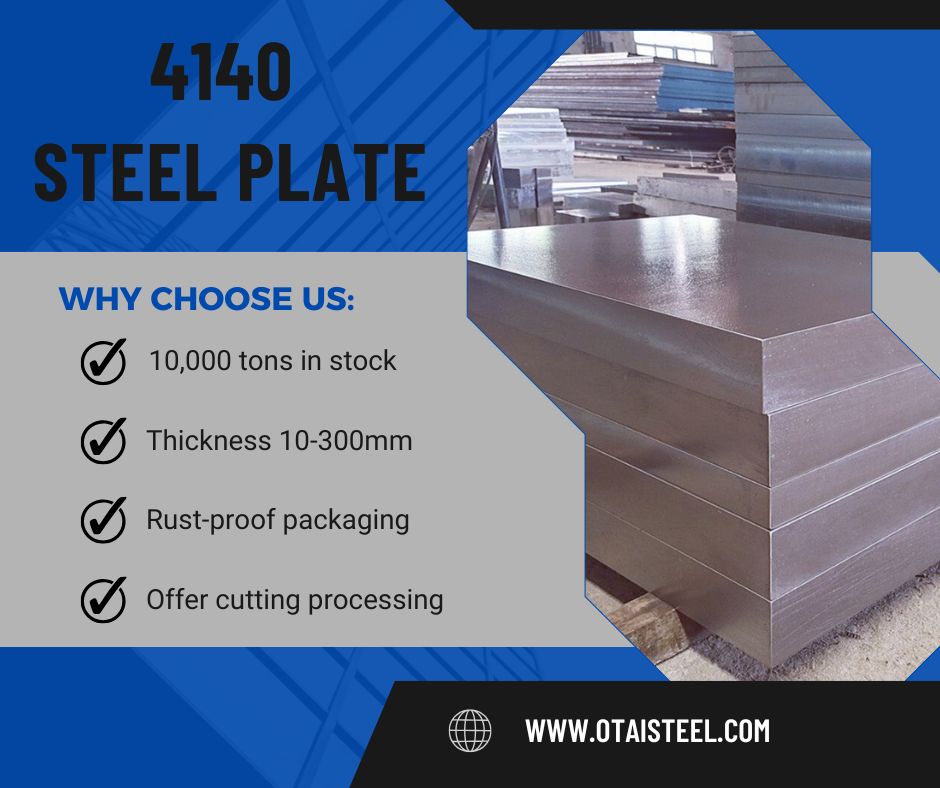
  • 📦 Huge Inventory – Over 10,000 tons in stock, ready for immediate delivery.

  • 🛠️ Custom Processing – Cutting, heat treatment, and surface finishing tailored to your needs.

  • 🔬 Quality Assurance – Ultrasonic testing (UT), chemical analysis, and SGS inspection available.

  • 🌍 Global Reach – Experience supplying world-class companies like Thyssenkrupp and Schlumberger.

  • 💰 Competitive Pricing – Factory-direct supply for cost-effective solutions.

Whether you need small quantities or bulk orders, Otai is your reliable partner for 4140 alloy steel supply.


❓ FAQ

Q1: Is 4140 steel stainless?
No. It contains chromium, but not enough to classify it as stainless steel.

Q2: Can 4140 steel resist corrosion?
It has moderate resistance, better than plain carbon steel, but much lower than stainless steel. Protective coatings are recommended.

Q3: When should I choose stainless over 4140 steel?
If corrosion resistance is critical (e.g., food, marine, or medical industries), stainless steel is the better choice.

Q4: What’s the biggest advantage of 4140 steel?
Its combination of toughness, hardness, and strength makes it ideal for gears, shafts, and heavy-duty parts.

Q5: Can 4140 steel be heat treated?
Yes. It responds very well to heat treatments like quenching and tempering, improving hardness and mechanical performance.
0 0 Continue Reading →

4140 Steel Bar Stock – Sizes, Grades, and Industrial Uses

4140 Steel Bar Stock – Sizes, Grades, and Industrial Uses4140 Steel Bar Stock – Sizes, Grades, and Industrial Uses

If you’re sourcing 4140 steel bar stock, you’re likely working on projects that demand strength, toughness, and reliability. From automotive shafts to oilfield tools, this alloy steel is one of the most versatile materials in engineering. Let’s dive into what makes 4140 alloy bar stock so valuable, how it’s supplied, and why it’s trusted in heavy-duty applications worldwide.


✨ What Is 4140 Steel Bar Stock?

4140 steel bar stock refers to pre-manufactured round, square, or flat bars of 4140 alloy steel that are ready for machining or further processing. With its balanced chemistry of chromium, molybdenum, and carbon, 4140 steel offers a unique mix of strength, wear resistance, and machinability.

The typical composition of 4140 steel round bar stock is:

Element Percentage (%)
Carbon (C) 0.38 – 0.43
Chromium (Cr) 0.80 – 1.10
Molybdenum (Mo) 0.15 – 0.25
Manganese (Mn) 0.75 – 1.00
Silicon (Si) 0.15 – 0.35
Iron (Fe) Balance

This chemical balance makes 4140 forged bar stock especially suitable for both strength and toughness.


🔧 Mechanical Properties of 4140 Bar Stock

One of the biggest advantages of 4140 pre-hardened bar stock is its adaptability. Depending on heat treatment, it can achieve a wide range of mechanical properties.

Condition Tensile Strength (MPa) Yield Strength (MPa) Hardness (HRC)
Annealed 655 – 880 415 – 655 ~20 – 22
Normalized + Tempered 850 – 1000 655 – 850 ~28 – 32
Quenched + Tempered 950 – 1600 655 – 1300 ~28 – 55

This means buyers of 4140 alloy steel bar stock can select the exact hardness and strength required for their projects.


⚙️ Advantages of Using 4140 Steel Bar Stock

The reason 4140 hot rolled bar stock is a global favorite lies in its balance of properties:

  • ✅ High tensile strength for heavy load applications

  • ✅ Good toughness and impact resistance

  • ✅ Excellent response to heat treatment

  • ✅ Better wear resistance than plain carbon steels

  • ✅ Wide availability in multiple sizes and forms


🛠 Common Applications of 4140 Alloy Bar Stock

Because of its unique balance, 4140 cold drawn steel bar stock is used in industries like automotive, aerospace, and energy.

Some typical applications include:

  • Automotive industry: axles, crankshafts, gear shafts

  • Oil & Gas industry: drill collars, tool joints, downhole tools

  • Aerospace industry: landing gear components, engine shafts

  • Heavy machinery: hydraulic shafts, spindles, couplings

  • Tooling: dies, fixtures, machine tool bodies

The 4140 precision ground bar stock is particularly valued for components requiring close dimensional tolerance.


🔥 Heat Treatment Options for 4140 Steel Bar Stock

The performance of 4140 steel rod stock depends heavily on heat treatment:

  • Annealing: improves machinability, softens the steel

  • Normalizing: refines grain size, improves toughness

  • Quenching + Tempering: increases strength and wear resistance

  • Nitriding: produces a very hard surface while keeping the core tough

This adaptability makes 4140 quenched and tempered bar stock a preferred material for customized requirements.


📏 Availability and Sizes

4140 steel flat bar stock and round bars are supplied in a wide range of diameters and lengths, commonly:

  • Round bars: 10mm – 600mm

  • Flat bars: thickness 6mm – 300mm

  • Length: typically 3m – 6m, with custom cutting available

Suppliers often provide 4140 alloy round bar stock in both hot rolled and cold drawn conditions to meet different project needs.


🌍 Global Standards and Equivalents

Even though naming varies by region, 4140 steel bar stock maintains consistent chemical composition and properties.

  • AISI 4140 (USA)

  • DIN 1.7225 / 42CrMo4 (Europe)

  • JIS SCM440 (Japan)

  • GB 42CrMo (China)

This means buyers can source 4140 chromium molybdenum bar stock globally with confidence in its performance.


🏆 Company Advantages – Why Choose OTAI Steel

At OTAI Special Steel, we specialize in supplying 4140 steel bar stock with high quality and reliable service:

  • ✅ Over 10,000 tons in stock, in round, flat, and square bars

  • ✅ Sizes from 6mm to 600mm diameter, cut-to-size available

  • Ultrasonic testing (UT) and chemical composition certificates provided

  • Heat treatment services: annealing, Q&T, nitriding available

  • ✅ Proven supplier to world-leading companies like Thyssenkrupp & Schlumberger


❓ FAQ on 4140 Steel Bar Stock

Q1: What sizes are available in 4140 steel bar stock?
A: Round bars from 10mm to 600mm, flat bars up to 300mm thick, custom cutting available.

Q2: Is 4140 bar stock pre-hardened?
A: We supply it annealed, normalized, or quenched-and-tempered to match your hardness requirement.
Q3: Can 4140 bar stock be welded?
A: Weld it successfully—just pre-heat and post-weld stress-relieve to counter its carbon level.
Q4: What is the difference between hot-rolled and cold-drawn 4140 bar stock?
A: Cold drawing delivers tighter tolerances and higher strength; hot rolling keeps costs down.
Q5: Is 4140 alloy bar stock available worldwide?
A: We stock and ship it globally under the equivalent grades DIN 1.7225, 42CrMo4, and SCM440.

0 0 Continue Reading →

4140 Steel Carbon Content – Why It Matters for Strength and Performance

4140 Steel Carbon Content – Why It Matters for Strength and Performance4140 Steel Carbon Content – Why It Matters for Strength and Performance

When it comes to alloy steels, 4140 steel carbon content is one of the most discussed aspects. Engineers, machinists, and buyers often want to know: How much carbon does 4140 steel have, and how does it affect its properties? Let’s break it down in detail and see why this specific percentage of carbon makes 4140 steel a favorite in industries like automotive, oil & gas, tooling, and heavy machinery.


✨ What Is the Carbon Content in 4140 Steel?

4140 steel belongs to the chromium-molybdenum alloy steel family. Its carbon content typically ranges between 0.38% and 0.43%, which places it in the medium-carbon steel category.

Here’s a simplified breakdown of its main composition:

Element Typical Percentage (%)
Carbon (C) 0.38 – 0.43
Chromium (Cr) 0.80 – 1.10
Molybdenum (Mo) 0.15 – 0.25
Manganese (Mn) 0.75 – 1.00
Silicon (Si) 0.15 – 0.35
Iron (Fe) Balance

This carbon range in 4140 steel is crucial—it gives a perfect balance of hardness, toughness, and machinability. Too little carbon would make the steel too soft, while too much would make it hard but brittle.


🔧 Why Carbon Content Matters

The carbon level in 4140 steel plays a direct role in the following properties:

  1. Hardness & Strength

    • With ~0.4% carbon, 4140 can reach Rockwell hardness values in the 28–32 HRC range when normalized, and even higher after quenching and tempering.

  2. Toughness & Impact Resistance

    • The medium carbon level allows it to resist cracking under stress, unlike high-carbon steels that may become brittle.

  3. Weldability

    • While weldable, preheating is often required because the carbon content makes it more prone to cracking compared to low-carbon steels.

  4. Heat Treatment Response

    • The carbon composition of 4140 steel makes it highly responsive to quenching and tempering, giving flexibility in achieving different mechanical properties.


⚙️ 4140 Steel Carbon Content vs. Other Steels

To see why 4140 steel carbon percentage is so important, let’s compare it with other common steels:

Steel Grade Carbon Content (%) Characteristics
A36 (mild steel) ~0.25 Excellent weldability, but low strength
1045 (medium carbon) 0.43 – 0.50 Higher hardness, lower toughness
4140 alloy steel 0.38 – 0.43 Balanced strength, toughness, wear resistance
8620 alloy steel 0.18 – 0.23 Low carbon core, good for carburizing

This comparison shows that 4140’s carbon range is the sweet spot between strength and ductility, making it versatile for demanding applications.


🛠 Applications Driven by 4140 Steel Carbon Level

Because of its controlled carbon percentage, 4140 is widely used in parts that need both toughness and wear resistance:

  • Automotive components: crankshafts, connecting rods, gears

  • Oil & gas industry: drill collars, tool joints

  • Tooling: dies, fixtures, cutting tools

  • Machinery: shafts, spindles, and axles

The 4140 steel carbon makeup ensures these components don’t fail under cyclic stress and impact loads.


🔥 Heat Treatment and Carbon Synergy

The carbon concentration in 4140 steel determines how well it responds to heat treatments:

  • Annealing: improves machinability while reducing hardness

  • Quenching + Tempering: enhances strength up to 95,000–160,000 psi tensile strength

  • Nitriding: creates a hard surface layer (~60 HRC) while keeping the core tough

Without its precise carbon level, 4140 would not achieve this balance of hardness and toughness through heat treatment.


🌍 Global Standards and Designations

Depending on where you are, 4140 may be listed under different standards, but the carbon composition remains consistent:

  • AISI 4140 (USA)

  • DIN 1.7225 (Europe/Germany)

  • 42CrMo4 (EN standard)

  • SCM440 (Japan)

No matter the name, the carbon percentage in 4140 steel is what makes these equivalents perform similarly.


🏆 Company Advantages – Why Choose OTAI Steel

At OTAI Special Steel, we supply 4140 alloy steel plates, bars, and tubes with full traceability and strict chemical composition control. Our advantages include:

  • ✅ Over 10,000 tons in stock, including thicknesses 6mm–300mm

  • UT-tested & composition-certified for quality assurance

  • Custom services: cutting, heat treatment, and machining

  • ✅ Long-term supply to top international companies like Thyssenkrupp & Schlumberger

  • ✅ Competitive pricing with fast worldwide delivery


❓ FAQ on 4140 Steel Carbon Content

Q1: What is the exact carbon percentage in 4140 steel?
A: It ranges from 0.38% to 0.43%, making it a medium-carbon alloy steel.

Q2: How does carbon content affect 4140’s weldability?
A: The higher carbon level requires preheating and post-weld stress relief to avoid cracking.

Q3: Can 4140 be surface hardened due to its carbon level?
A: Yes, processes like carburizing or nitriding are very effective.

Q4: Why not use higher carbon steel for strength instead?
A: Too much carbon reduces toughness and ductility, making the material brittle.

Q5: Is the carbon percentage the same across global equivalents?
A: Yes, equivalents like DIN 1.7225, 42CrMo4, and SCM440 maintain the same carbon range.

0 0 Continue Reading →

4140 Steel Equivalent Material – Exploring Global Alternatives

4140 Steel Equivalent Material – Exploring Global Alternatives4140 Steel Equivalent Material – Exploring Global Alternatives

When engineers or buyers look for 4140 steel equivalent material, it’s usually because they are sourcing from different regions or working on international projects. Since steel standards vary by country, understanding the equivalents of 4140 steel helps avoid confusion and ensures you choose the right grade for your application. Let’s dive into the details, comparing its global equivalents, mechanical properties, and real-world uses.


🌍 Why Equivalent Materials Matter in Steel Procurement

Steel is a global business. A designer in the U.S. might specify AISI 4140 steel, but a supplier in Europe will reference 42CrMo4, while a customer in China may request 42CrMo. These materials are essentially the same in composition and performance, but the naming convention differs by standard. Knowing the 4140 steel equivalent grades ensures smooth communication between buyers, suppliers, and manufacturers.


🧪 Chemical Composition of 4140 Steel

The foundation of equivalency lies in chemical composition. Let’s look at what makes 4140 unique:

Element Content (%)
Carbon (C) 0.38 – 0.43
Chromium (Cr) 0.80 – 1.10
Molybdenum (Mo) 0.15 – 0.25
Manganese (Mn) 0.75 – 1.00
Silicon (Si) 0.15 – 0.35
Sulfur (S) ≤ 0.04
Phosphorus (P) ≤ 0.035

This balanced combination of carbon, chromium, and molybdenum gives 4140 its excellent toughness, wear resistance, and heat treatment response.


🔑 Global Equivalent Standards of 4140 Steel

Here’s how 4140 steel equivalent material appears in different international standards:

Country/Standard Equivalent Grade Notes
USA (AISI/SAE) 4140 Widely used in North America
Germany (DIN/EN) 42CrMo4 Common in Europe, high strength
China (GB) 42CrMo Closely matches 4140 properties
Japan (JIS) SCM440 Used in automotive and machinery
UK (BS) 708M40 Similar applications to AISI 4140
France (AFNOR) 42CD4 Strong alloy steel grade
Russia (GOST) 38Ch2MFA Local standard equivalent

This chart shows that no matter where you source your steel, there’s usually a direct 4140 steel equivalent material available.


⚙️ Mechanical Properties Comparison

While names differ, the mechanical performance of 4140 steel equivalents remains consistent:

Property Value (Typical)
Tensile Strength 655 – 1080 MPa (depending on heat treatment)
Yield Strength 415 – 830 MPa
Hardness (Rockwell C) 28 – 55 HRC (after quenching & tempering)
Elongation ~25%
Impact Toughness High

Thanks to its versatile properties, 4140 and its equivalents are favored for critical applications where strength, toughness, and fatigue resistance are required.


🛠️ Common Applications of 4140 Steel Equivalent Material

Because of its wide availability, 4140 and its equivalents are used globally in industries such as:

  • Automotive: gears, shafts, crankshafts, axles

  • Oil & Gas: drill collars, couplings, downhole tools

  • Heavy Machinery: forged parts, bolts, hydraulic shafts

  • Aerospace: landing gear components, tooling

  • Tooling Industry: dies, molds, fixtures

For example, a European buyer might request 42CrMo4 round bar for gear production, while a U.S. manufacturer would specify 4140 alloy steel bar—but the result is the same high-strength product.


📌 Key Advantages of Choosing 4140 Steel Equivalents

  1. Global Sourcing Flexibility – Buyers can procure the same material across multiple regions.

  2. Reliable Performance – Equivalent grades meet similar mechanical property ranges.

  3. Heat Treatability – Quenching and tempering improve hardness and strength regardless of standard.

  4. Versatility – Works well in forging, machining, and welding.

  5. Cost Efficiency – Local equivalents often lower procurement costs without compromising quality.


🏭 Company Advantage – Why Choose Otai Special Steel

At Otai Special Steel, we maintain an extensive inventory of 4140 alloy steel and its equivalents like 42CrMo4, SCM440, and 42CrMo.

  • ✅ Over 10,000 tons of stock in plates, round bars, and blocks.

  • ✅ Cutting, heat treatment, and ultrasonic testing services.

  • ✅ Proven track record supplying to Thyssenkrupp, Schlumberger, Borealis, and other global leaders.

  • ✅ Expert guidance on choosing the right 4140 steel equivalent material for your region and application.


❓ FAQ – 4140 Steel Equivalent Material

Q1: Is 42CrMo4 the same as AISI 4140?
Yes, 42CrMo4 is the European equivalent of AISI 4140 steel, with nearly identical chemistry and properties.

Q2: Can I substitute SCM440 for 4140 steel?
Yes, SCM440 is the Japanese equivalent, and it performs the same in heat treatment and mechanical properties.

Q3: Why do different countries have different names for the same steel?
Because steel standards are governed by regional organizations (AISI, DIN, JIS, GB, etc.), each assigns its own designation.

Q4: Do equivalent grades always perform the same?
While small variations in composition exist, reputable suppliers ensure that equivalents meet international mechanical property requirements.

Q5: Where can I buy 4140 steel equivalents?
Otai Special Steel supplies a wide range of equivalents globally, with custom services like machining and testing.

0 0 Continue Reading →

4140 Steel Galling – Causes, Prevention, and Engineering Insights

4140 Steel Galling – Causes, Prevention, and Engineering Insights4140 Steel Galling – Causes, Prevention, and Engineering Insights

When engineers and buyers work with 4140 steel, one issue that sometimes arises in machining and service applications is galling. Galling is a severe form of adhesive wear where metal surfaces slide against each other, leading to localized welding, tearing, and surface damage. Understanding galling in 4140 steel is essential for applications involving fasteners, bushings, gears, or high-pressure contact surfaces.

This article explores the causes of galling in 4140 steel, factors that influence its severity, methods to reduce it, and practical advice for industries that rely on this versatile alloy steel.


✨ What Is Galling in Steel?

Galling is different from ordinary wear. While abrasive wear removes material by cutting or scratching, galling happens when two metal surfaces with insufficient lubrication or hardness slide under pressure, causing:

  • Surface adhesion (micro-welding).

  • Material transfer between surfaces.

  • Severe scoring or tearing of the contact areas.

In the case of 4140 alloy steel, galling may occur if the steel is used in fasteners, threads, or sliding contact without proper treatment, lubrication, or hardness control.


⚙️ Why Does Galling Occur in 4140 Steel?

Several factors contribute to galling in 4140 steel components:

  1. Material Properties

    • 4140 steel contains chromium and molybdenum, which provide strength and toughness, but its moderate hardness in the annealed state (around Rockwell C 18–22) makes it prone to adhesive wear.

  2. Surface Roughness

    • Rough surfaces increase the chance of localized friction and micro-welding.

  3. Contact Pressure

    • High contact stress (such as in bolted joints or gear teeth) accelerates galling.

  4. Heat Build-Up

    • Sliding without lubrication generates heat, softening the steel surface and worsening adhesion.

  5. Improper Heat Treatment

    • Untempered or improperly quenched 4140 may lack the optimal hardness balance, making galling more likely.


📊 Galling Risk by Hardness Level

Heat Treatment Condition Typical Hardness (HRC) Galling Resistance
Annealed 4140 Steel 18–22 HRC Low (high risk)
Quenched Only 45–55 HRC Moderate (better surface strength)
Quenched & Tempered 28–40 HRC High (balanced hardness and toughness)
Nitrided/Carburized 55–65 HRC (surface) Very High (excellent galling resistance)

This shows that heat-treated 4140 steel has far better galling resistance compared to untreated material.


🔧 Practical Ways to Prevent Galling in 4140 Steel

To minimize the risk of galling when using 4140 steel in engineering applications:

  1. Apply Heat Treatment

    • Use quenching and tempering to achieve hardness around 28–36 HRC for balanced strength and wear resistance.

  2. Surface Hardening Treatments

    • Nitriding or carburizing forms a hard outer layer (up to 65 HRC), significantly improving galling resistance.

  3. Use Lubrication

    • Apply anti-seize compounds, oils, or dry film lubricants in threaded or sliding applications.

  4. Choose Correct Surface Finish

    • A smoother surface reduces localized adhesion points. Polished surfaces are less likely to gall.

  5. Material Pairing

    • Avoid pairing 4140 steel with the same grade in high-load sliding contacts. Instead, use a dissimilar but compatible alloy (e.g., bronze or stainless).

  6. Controlled Tightening in Fasteners

    • Over-tightening bolts made of 4140 steel without lubrication increases galling risk. Use torque control methods.


🏭 Real-World Applications and Galling Considerations

  • Fasteners & Bolts

    • 4140 steel is often used in high-strength bolts. Without lubrication or coating (e.g., zinc, phosphate), galling can occur during tightening.

  • Gears & Shafts

    • In machinery, gears made of 4140 steel benefit from carburizing or nitriding to reduce galling in meshing contact.

  • Bushings & Bearings

    • When used against other steel surfaces, untreated 4140 may gall quickly; pairing with bronze bushings prevents this.

  • Hydraulic & Oilfield Tools

    • Sliding and threaded parts in oilfield environments require surface hardening and anti-galling coatings.


🧪 Engineering Recommendations

For industries choosing 4140 alloy steel in galling-sensitive applications:

  • For fasteners → Use a surface coating (phosphate, zinc plating) plus anti-seize lubricant.

  • For gears/shafts → Opt for carburizing or nitriding for a hard surface with tough core strength.

  • For threaded connections in oil & gas → Use phosphate coatings, controlled torque, and lubricants.

  • For sliding parts → Avoid steel-on-steel pairing; instead, combine 4140 with bronze or other alloys.


🌟 Company Advantages – Why Choose Otai Special Steel?

At Otai Special Steel, we supply 4140 steel in plates, bars, and customized forms, all with quality certification and international standards compliance. Our advantages include:

  • Over 10,000 tons of stock in sizes from 6mm to 300mm.

  • Heat treatment services including quenching, tempering, and nitriding.

  • Ultrasonic testing (UT), composition analysis, and third-party inspection (SGS, TUV).

  • Customized cutting and machining for fast delivery.

  • Export experience with top companies like Thyssenkrupp, Schlumberger, and Borealis.

With our expertise, we help clients minimize issues like galling by providing the right heat-treated 4140 steel solution.


❓ FAQ – 4140 Steel Galling

Q1: Is 4140 steel more prone to galling compared to stainless steel?
Not necessarily. Austenitic stainless steels often have higher galling risk than 4140, but untreated 4140 can still gall if not hardened or lubricated.

Q2: What is the best way to prevent galling in 4140 fasteners?
Apply lubrication and surface coatings (phosphate, zinc, or dry film) to reduce adhesion.

Q3: Can nitriding 4140 steel eliminate galling completely?
It significantly reduces galling, but proper lubrication is still recommended under extreme loads.

Q4: What industries face galling issues with 4140 steel?
Oil & gas, automotive, aerospace, and heavy machinery industries often encounter this issue in bolts, shafts, and gears.

Q5: Should I use dissimilar metals with 4140 steel to avoid galling?
Yes, pairing 4140 with bronze, brass, or dissimilar steels reduces the risk of adhesive wear.

0 0 Continue Reading →

How to Weld 4140 Steel – Techniques, Tips, and Challenges

How to Weld 4140 Steel – Techniques, Tips, and ChallengesHow to Weld 4140 Steel – Techniques, Tips, and Challenges

Welding 4140 steel is a challenge that many fabricators, engineers, and manufacturers face. Known as a chromium-molybdenum alloy steel, 4140 is highly valued for its strength, toughness, and wear resistance, making it a go-to choice for demanding applications in automotive, aerospace, and oil & gas. However, its medium-high carbon content and alloy composition make welding far more complex compared to mild steels.

In this article, we will explore in detail how to weld 4140 steel, why it requires special care, the recommended welding procedures, parameters, and heat treatment techniques. By the end, you’ll have a full picture of what it takes to successfully weld this material without compromising its performance.


⚡ What Makes 4140 Steel Hard to Weld?

The chemistry of 4140 steel is the root of its welding difficulties. It typically contains:

  • Carbon: 0.38–0.43%

  • Chromium: 0.8–1.1%

  • Molybdenum: 0.15–0.25%

  • Manganese: 0.75–1.0%

This combination makes the steel strong and hardenable but also sensitive to heat. The higher carbon level compared to mild steels promotes the formation of martensite in the heat-affected zone (HAZ), which is extremely hard and brittle. This is why improper welding often leads to cold cracking, hardness issues, and reduced ductility.

In simple terms, welding 4140 is like trying to balance two opposites: you need to retain its strength but prevent it from becoming too brittle.


🔧 General Welding Procedure for 4140 Steel

If you’re wondering how to weld 4140 steel in real industrial practice, here’s the standard approach that experienced welders follow:

1. Preheating

  • Temperature: 400–600°F (200–315°C).

  • Purpose: Slows down cooling, reduces the risk of martensite formation, and minimizes hydrogen-induced cracking.

  • Larger and thicker sections may need to be heated toward the higher end of the range.

2. Filler Metal Selection

  • For strength matching: ER80S-D2 (TIG/MIG), 8018-B2 (SMAW).

  • For improved ductility: ER70S-2 (TIG/MIG), 7018 (SMAW).

  • If joining 4140 to mild steel, a lower-strength filler is usually preferred to absorb stresses.

3. Welding Technique

  • Stick (SMAW), MIG (GMAW), and TIG (GTAW) are commonly used.

  • TIG welding is favored for precision and better heat control.

  • Small stringer beads should be applied instead of wide weave beads to reduce stress.

4. Interpass Temperature

  • Maintain 500–600°F (260–315°C) between passes.

  • Avoid letting the material cool below 400°F before the next pass.

5. Post-Weld Heat Treatment (PWHT)

  • Perform stress-relieving at 1100–1250°F (593–677°C) for 1–2 hours.

  • For critical components, a full tempering process may be required to restore mechanical balance.


📊 Welding Parameters and Guidelines

To make welding more reliable, the following table summarizes the commonly used parameters when fabricating with 4140 steel:

Process Preheat (°F) Interpass (°F) Filler Options PWHT Temp (°F) Notes
SMAW 400–600 500–600 7018, 8018-B2 1100–1250 Good for structural welding
GMAW 400–600 500–600 ER70S-2, ER80S-D2 1100–1250 Efficient for medium to large parts
GTAW 400–600 500–600 ER70S-2, ER80S-D2 1100–1250 Best control for critical welds

🔍 Key Issues to Watch Out For

  1. Hydrogen Cracking

    • Occurs in the heat-affected zone due to trapped hydrogen and high hardness.

    • Solution: Use low-hydrogen electrodes, preheat, and PWHT.

  2. Excessive Hardness in HAZ

    • Can exceed 55 HRC if cooled too quickly.

    • Controlled preheat and slow cooling help avoid this.

  3. Distortion and Residual Stress

    • 4140 is strong and tends to hold stress after welding.

    • PWHT is critical to relieve these stresses.


🏭 Real-World Applications of Welding 4140 Steel

Knowing how to weld 4140 steel is important across industries:

  • Automotive: Crankshafts, axles, suspension parts.

  • Aerospace: Landing gear, structural supports.

  • Oil & Gas: Drill collars, downhole tools.

  • Machinery: Gears, spindles, shafts, dies.

For example, in oil drilling, 4140 components are subjected to extreme cyclic loads. Welding must ensure both fatigue resistance and fracture toughness—which means careful preheating, correct filler choice, and a strict PWHT cycle.


🧰 Practical Welding Tips from Industry Experience

  • Always keep parts insulated during cooling to avoid sharp temperature drops.

  • For sections thicker than 50 mm, consider submerged arc welding (SAW) with preheat and PWHT.

  • If welding to cast steel or mild steel, mismatched fillers are better to prevent cracking.

  • Avoid welding 4140 that has been quenched and tempered to high hardness unless it is re-heat-treated after welding.

  • In critical aerospace or defense applications, non-destructive testing (NDT) like ultrasonic testing is usually mandatory.


🔬 Case Example: Welding a 4140 Crankshaft

One real-life case comes from the automotive sector. A 4140 steel crankshaft required repair welding. The procedure was:

  1. Preheated to 550°F.

  2. Used ER70S-2 filler to provide ductility.

  3. Applied TIG welding with multiple small passes.

  4. Maintained interpass at ~575°F.

  5. Stress relieved at 1200°F for 2 hours.

The result was a defect-free repair with hardness restored to ~30–32 HRC after tempering. This demonstrated that strict process control makes welding 4140 steel reliable even in high-load applications.


🏆 Why Choose Otai Special Steel for 4140 Welding Projects?

At Otai Special Steel, we supply 4140 alloy steel plates, bars, and tubes with customizable cutting, heat treatment, and ultrasonic testing services. Our stock ranges from 6mm to 300mm thickness, always ready for quick delivery.

We also support buyers with material certificates, SGS inspections, and technical guidance—including the right welding recommendations for your project. Whether you’re an end-user, supplier, or trading company, we make sure you get the right steel with no surprises.


❓ FAQ on Welding 4140 Steel

Q1: Can 4140 steel be welded without preheating?
Not recommended. Preheating prevents hydrogen cracking and ensures weld integrity.

Q2: Which filler rod is best for welding 4140 steel?
For strength: ER80S-D2. For ductility and crack resistance: ER70S-2.

Q3: Do I need PWHT after welding 4140 steel?
Yes, it’s essential for stress relief and restoring toughness.

Q4: Can 4140 be welded to mild steel?
Yes, but use a ductile filler like ER70S-2 to prevent cracking from mismatch.

Q5: Is TIG welding better for 4140 steel?
Yes, TIG allows better control over heat input, reducing risks of cracks.

0 0 Continue Reading →

4140 Steel Information –What is 4140 Steel?

4140 Steel Information –What is 4140 Steel?4140 Steel Information –What is 4140 Steel?

When it comes to high-performance alloy steels, 4140 steel is one of the most widely used and recognized materials in the world. Its unique balance of toughness, strength, and wear resistance makes it an essential choice across industries ranging from automotive to oil & gas, heavy machinery, and tool manufacturing. In this article, we’ll provide all the essential 4140 steel information you need—covering its composition, mechanical properties, heat treatment behavior, and practical applications.


🌟 What is 4140 Steel?

4140 steel is a chromium-molybdenum low-alloy steel that belongs to the AISI-SAE family of alloy steels. It is classified as a versatile material because it offers an excellent combination of mechanical strength, fatigue resistance, and toughness—qualities that make it suitable for demanding engineering components.

  • Category: Low-alloy steel

  • Common Forms: Plate, bar, tube, and forgings

  • Standards: AISI 4140, ASTM A29, DIN 1.7225, JIS SCM440

This steel is especially known for its ability to be heat treated to various hardness levels, depending on the final application.


🔬 4140 Steel Chemical Composition

The properties of 4140 steel stem from its carefully balanced chemical composition.

Element Typical Content (%)
Carbon (C) 0.38 – 0.43
Chromium (Cr) 0.80 – 1.10
Molybdenum (Mo) 0.15 – 0.25
Manganese (Mn) 0.75 – 1.00
Silicon (Si) 0.15 – 0.35
Phosphorus (P) ≤ 0.035
Sulfur (S) ≤ 0.040

This balanced mix gives 4140 steel its well-known strength, toughness, and wear resistance.


⚙️ Mechanical Properties of 4140 Steel

4140 steel is valued because it delivers high strength without sacrificing ductility.

Property Condition Typical Value
Tensile Strength Annealed 655 MPa (95 ksi)
Yield Strength Annealed 415 MPa (60 ksi)
Tensile Strength Quenched & Tempered 850 – 1000 MPa (123 – 145 ksi)
Yield Strength Quenched & Tempered 655 – 862 MPa (95 – 125 ksi)
Hardness (HB) Annealed 197 HB max
Hardness (HRC) Heat Treated 28 – 32 HRC (typical), up to 50 HRC

This flexibility allows engineers to adjust the material performance through quenching and tempering, making it suitable for parts under heavy loads.


🔥 Heat Treatment Behavior

One of the most critical aspects of 4140 steel information is how it responds to heat treatment:

  • Annealing: Refines grain structure and reduces hardness to improve machinability.

  • Quenching: Achieves higher hardness and wear resistance.

  • Tempering: Adjusts strength and toughness after quenching.

  • Normalizing: Improves toughness and mechanical uniformity.


🏭 Applications of 4140 Steel

Because of its versatility, 4140 steel is found in countless applications, including:

  • Gears and shafts

  • Bolts and fasteners

  • Crankshafts and connecting rods

  • Drill collars and oilfield equipment

  • Tool bodies and dies

  • Hydraulic machinery parts

For applications that require high fatigue resistance, dimensional stability, and strength under stress, 4140 steel is a leading choice.


🛠 Machinability and Weldability

  • Machinability: 4140 steel offers moderate machinability in its annealed state, but it becomes more difficult to machine after hardening. Proper cutting fluids and rigid setups are essential.

  • Weldability: 4140 steel can be welded, but preheating and post-weld heat treatment are often necessary to avoid cracking due to its higher carbon content.


📦 Forms Available on the Market

When sourcing 4140 steel, buyers can find it in multiple shapes and sizes:

  • Plates (6mm – 300mm thick)

  • Round bars and square bars

  • Hollow bars and tubes

  • Forged blocks

This flexibility allows suppliers and buyers to choose the right form for machining or direct use.


💡 Why Choose 4140 Steel?

The unique benefits of 4140 steel include:

  • Balanced strength and toughness

  • Wide availability in global markets

  • Excellent fatigue resistance

  • Customizable hardness through heat treatment

  • Strong track record in heavy-duty engineering applications


🌍 Company Advantages – Otai Special Steel

At Otai Special Steel, we are experts in supplying 4140 steel and other alloy steels. With over 10,000 tons of inventory available, we provide plates, bars, and tubes in various sizes with value-added services such as cutting, heat treatment, and ultrasonic testing.

Our company has supplied major international corporations, offering:

  • Stable and consistent quality

  • Global export experience

  • SGS/UT inspection services

  • Competitive prices with fast delivery


❓ FAQ About 4140 Steel Information

Q1: What makes 4140 steel better than plain carbon steel?
4140 has chromium and molybdenum, giving it better strength, toughness, and wear resistance.

Q2: Can 4140 steel be surface hardened?
Yes, it can undergo induction hardening or carburizing for improved surface wear resistance.

Q3: Is 4140 steel corrosion-resistant?
It has some corrosion resistance due to chromium, but it’s not stainless. Protective coatings are recommended.

Q4: Which industries use 4140 steel the most?
Automotive, oil & gas, aerospace, tool manufacturing, and heavy machinery.

Q5: Does heat treatment affect machinability?
Yes. 4140 steel is easiest to machine in the annealed state; after hardening, it requires more advanced machining setups.

0 0 Continue Reading →

4140 Steel and Other Steel – A Practical Comparison for Buyers

4140 Steel and Other Steel – A Practical Comparison for Buyers

When it comes to selecting materials for manufacturing and engineering projects, steel is always at the center of the discussion. But with so many options available, how do you know which one fits your project? Among the countless grades, 4140 steel is one of the most widely used because of its outstanding balance of strength, toughness, and machinability. In this guide, we’ll break down how 4140 steel stacks up against other steels in terms of mechanical properties, applications, and cost-effectiveness.


🌟 What is 4140 Steel?

4140 steel is a chromium-molybdenum alloy steel that belongs to the family of low-alloy steels. Its composition usually includes:

  • Carbon: 0.38–0.43%

  • Chromium: 0.8–1.1%

  • Molybdenum: 0.15–0.25%

  • Manganese: 0.75–1.0%

This specific chemistry allows it to achieve high tensile strength after heat treatment, while still maintaining good toughness and wear resistance. One of the main reasons buyers prefer 4140 over basic carbon steels is because it offers higher fatigue resistance and better hardenability, making it suitable for critical parts such as gears, shafts, and axles.


🔍 Comparing 4140 Steel and Other Steel Grades

To make the choice easier, let’s compare 4140 steel with other popular steel grades used in different industries.

Steel Grade Type Yield Strength (MPa) Rockwell Hardness (HRC) Typical Applications
4140 steel Alloy Steel 655–1080 28–32 (annealed), 50+ (quenched/tempered) Shafts, gears, crankshafts, high-stress parts
A36 steel Mild Carbon Steel ~250 <20 Construction beams, structural supports
4340 steel Nickel-Chromium-Moly Alloy 745–1080 Up to 50+ Aerospace components, landing gear
1045 steel Medium Carbon Steel ~530 22–30 Machinery parts, axles
8620 steel Low-Alloy, Carburizing Steel ~400 Up to 60 (case hardened) Gears, camshafts

From this table, it’s clear that 4140 alloy steel bridges the gap between mild steels like A36 and ultra-high-strength alloys like 4340. It offers a good balance of cost, machinability, and mechanical strength.


🛠️ Why Choose 4140 Steel Over Others?

  1. Better Wear Resistance than Carbon Steels
    Compared with 1045 steel or A36 steel, 4140 steel shows superior resistance to wear and fatigue. This is particularly important in applications where components are subjected to repetitive stress, like automotive drive shafts or heavy-duty machinery gears.

  2. High Strength-to-Weight Ratio
    Compared to mild steels, 4140 alloy steel delivers higher yield strength without adding significant weight. This makes it ideal for aerospace and automotive parts where weight reduction is critical.

  3. Versatility in Heat Treatment
    One of the key differences between 4140 and many other steels is its ability to be quenched and tempered. 4140 steel heat treated can achieve Rockwell hardness values above 50 HRC, whereas mild steels cannot reach such levels.

  4. Good Machinability and Weldability
    While steels like 4340 can sometimes be difficult to machine due to their high hardness, machining 4140 steel is comparatively easier. It strikes a balance between hardness and machinability, making it a favorite for machine shops.


⚙️ Applications

  • 4140 Steel → Widely used in automotive, oil & gas, and industrial machinery for shafts, gears, drill collars, and hydraulic parts.

  • A36 Steel → Chosen primarily for construction due to its low cost and ease of welding.

  • 4340 Steel → Used in aerospace for landing gear, high-stress bolts, and crankshafts due to its ultra-high toughness.

  • 8620 Steel → Ideal for carburized gears, camshafts, and bushings because of its ability to form a tough surface with a softer core.

This highlights that 4140 is a versatile middle ground—affordable enough for general engineering but tough enough for demanding applications.


📊 Mechanical Property Comparison – 4140 vs Other Steels

To give you a better picture, here’s how 4140 stacks up against other steels in mechanical properties:

Property 4140 Steel A36 Steel 1045 Steel 4340 Steel
Ultimate Tensile Strength (MPa) 1080 (quenched/tempered) 400–550 ~620 1080–1180
Yield Strength (MPa) 655–1080 ~250 ~530 745–1080
Elongation (%) 20–25 20+ 16–18 10–15
Toughness High Moderate Good Very High

This shows that while 4340 offers extreme toughness, 4140 alloy steel is more cost-effective and easier to machine, making it a more balanced choice for many industries.


💡 Practical Tips for Choosing Between 4140 and Other Steels

  • If cost is the main factor, A36 or 1045 may be sufficient.

  • If you need case hardening for gears, 8620 steel is better.

  • If you need ultra-high strength with toughness, 4340 is the choice.

  • But if you want a balance of strength, toughness, machinability, and cost, 4140 steel is the go-to option.


🌍 Company Advantages – Why Choose Otai Special Steel?

At Otai Special Steel, we specialize in supplying 4140 steel plates, bars, and tubes in a wide range of dimensions. Our advantages include:

  • 📦 Large stock availability: Over 10,000 tons ready for shipment.

  • 🔍 Quality assurance: Ultrasonic testing, chemical composition analysis, and SGS third-party inspection.

  • ⚙️ Processing services: Cutting, heat treatment, and custom machining available.

  • 🌐 Global clients: Trusted by top corporations like Thyssenkrupp and Schlumberger.

  • 💰 Cost-effective supply chain: Competitive prices with guaranteed stable quality.


❓ FAQ

Q1: Is 4140 stronger than A36?
Yes, 4140 steel is significantly stronger and harder than A36 steel. A36 is used mainly for construction, while 4140 is designed for high-stress mechanical parts.

Q2: How does 4140 compare to 4340?
4340 steel is tougher and stronger, but more expensive and harder to machine. 4140 is a more balanced and versatile option.

Q3: Can 4140 be welded like A36?
Yes, but it requires preheating and post-weld heat treatment to avoid cracking due to its higher carbon content.

Q4: Is 4140 more wear-resistant than 1045?
Yes, thanks to its alloying elements (chromium and molybdenum), 4140 has higher wear and fatigue resistance than 1045.

Q5: When should I choose 8620 over 4140?
If surface hardness and core toughness are required—like in gears or camshafts—8620 with carburizing is better. Otherwise, 4140 works well for general engineering parts.

0 0 Continue Reading →

Properties of 4140 Steel: A Complete Technical Guide

Properties of 4140 Steel: A Complete Technical GuideProperties of 4140 Steel: A Complete Technical Guide

When engineers, buyers, or manufacturers are searching for high-performance materials, 4140 steel often appears at the top of the list. Known for its excellent balance of strength, toughness, and machinability, this alloy steel has become a favorite across industries such as automotive, aerospace, defense, construction, and heavy machinery.

In this article, we’ll break down the properties of 4140 steel, exploring its mechanical characteristics, chemical composition, processing behavior, and practical applications. Whether you are considering it for shafts, gears, or pressure vessels, this guide will help you understand why it’s so widely trusted.


✨ Chemical Composition of 4140 Steel

The unique properties of 4140 steel are rooted in its carefully balanced chemical composition. It belongs to the family of chromium-molybdenum low alloy steels, with the following typical range of elements:

Element Percentage (%) Function
Carbon (C) 0.38 – 0.43 Provides strength and hardness
Chromium (Cr) 0.80 – 1.10 Improves hardenability, corrosion resistance, and wear resistance
Molybdenum (Mo) 0.15 – 0.25 Enhances toughness and high-temperature strength
Manganese (Mn) 0.75 – 1.00 Improves strength and hardenability
Silicon (Si) 0.15 – 0.35 Increases strength and deoxidizes steel
Sulfur (S) & Phosphorus (P) ≤ 0.035 each Impurities that are tightly controlled

This composition makes 4140 steel significantly stronger and tougher than plain carbon steels like A36, while maintaining good machinability and weldability (with precautions).


⚙️ Mechanical Properties of 4140 Steel

The mechanical properties of 4140 steel are what make it so attractive for demanding applications.

Property Condition (Normalized) Condition (Quenched & Tempered)
Yield Strength ~655 MPa 850 – 1000 MPa
Ultimate Tensile Strength ~950 MPa 1050 – 1200 MPa
Elongation 20% 12 – 16%
Hardness (Rockwell C) ~28 HRC 32 – 40 HRC
Impact Toughness (Charpy V-notch) High Maintains toughness after heat treatment

👉 What’s unique is that 4140 steel maintains strength without becoming brittle, which is why it’s popular for safety-critical components like crankshafts and aerospace parts.


🔥 Heat Treatment and Its Effect on Properties

One of the most important aspects of the properties of 4140 steel is how dramatically they can be adjusted through heat treatment.

  • Annealed 4140 steel → Soft, with excellent machinability and good ductility.

  • Normalized condition → Balanced strength and toughness, ideal for general use.

  • Quenched and tempered (Q&T) → Provides the best performance, with high strength and hardness but still maintaining impact resistance.

  • Nitrided condition → Increases surface hardness and wear resistance while keeping the core tough.

This versatility makes it possible for manufacturers to tailor the steel’s properties depending on the application requirements.


🛠️ Machinability and Workability

  • Machinability: 4140 steel is easier to machine in the annealed state (~197 HB) compared to the hardened condition. Cutting tools need to be carefully selected when machining quenched and tempered material.

  • Formability: With proper preheating, 4140 steel can be hot forged and shaped effectively.

  • Weldability: While weldable, it requires preheating (150–260°C) and post-weld heat treatment to prevent cracking due to its medium carbon content.

These machining and forming properties are highly valued in industries where complex shapes and precision are needed.


🏗️ Common Applications of 4140 Steel

The properties of 4140 steel make it ideal for high-stress engineering applications, such as:

  • Shafts, axles, and spindles

  • Gears and pinions

  • Crankshafts and connecting rods

  • Pressure vessels and pipelines

  • Die holders, molds, and tooling equipment

For example, automotive manufacturers often use 4140 steel gears because they can withstand repeated stress and shock loads, while oil and gas companies rely on it for downhole drilling tools where both toughness and wear resistance are essential.


📊 Comparison with Other Steels

Steel Grade Key Features Where It’s Used
4140 Steel Balanced strength, toughness, good machinability Shafts, gears, aerospace parts
A36 Steel Low carbon, excellent weldability, low cost Structural beams, plates
4340 Steel Higher Ni content, better toughness at high strength Aerospace, defense, heavy machinery
8620 Steel Case-hardening steel with tough core Gears, crankshafts

This table shows how the properties of 4140 steel make it a “middle ground” material — stronger than carbon steels like A36, but more cost-effective than higher-alloy steels such as 4340.


🌟 Why Engineers Choose 4140 Steel

To summarize, the most important properties of 4140 steel include:

  1. High tensile and yield strength.

  2. Excellent toughness and fatigue resistance.

  3. Adjustable hardness through heat treatment.

  4. Good machinability in annealed condition.

  5. Adequate weldability with precautions.

  6. Versatility across industries.

It is this unique combination that keeps 4140 in demand worldwide.


💎 Company Advantages – Why Choose Otai Special Steel?

At Otai Special Steel, we maintain a massive inventory of 4140 steel plates, bars, and tubes ranging from 6mm to 300mm thickness. Our advantages include:

  • 📦 Large Stock Availability: Over 10,000 tons ready for fast delivery.

  • 🔍 Strict Quality Assurance: Ultrasonic testing (UT), chemical analysis, SGS and third-party inspection.

  • ⚒️ Value-Added Services: Cutting, heat treatment, pre-machining, custom packaging.

  • 🌍 Trusted by Global Brands: Supplying to top companies like Thyssenkrupp, Borealis, and Schlumberger.

  • 💲 Competitive Pricing: Cost-effective solutions without sacrificing quality.

With us, buyers and engineers can source 4140 steel with confidence.


❓ FAQ on Properties of 4140 Steel

Q1: What is the hardness range of 4140 steel?
In quenched and tempered condition, it can reach 32–40 HRC, while nitriding can push surface hardness above 60 HRC.

Q2: Is 4140 stronger than A36?
Yes. 4140 steel has much higher tensile and yield strength compared to A36, making it suitable for load-bearing components.

Q3: Can 4140 steel be welded?
Yes, but it requires preheating and post-weld stress relieving to avoid cracking.

Q4: What industries use 4140 the most?
Automotive, aerospace, oil & gas, defense, and heavy machinery all rely heavily on this alloy.

Q5: How does heat treatment change its properties?
Annealing improves machinability, quenching & tempering increases strength and hardness, and nitriding boosts wear resistance.

0 0 Continue Reading →

4140 Steel Grinding: Mastering the Technique

4140 Steel Grinding: Mastering the Technique4140 Steel Grinding: Mastering the Technique

When it comes to machining and finishing 4140 steel, grinding is often the final step to achieve precision, tight tolerances, and a clean surface finish. But 4140 isn’t your average steel—it’s tough, strong, and heat-treatable. That means grinding it the wrong way can lead to burns, cracks, and unnecessary tool wear. 😩

So how do you grind 4140 steel the smart way? Let’s dive into the process, tools, parameters, and tips you need to know to handle this alloy like a pro. 😎


🌟 What Makes 4140 Steel Tricky to Grind?

4140 alloy steel is a chromium-molybdenum (Cr-Mo) low-alloy steel with medium carbon content. It offers a great balance of strength, toughness, and hardenability—but these same traits can make it more difficult to grind compared to softer materials like mild steel.

Things to watch out for:

  • High heat sensitivity (can cause surface burns)

  • Work hardening during dry grinding

  • Risk of microcracking if overheating occurs

That’s why choosing the right technique and tools is critical when you’re grinding 4140.


🧱 Recommended Grinding Methods for 4140 Steel

There are several common grinding techniques used based on the part geometry and finish requirements:

1️⃣ Surface Grinding 4140 Steel

Ideal for flat surfaces. Use coolant generously and go easy on depth per pass. A resin bond aluminum oxide wheel is usually suitable unless the steel has been hardened.

2️⃣ Cylindrical Grinding of 4140

Perfect for round parts like shafts. For hardened shafts, you’ll need to use a CBN wheel to maintain profile accuracy and avoid glazing.

3️⃣ Centerless Grinding

Used when parts don’t have centers. Effective but requires precise setup.


🔍 Choosing the Best Grinding Wheel

Not all wheels are created equal! The best grinding wheel for 4140 steel depends on its heat treatment condition and desired finish.

Condition of 4140 Recommended Wheel Type
Annealed (soft) Aluminum oxide (A46 or A60)
Hardened (28–32 HRC) CBN (Cubic Boron Nitride) or Ceramic
Nitrided Surface CBN with fine grit for surface control

For how to grind hardened 4140 steel, CBN wheels are your best friends—they offer high thermal resistance and low dressing requirements.


⚙️ Grinding Parameters: Speed, Feed & Coolant

Setting the right parameters is key to avoid damaging the steel or your grinding wheel.

✨ Key 4140 Steel Grinding Parameters:

  • Wheel Speed (VS): 30–35 m/s (typical for hardened steel)

  • Work Speed (VW): 10–25 m/min

  • Depth of Cut: 0.01–0.03 mm/pass (light passes recommended)

  • Feed Rate: Slow and steady—don’t rush

Using the proper grinding speed for 4140 alloy steel helps prevent overheating, improves tool life, and ensures a smoother surface.

💦 Pro tip: Use flood coolant generously to dissipate heat. Dry grinding is not recommended unless you have specialized equipment.


🧪 What Happens If You Don’t Do It Right?

Grinding 4140 steel the wrong way can lead to:

  • Burn marks and discoloration

  • Cracking or checking due to thermal shock

  • Hardness variation across the surface

  • Rapid wheel wear

💥 Especially after heat treatment, 4140 becomes even more sensitive. That’s why grinding 4140 steel after heat treatment requires slower passes, more coolant, and precise control of wheel pressure.


🌡️ Heat Generation & Its Effects

One of the biggest concerns during grinding is heat.

Grinding naturally creates friction, but with 4140 steel, this can quickly build up and cause:

  • Surface decarburization

  • Grain boundary oxidation

  • Alteration of mechanical properties

That’s why minimizing the heat generated during grinding 4140 is essential for maintaining part integrity.


💧 Coolant: Don’t Skip It!

Coolant is your best friend when grinding this alloy. Whether it’s oil-based or water-soluble, always:

  • Direct the stream right into the grinding zone

  • Maintain a steady pressure

  • Replace dirty coolant regularly to avoid contamination

Proper coolant use in 4140 steel grinding not only reduces heat but also flushes away swarf, improving surface finish.


🛠️ Pro Tips & Best Practices

  • Dress the Wheel Regularly: Keeps the abrasive surface sharp
  • Use Sharp Tools: Avoid forcing dull wheels into hard material
  • Pre-heat Hardened Parts: Slightly warming the part reduces thermal shock
  • Test Passes: Run test cuts on sample pieces before final grinding

🌍 Real-World Applications That Demand 4140 Grinding

Grinding 4140 steel isn’t just for fun—it’s necessary for components like:

  • Precision shafts and gears

  • Tooling dies and punches

  • Hydraulic cylinder rods

  • Automotive transmission parts

  • Structural parts in aerospace or energy

These parts require tight tolerances and clean surfaces, and proper grinding ensures they meet specs without failures.


🎯 Final Thoughts: Mastering the Grind

Grinding 4140 steel takes a mix of the right setup, sharp tools, and smart technique. Whether you’re working with annealed material or hardened 4140, the key is to manage heat, use proper wheels, and respect the material’s toughness.

👉 Want to ensure flawless machining from start to finish? Trust the process and your tools—and when in doubt, test before committing to full production.


🏭 Why Choose Otai for 4140 Steel?

At Otai Special Steel, we’re more than just a steel supplier—we’re your heat treatment advisor and reliable partner. Here’s why global customers trust us:

  • Over 10,000 tons of 4140 steel in stock
  • Available in annealed, Q&T, or normalized condition
  • Thickness from 6mm to 300mm, cut to exact size
  • Chemical and mechanical testing (with SGS/BV support)
  • Support with flame hardening guidelines and post-processing
  • Supplied to companies like Thyssenkrupp, Borealis, Schlumberger
  • Export-ready: rust-proof packaging, fast global delivery

📧 Email: jack@otaisteel.com
📱 WhatsApp: +8676923190193

0 0 Continue Reading →