 16MnCr5 Case Hardening: How Surface Hardening Delivers Wear Resistance Without Losing Toughness
When manufacturers need a steel that combines a hard, wear-resistant surface with a tough, shock-absorbing core, 16MnCr5 case hardening becomes a proven solution. Engineers across automotive, machinery, and gearbox industries rely on this low-alloy carburizing steel to achieve long service life under cyclic load and friction.
Instead of hardening the entire section, case hardening allows 16MnCr5 to focus hardness where it matters most—on the surface—while preserving internal ductility. This balance explains why the material continues to dominate high-volume, high-reliability applications.
🔍 What Is 16MnCr5 Case Hardening?
16MnCr5 case hardening refers to carburizing-based surface hardening applied to EN 10084 grade 16MnCr5 steel. During this process, carbon diffuses into the surface layer at elevated temperature, followed by quenching and tempering.
This method creates:
-
A very hard outer case (for wear resistance)
-
A tough, low-carbon core (for impact and fatigue resistance)
Unlike through-hardening steels, 16MnCr5 gains performance through controlled carbon enrichment, not bulk hardness.
🧪 Why 16MnCr5 Works So Well for Case Hardening
The chemical design of 16MnCr5 directly supports carburizing efficiency and hardness response.
📊 Typical Chemical Composition of 16MnCr5
| Element | Content (%) | Contribution to Case Hardening |
|---|---|---|
| Carbon (C) | 0.14 – 0.19 | Low core carbon, excellent carburizing response |
| Manganese (Mn) | 1.00 – 1.30 | Improves hardenability and strength |
| Chromium (Cr) | 0.80 – 1.10 | Enhances wear resistance and case depth |
| Silicon (Si) | ≤ 0.40 | Strengthens matrix |
| Phosphorus / Sulfur | ≤ 0.035 | Controlled for toughness |
This chemistry allows fast carbon diffusion and uniform case formation during heat treatment.
🔥 16MnCr5 Case Hardening Process (Step by Step)
Manufacturers typically follow a controlled multi-stage process:
⚙️ Standard Case Hardening Cycle
-
Carburizing at 880–930 °C in a carbon-rich atmosphere
-
Soaking to achieve the required case depth
-
Quenching (oil or polymer) to lock in surface hardness
-
Tempering at low temperature to relieve stresses
Each step directly influences hardness profile, distortion, and fatigue life.
📏 Case Depth and Hardness After Case Hardening
One of the main advantages of 16MnCr5 case hardening lies in its predictable hardness gradient.
📊 Typical Hardness Values
| Zone | Hardness Range |
|---|---|
| Surface (case) | 58 – 62 HRC |
| Transition layer | Gradual decrease |
| Core | 28 – 35 HRC |
📊 Typical Effective Case Depth
| Application | Case Depth |
|---|---|
| Gears | 0.8 – 1.2 mm |
| Shafts | 0.6 – 1.0 mm |
| Pins & bushings | 0.5 – 0.8 mm |
This structure ensures wear resistance without sacrificing bending strength.
⚙️ Mechanical Benefits of 16MnCr5 Case Hardening
Compared with through-hardened steels, case-hardened 16MnCr5 offers several practical advantages:
-
High resistance to surface wear and pitting
-
Excellent fatigue strength under cyclic load
-
Strong impact resistance due to soft core
-
Reduced risk of brittle fracture
-
Long service life in sliding and rolling contact
These benefits explain its dominance in drivetrain components.
🏗️ Typical Applications of Case-Hardened 16MnCr5
Industries choose 16MnCr5 case hardening when surface durability and core toughness must coexist.
-
Automotive → Transmission gears, cam components, shafts
-
Industrial gearboxes → Gear wheels, splines, pinions
-
Machinery → Wear-resistant shafts, guide elements
-
Agricultural equipment → Drive components, couplings
-
Construction machinery → Load-bearing rotating parts
In these applications, surface failure often determines component life—case hardening directly addresses that risk.
🔧 Machining Before and After Case Hardening
Manufacturers usually machine 16MnCr5 before carburizing, when the material remains soft and easy to cut.
Practical Machining Notes
-
Perform rough and finish machining before heat treatment
-
Allow grinding stock for post-hardening finishing
-
Use grinding or honing after hardening for precision surfaces
This workflow minimizes tool wear and dimensional deviation.
🆚 16MnCr5 Case Hardening vs Through-Hardened Steels
📊 Comparison Overview
| Property | 16MnCr5 Case Hardened | Through-Hardened Steel |
|---|---|---|
| Surface hardness | Very high | Moderate |
| Core toughness | Excellent | Lower |
| Distortion risk | Controlled | Higher |
| Fatigue resistance | Excellent | Moderate |
| Cost efficiency | High for mass parts | Lower for small parts |
For gears and shafts, case hardening often delivers the best balance.
🏅 Company Advantages – Why Choose Otai Special Steel?
At Otai Special Steel, we supply 16MnCr5 specifically optimized for stable case hardening performance.
-
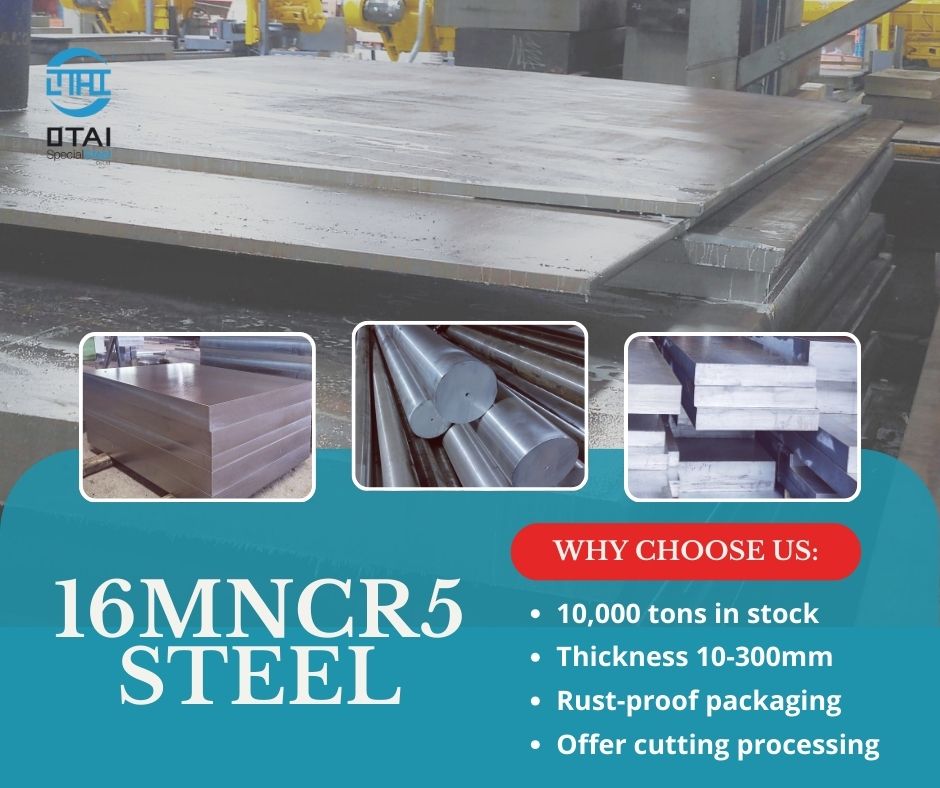
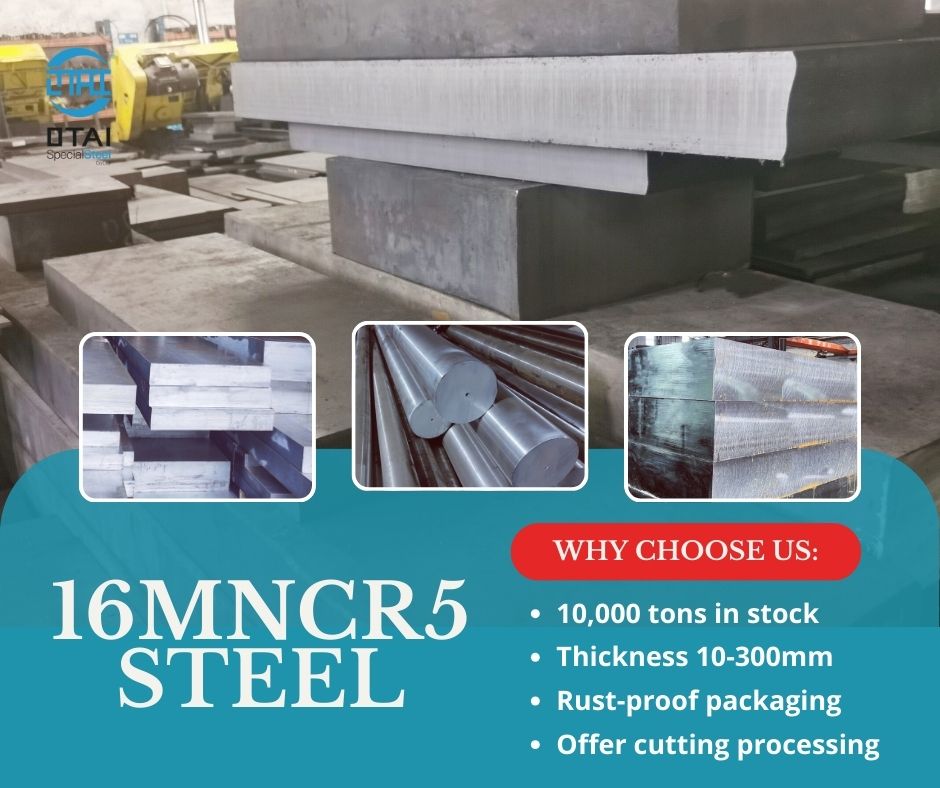
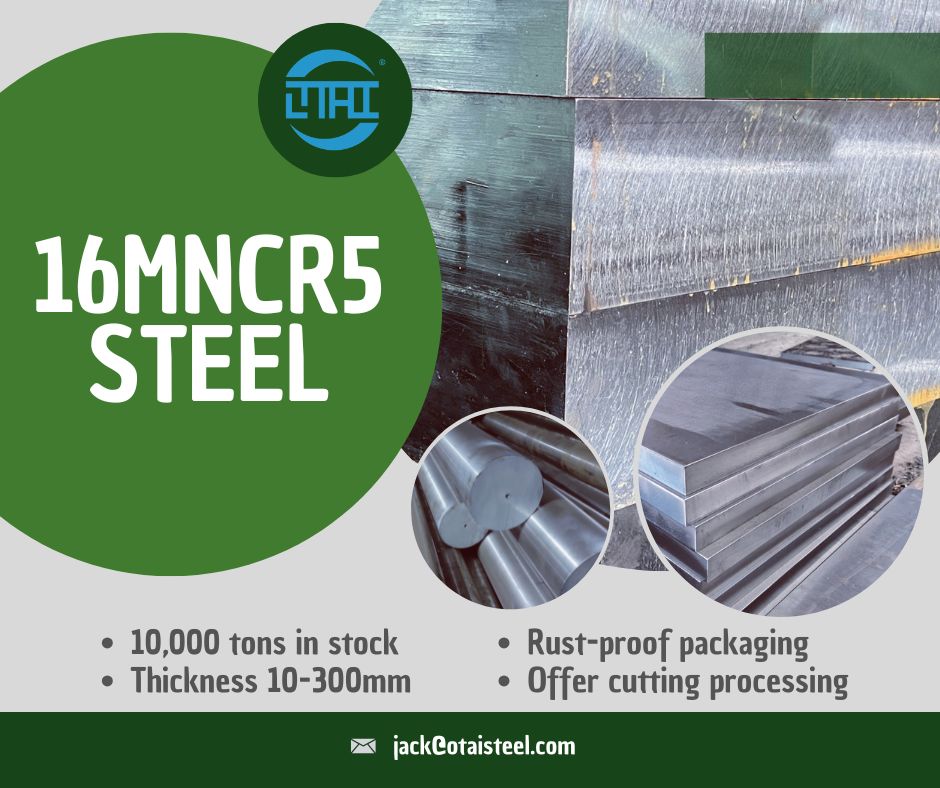
Large Inventory: 16MnCr5 plates, bars, and forgings in stock
-
Wide Size Range: Thickness from 6 mm to 300 mm
-
Heat Treatment Support: Case hardening, annealing, and pre-machining advice
-
Quality Control: UT testing, chemical analysis, SGS inspection
-
Global Experience: Serving automotive and machinery clients worldwide
We help customers reduce distortion risk and improve consistency after carburizing.
❓ FAQ – 16MnCr5 Case Hardening
Q1: Is 16MnCr5 suitable for deep case hardening?
Yes. It supports consistent case depths up to ~1.2 mm with proper control.
Q2: Can 16MnCr5 be through-hardened instead?
It can, but it performs best as a carburizing steel rather than a bulk-hardened grade.
Q3: What surface hardness can 16MnCr5 reach after case hardening?
Typically 58–62 HRC, depending on process parameters.
Q4: Does case hardening increase brittleness?
No. The hard surface sits on a tough core, which prevents brittle failure.
Q5: Is 16MnCr5 better than 20MnCr5 for case hardening?
16MnCr5 offers slightly better toughness, while 20MnCr5 provides marginally higher hardenability.