Skip to Content

Blog Archives

16MnCr5 Annealing Temperature: Complete Guide for Industrial Applications

16MnCr5 Annealing Temperature: Complete Guide for Industrial Applications

16MnCr5 Annealing Temperature: Complete Guide for Industrial Applications

When engineers and material buyers need a steel that balances strength, toughness, and machinability, 16MnCr5 often becomes the material of choice. Proper annealing of 16MnCr5 steel ensures uniform properties, reduces internal stress, and facilitates machining and further heat treatments.


🔎 Understanding 16MnCr5 Steel

16MnCr5 is a low-alloy steel known for its combination of toughness, wear resistance, and hardenability. Its alloy composition, which includes manganese and chromium, allows it to perform reliably in high-stress conditions. Engineers choose this steel for applications like gears, shafts, axles, and other mechanical components.


🔍 What Is 16MnCr5 Annealing?

Annealing is a heat treatment process in which 16MnCr5 steel is heated to a controlled temperature, held for a specified time, and then cooled slowly. This process:

  • Reduces internal stresses

  • Increases ductility

  • Improves machinability

  • Homogenizes the microstructure

Annealing prepares 16MnCr5 for subsequent processes such as quenching, tempering, or carburization.


🧪 Chemical Composition of 16MnCr5

The properties of 16MnCr5 depend on its carefully balanced alloy composition. Typical chemical makeup:

Element Content (%) Role in Properties
Carbon (C) 0.14 – 0.19 Ensures surface hardenability
Manganese (Mn) 0.50 – 0.80 Enhances toughness and strength
Chromium (Cr) 1.00 – 1.30 Increases hardness and wear resistance
Silicon (Si) 0.15 – 0.35 Improves microstructure stability
Sulfur & Phosphorus (S, P) ≤0.035 Controlled impurities for machinability

This chemical balance allows annealed 16MnCr5 to maintain a ferrite-perlite microstructure, ideal for critical mechanical applications.


⚡ Recommended Annealing Temperature

The 16MnCr5 annealing temperature typically ranges from 820 °C to 860 °C, followed by slow cooling in a furnace or air. Exact parameters depend on component size and required ductility.

Part Size Annealing Temperature (°C) Holding Time
Small (≤50 mm) 820 – 840 1–2 hours
Medium (50–150 mm) 830 – 850 2–3 hours
Large (>150 mm) 840 – 860 3–4 hours

Following this range ensures uniform microstructure, reduced residual stress, and minimal deformation during cooling.


⚙️ Mechanical Properties of Annealed 16MnCr5

Annealing directly affects mechanical properties, making the steel easier to machine and prepare for hardening. Typical properties in the annealed state:

Property Value
Tensile Strength ~550 – 650 MPa
Yield Strength ~350 – 450 MPa
Elongation ~16 – 20%
Hardness (HB) 180 – 220

These values allow engineers to design components with predictable performance and consistent machining behavior.


🏗️ Applications of 16MnCr5 Annealed Steel

Industries select annealed 16MnCr5 due to its excellent combination of ductility and hardenability:

  • Automotive → Drive shafts, gears, axles, and crankshafts

  • Aerospace → Landing gear, engine components, and high-stress shafts

  • Industrial Machinery → Hydraulic rods, tool supports, and precision shafts

  • Tooling & Molds → Pre-machined components for subsequent surface hardening

  • Construction Equipment → Heavy-duty parts requiring machining flexibility

The annealed condition enables easier shaping and drilling before subsequent treatments like quenching, carburization, or nitriding.


🔧 Machinability and Post-Annealing Treatment

Annealed 16MnCr5 machines easily with standard carbon or carbide tools. After annealing:

  • Hardening and tempering can produce a surface hardness up to 55 HRC

  • Case hardening allows a tough core with a wear-resistant surface

  • Nitriding improves surface durability without affecting core toughness

Engineers rely on the annealed state to balance machinability and mechanical performance.


📏 Sizes and Forms Available

16MnCr5 steel comes in a variety of forms suitable for industrial applications:

Form Typical Sizes Notes
Bars 10 mm – 300 mm diameter Round, square, or flat
Plates 6 mm – 300 mm thickness For heavy-duty applications
Tubes 10 mm – 600 mm OD Seamless or DOM

Large bars and plates are used in automotive and aerospace, while smaller precision rods serve tooling and machinery components.


🛡️ Benefits of Annealed 16MnCr5 Steel

  • Enhanced ductility and machinability

  • Homogeneous microstructure ready for hardening

  • Reduced internal stress and deformation

  • Predictable mechanical properties for engineering applications


🏅 Company Advantages – Why Source from Otai Special Steel?

Choosing the right supplier ensures consistent quality and reliability:

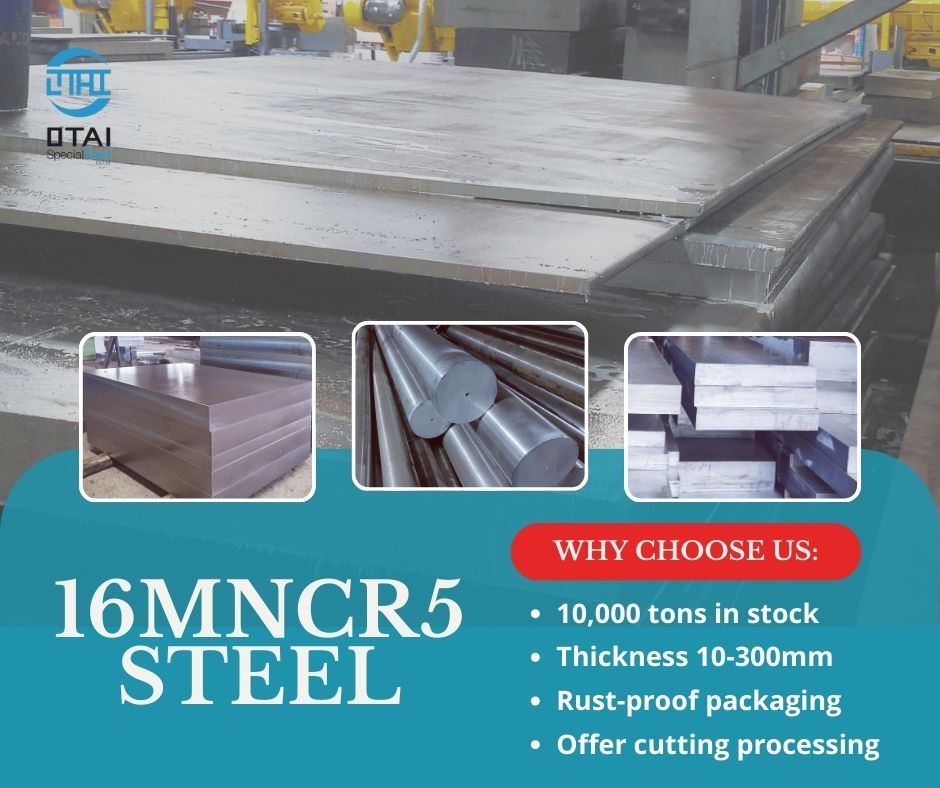
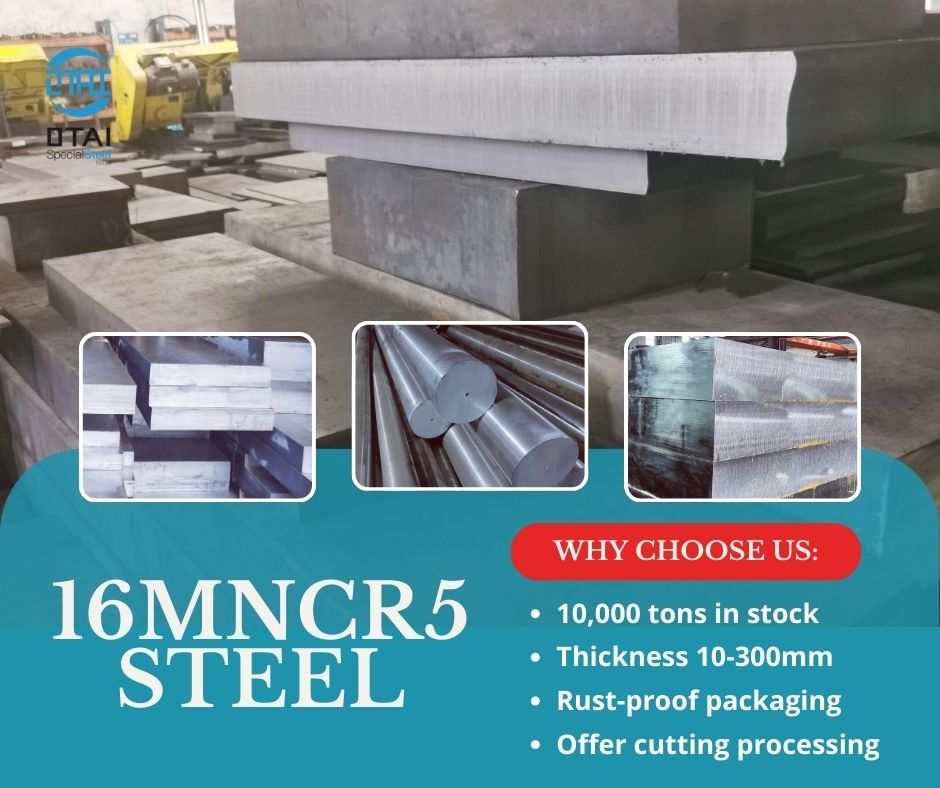
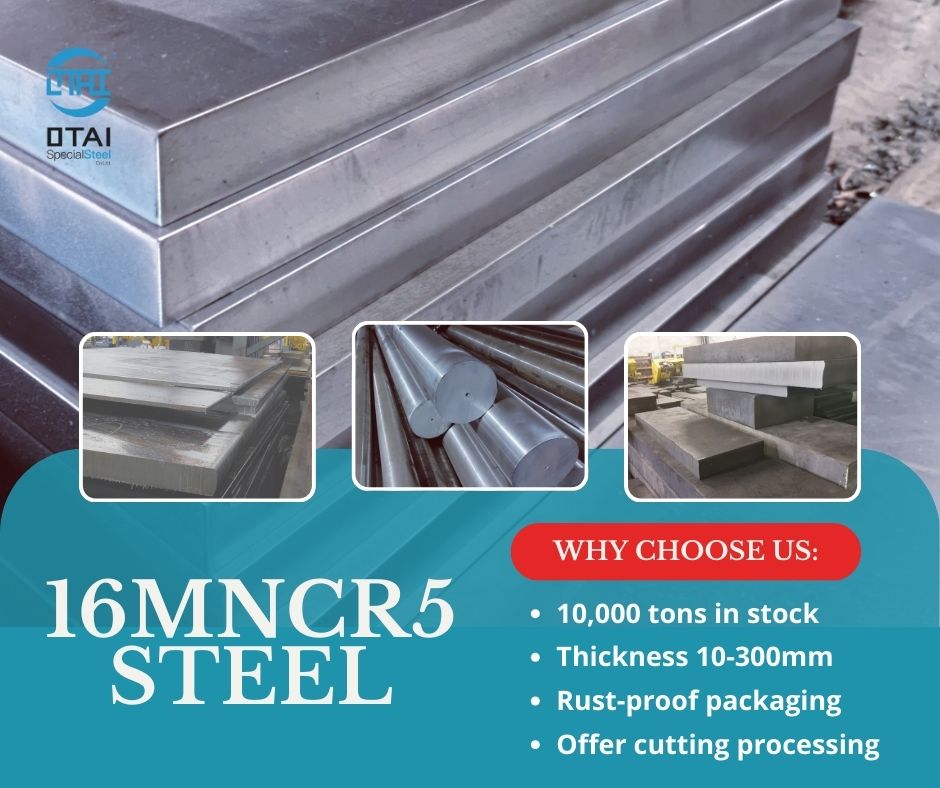
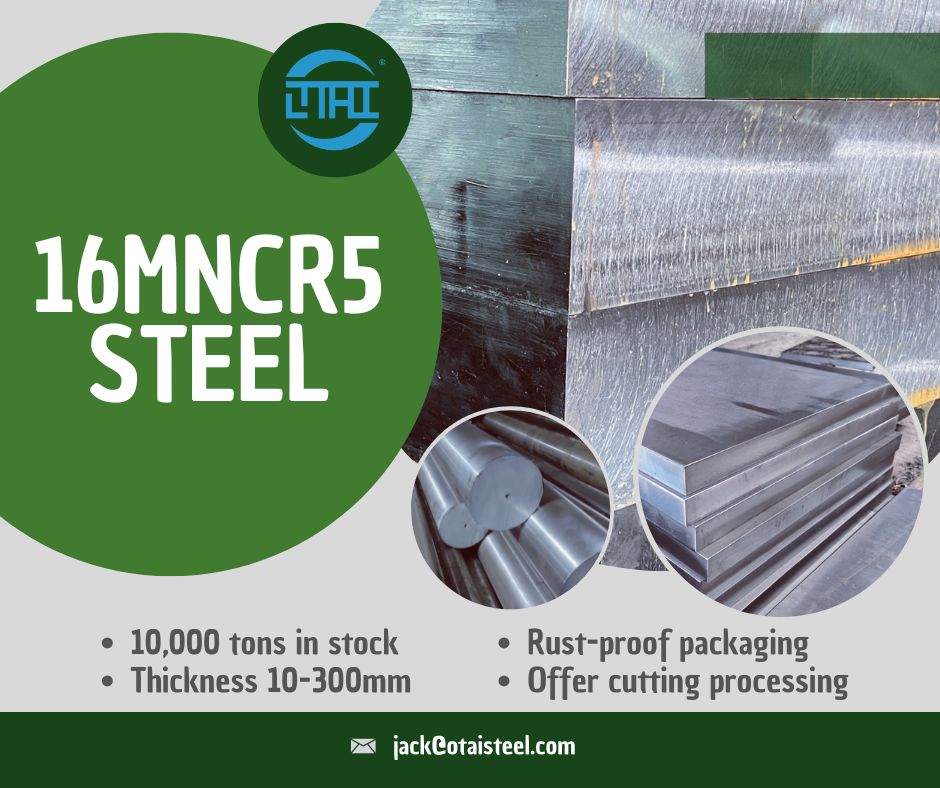
  • Large Inventory: Over 10,000 tons of 16MnCr5 steel in bars, plates, and tubes

  • Custom Processing: Tailored cutting, machining, and heat treatments

  • Certified Quality: Ultrasonic testing, chemical analysis, and SGS inspections

  • Global Supply: Trusted by companies such as Thyssenkrupp, Borealis, and Schlumberger


❓ FAQ

Q1: What is the ideal annealing temperature for 16MnCr5?
Between 820 °C and 860 °C, depending on part size.

Q2: Does annealing improve machinability?
Yes, it reduces hardness and enhances ductility, facilitating machining.

Q3: Can annealed 16MnCr5 undergo quenching afterward?
Absolutely. Annealing prepares the steel for uniform hardening and surface treatments.

Q4: Which applications benefit most from annealed 16MnCr5?
Automotive shafts, gears, industrial machinery, and tooling components.

Q5: Can annealed 16MnCr5 be used directly?
Yes, for components requiring ductility and moderate strength without further hardening.
0 0 Continue Reading →

16MnCr5 Steel Applications: Versatility in Industry

16MnCr5 Steel Applications: Versatility in Industry16MnCr5 Steel Applications: Versatility in Industry

16MnCr5 steel is a high-performance, medium-carbon alloy steel known for its strength, toughness, and wear resistance. These qualities make it a preferred material for components that must endure high mechanical stress and harsh operating conditions. 16MnCr5 steel excels in applications where toughness, fatigue resistance, and wear resistance are crucial. In this article, we’ll explore its various uses and how it performs across industries.


🏗️ What is 16MnCr5 Steel?

16MnCr5 steel is a low-alloy, medium-carbon steel that includes manganese and chromium as its main alloying elements. Manganese improves its strength and toughness, while chromium enhances its wear resistance and hardness. The combination of these properties makes 16MnCr5 a well-balanced material for a wide range of demanding applications.


🔧 Key Properties of 16MnCr5 Steel

Before we explore its uses, let’s review the key properties of 16MnCr5 steel:

  1. Tensile Strength: 16MnCr5 steel offers high tensile strength, typically ranging from 800 MPa to 1000 MPa, allowing it to withstand substantial mechanical stress.

  2. Hardness: With a Brinell hardness between 200-250 HB, 16MnCr5 steel provides excellent wear resistance, making it ideal for parts exposed to friction and wear.

  3. Ductility and Toughness: This steel has good ductility, allowing it to absorb energy under stress without fracturing. This property makes it suitable for components that undergo impact loading.

  4. Fatigue Resistance: 16MnCr5 steel performs well under cyclic loading and fatigue, making it perfect for parts exposed to repetitive stresses over time.


🔨 Common Uses of 16MnCr5 Steel

Thanks to its high strength and wear resistance, 16MnCr5 steel finds applications in several industries. Here are some of its most common uses:

1. Automotive Industry

  • 16MnCr5 steel is used extensively in the automotive industry to manufacture gears, shafts, crankshafts, and axles. These parts face high torque and dynamic stresses, and 16MnCr5 ensures they remain durable and reliable under tough conditions.

  • 16MnCr5‘s wear resistance makes it an excellent choice for gears in transmissions and differentials, where performance and reliability are essential.

2. Industrial Machinery

  • 16MnCr5 steel is essential in industrial machinery for bearings, gears, and camshafts. These parts endure continuous wear, high torque, and high-speed rotation. The hardness and toughness of 16MnCr5 guarantee long-term performance under demanding conditions.

  • Machine tools like spindles, crankshafts, and levers made from 16MnCr5 withstand abrasive conditions and high mechanical stress, ensuring long-lasting functionality.

3. Mining and Heavy Equipment

  • 16MnCr5 steel plays a vital role in the mining and heavy equipment industries for gears, axles, and drive shafts. These parts need to withstand heavy impact, abrasive wear, and high loads. 16MnCr5 provides the necessary toughness to handle shock loading, making it perfect for harsh environments such as mining and construction equipment.

4. Tooling and Dies

  • 16MnCr5 steel is a go-to material for tooling and dies that require strength, wear resistance, and toughness. Common applications include press tools, molds, and cutting tools.

  • The wear resistance and toughness of 16MnCr5 ensure that tools and dies perform well under high-stress, repetitive conditions, maintaining functionality over time.

5. Oil and Gas Industry

  • 16MnCr5 steel finds use in the oil and gas industry for valves, pumps, and drill bits. These parts must endure high pressures and extreme operating conditions.

  • The fatigue resistance and abrasion resistance of 16MnCr5 make it well-suited for demanding drilling and production environments.

6. Aerospace Industry

  • 16MnCr5 steel is also used in aerospace components such as landing gear parts, connectors, and valves. These components require both high strength and fatigue resistance, qualities that 16MnCr5 provides effectively.


📊 Applications of 16MnCr5 Steel Compared to Other Materials

Property/Use 16MnCr5 Steel Other Steels
Wear Resistance Excellent Moderate
Tensile Strength 800-1000 MPa 600-850 MPa
Common Uses Gears, Shafts, Crankshafts Gears, Bearings
Fatigue Resistance High Moderate
Machinability Good Good to Moderate

🏆 Why Choose Otai Special Steel for 16MnCr5 Steel?

At Otai Special Steel, we provide premium 16MnCr5 steel that undergoes strict quality control to ensure it meets the highest performance standards. Our 16MnCr5 steel offers strength, wear resistance, and fatigue resistance for a wide variety of applications. We also offer custom cutting, heat treatment, and machining services to meet your specific project requirements.

Advantages of Working with Otai Special Steel:

  • High-Quality Materials: Our 16MnCr5 steel ensures high strength, wear resistance, and fatigue resistance for optimal performance.

  • Customization: We offer custom cutting, machining, and heat treatment services tailored to your needs.

  • Competitive Pricing: We provide high-performance steel at competitive prices, delivering excellent value for your projects.

  • Fast Delivery: With an extensive inventory, we guarantee fast and reliable delivery to meet your deadlines.


Frequently Asked Questions (FAQ)

Q1: What are the main uses of 16MnCr5 steel?

  • A1: 16MnCr5 steel is widely used in the automotive, machinery, mining, tooling, and aerospace industries due to its strength, wear resistance, and fatigue resistance.

Q2: How does 16MnCr5 steel compare to other steels in terms of wear resistance?

  • A2: 16MnCr5 steel offers superior wear resistance, making it ideal for gears and bearings that experience constant friction and wear.

Q3: Can 16MnCr5 steel be used for high-stress components?

  • A3: Yes, 16MnCr5 steel offers high tensile strength and fatigue resistance, making it suitable for high-stress components like crankshafts, shafts, and gears.

0 0 Continue Reading →

16MnCr5 steel Price: Factors Affecting Cost

16MnCr5 steel Price: Factors Affecting Cost16MnCr5 steel Price: Factors Affecting Cost and How to Get the Best Value

16MnCr5 steel is a popular alloy steel known for its excellent mechanical properties, such as high strength, wear resistance, and toughness. This steel is widely used in industries that require components to endure high mechanical stresses, such as automotive, machinery, and aerospace. However, when sourcing 16MnCr5 steel, one of the most important considerations is the material price. The price of 16MnCr5 steel can vary based on multiple factors. In this article, we will discuss the key factors that influence the price of 16MnCr5 steel and provide tips on how to get the best value for your purchase.


🏗️ What is 16MnCr5 Steel?

16MnCr5 steel is a medium-carbon alloy steel that combines manganese and chromium to enhance its strength, toughness, and wear resistance. It is commonly used in applications such as gears, shafts, crankshafts, and other parts that require good fatigue strength and resilience to mechanical stress. The steel’s composition includes the following elements:

  • Carbon (C): 0.14% – 0.20%

  • Manganese (Mn): 0.60% – 0.90%

  • Chromium (Cr): 0.80% – 1.10%

  • Silicon (Si): 0.15% – 0.35%

  • Phosphorus (P): ≤ 0.025%

  • Sulfur (S): ≤ 0.025%

These elements give 16MnCr5 steel its impressive hardenability, resistance to wear, and fatigue resistance, making it a top choice for demanding industrial applications.


🔧 Factors Affecting the Price of 16MnCr5 Steel

The price of 16MnCr5 steel is influenced by several factors. Understanding these factors can help you make a more informed decision when purchasing the material:

1. Raw Material Costs

  • The cost of raw materials used to produce 16MnCr5 steel plays a significant role in its overall price. Elements such as manganese, chromium, and carbon fluctuate in price based on global supply and demand. Since chromium and manganese are critical alloying elements, any changes in their market price can directly impact the price of 16MnCr5 steel.

2. Production Processes

  • The method used to produce 16MnCr5 steel can affect its price. For example, the steel may undergo processes like melting, casting, rolling, and heat treatment. Specialized processes like carburizing, quenching, and tempering further enhance the material’s mechanical properties, but they also add to the cost. If you require custom heat treatments or specific material forms (like round bars, plates, or sheets), these additional processes can increase the overall price.

3. Size and Shape of the Material

  • The size and shape of the 16MnCr5 steel you need will also affect the price. Large sections or custom shapes require more labor, machinery, and material, which increases the cost. Additionally, if the steel needs to be precision-cut to specific dimensions, this adds further processing costs.

4. Quantity Purchased

  • Bulk orders of 16MnCr5 steel often come with lower per-unit costs compared to smaller, single purchases. Manufacturers and suppliers usually offer discounts for larger orders. If your project requires a high volume of steel, negotiating a better price for a bulk order can help reduce costs.

5. Supplier Location and Shipping

  • The location of the supplier plays a crucial role in the cost of 16MnCr5 steel. Steel prices can vary depending on where you are sourcing the material from. Suppliers located in areas with lower production costs may offer better prices. Additionally, shipping costs can add up, especially if the steel needs to be delivered internationally or over long distances.

6. Market Demand and Supply

  • Like all commodities, the price of 16MnCr5 steel is also influenced by market demand and supply chain factors. If there is a high demand for steel in a particular industry, such as automotive or machinery, prices may rise. Similarly, supply chain disruptions, such as transportation delays or shortages in raw materials, can cause prices to increase.


🏷️ Average Price Range for 16MnCr5 Steel

The price of 16MnCr5 steel can vary depending on the factors mentioned above, as well as the supplier and market conditions. It is influenced by the quantity purchased, steel grade, size, and any additional services required, such as cutting, heat treatment, or machining.

  • Smaller Quantities: If you purchase smaller quantities of 16MnCr5 steel, you may expect to pay at the higher end of the range due to additional handling, processing, and shipping costs.

  • Bulk Orders: For larger quantities, you can typically get a better price per ton, especially if you negotiate with suppliers.

It’s important to keep in mind that these prices can fluctuate over time due to changes in the market, raw material costs, and production processes.


💡 How to Get the Best Value for 16MnCr5 Steel

To ensure that you get the best value when purchasing 16MnCr5 steel, consider the following tips:

1. Compare Suppliers

  • Research multiple suppliers and compare their prices, product quality, and service offerings. Some suppliers may offer discounts for bulk orders or provide more competitive prices due to their location or manufacturing capabilities.

2. Negotiate Bulk Discounts

  • If your project requires a large quantity of 16MnCr5 steel, consider negotiating a bulk discount with the supplier. Many suppliers are willing to offer a better price per unit for large orders, which can result in significant savings.

3. Check for Additional Services

  • Some suppliers offer value-added services such as cutting, heat treatment, and packaging. While these services may increase the price, they could save you time and money in the long run by streamlining the supply chain and reducing the need for additional processing.

4. Plan for Long-Term Supply

  • If you expect to use 16MnCr5 steel regularly in your projects, it may be worthwhile to establish a long-term relationship with a supplier. This could lead to favorable pricing, priority access to materials, and better delivery times.

5. Monitor Market Trends

  • Keep an eye on trends in raw material prices and steel market fluctuations. Understanding market dynamics can help you make better purchasing decisions and potentially avoid purchasing when prices are at their highest.


🏆 Why Choose Otai Special Steel for Your 16MnCr5 Steel Needs?

At Otai Special Steel, we provide high-quality 16MnCr5 steel at competitive prices. Our extensive inventory ensures we can meet the needs of any project, whether you need gears, shafts, or custom steel parts. We offer value-added services like precision cutting, heat treatment, and packaging, allowing us to deliver the perfect material for your project requirements.

Advantages of Working with Otai Special Steel:

  • High-Quality Materials: We offer top-grade 16MnCr5 steel that meets international standards.

  • Customization: Our services include custom cutting, heat treatment, and machining to suit your specific needs.

  • Competitive Pricing: We offer competitive prices, ensuring excellent value without compromising on quality.

  • Fast Delivery: With a vast inventory and efficient logistics, we guarantee quick delivery to keep your projects on schedule.


Frequently Asked Questions (FAQ)

Q1: Does buying 16MnCr5 steel in bulk offer any cost benefits?

  • A1: Yes, purchasing 16MnCr5 steel in bulk typically offers cost savings. Many suppliers provide discounts for large orders, reducing the overall price per unit.

Qw: How can I reduce the cost of 16MnCr5 steel?

  • A2: To reduce costs, consider negotiating bulk discounts, comparing prices from different suppliers, and looking for value-added services such as custom cutting or heat treatment.

0 0 Continue Reading →

16MnCr5 Normalizing: Enhancing Steel Properties for Better Performance

16MnCr5 Normalizing: Enhancing Steel Properties for Better Performance16MnCr5 Normalizing: Enhancing Steel Properties for Better Performance

16MnCr5 steel is a medium-carbon, low-alloy steel known for its excellent balance of strength, toughness, and wear resistance. It is widely used in industries such as automotive, aerospace, and machinery, particularly for parts like gears, shafts, and crankshafts. To improve these properties and ensure consistent performance in critical applications, normalizing is an essential heat treatment process.

Normalizing enhances the microstructure of 16MnCr5 steel, increasing its strength, ductility, and toughness. This article explores the normalizing process for 16MnCr5 steel, the benefits it brings, and how it helps achieve superior performance in demanding applications.


🏗️ What is Normalizing?

Normalizing is a heat treatment process where steel is heated to a temperature above its critical range (typically between 850°C and 950°C or 1562°F and 1742°F) and then air-cooled to room temperature. This process refines the steel’s grain structure, making the material more uniform and improving its mechanical properties. Unlike annealing, which uses slower cooling, normalizing results in a harder and stronger material with enhanced toughness.

The process enhances workability, machinability, and strength while eliminating internal stresses that could lead to cracks or distortion. It is particularly useful when manufacturers need uniformity and strength in the material for high-stress applications.


🔧 How Does Normalizing Work on 16MnCr5 Steel?

During normalizing, 16MnCr5 steel is heated to temperatures between 850°C and 950°C (1562°F and 1742°F). At this point, the carbon content fully dissolves, and the material transforms into austenite. When cooled in air, the austenite transforms into ferrite-pearlite, creating a uniform microstructure that enhances the steel’s mechanical properties.

Key Benefits of Normalizing 16MnCr5 Steel:

  1. Uniform Microstructure: Normalizing eliminates segregation and grain boundary issues, ensuring a consistent and stable microstructure.

  2. Increased Strength: The process refines the grain structure, improving the tensile strength of the steel.

  3. Improved Toughness: Normalizing increases the steel’s impact resistance, making it less prone to failure under stress.

  4. Enhanced Workability: After normalizing, the steel becomes easier to machine, weld, or form, making it suitable for a variety of applications.


🔨 The Normalizing Process for 16MnCr5 Steel

The normalizing process for 16MnCr5 steel involves the following steps:

  1. Heating: The steel is heated to a temperature between 850°C and 950°C (1562°F and 1742°F). This temperature allows the steel to transform into austenite.

  2. Soaking: The steel is held at this temperature for a specific period of time, typically 30 minutes to 1 hour, to ensure that the material reaches uniform temperature and completes the transformation to austenite.

  3. Air Cooling: After soaking, the steel is removed from the furnace and allowed to cool in air. The cooling process is relatively fast, which leads to the formation of a ferrite-pearlite microstructure.

  4. Final Cooling and Inspection: After cooling, the steel is inspected to ensure uniformity, hardness, and strength. The material is now ready for further processing or use in applications.


🔧 Benefits of Normalizing 16MnCr5 Steel

Normalizing enhances the mechanical properties of 16MnCr5 steel, providing the following benefits:

1. Improved Strength and Toughness

  • The process increases the tensile strength of the steel while improving its toughness and resilience under stress. This makes 16MnCr5 steel ideal for parts that must endure high levels of mechanical stress and impact.

2. Enhanced Machinability

  • The uniform microstructure formed after normalizing makes 16MnCr5 steel easier to machine, shape, or weld. This reduces manufacturing time and costs while ensuring precision and accuracy in the final product.

3. Reduced Risk of Cracking

  • By eliminating internal stresses, normalizing reduces the risk of cracks or defects in the material. This helps maintain the integrity of parts during further processing, such as welding or forming.

4. Consistency Across Large Parts

  • Normalizing ensures that large components, such as gears and crankshafts, maintain consistent properties throughout the entire part. This consistency is crucial in ensuring the performance and durability of high-stress components.


🏭 Applications of Normalized 16MnCr5 Steel

The enhanced properties of 16MnCr5 steel after normalizing make it ideal for various applications in industries where strength, toughness, and wear resistance are essential.

1. Automotive Industry

  • 16MnCr5 steel is commonly used for gears, shafts, crankshafts, and axles in the automotive industry. Normalizing enhances the steel’s ability to withstand continuous mechanical stresses and fatigue, making it ideal for high-performance automotive components.

2. Industrial Machinery

  • In industrial machinery, components like gears, bearings, and shafts benefit from the improved strength and machinability provided by normalizing. These components must operate under high loads and wear, and normalizing ensures their durability and reliability.

3. Aerospace Components

  • 16MnCr5 steel is used in aerospace components such as landing gears, actuators, and rotors. Normalizing increases the steel’s fatigue resistance and impact resistance, which are critical in high-stress aerospace applications.

4. Heavy Equipment

  • For heavy machinery and construction equipment, 16MnCr5 steel undergoes normalizing to enhance the toughness and wear resistance of components like hydraulic parts, gears, and shaft assemblies. The increased strength ensures these parts can endure harsh working environments.


📊 Comparison of 16MnCr5 Steel Before and After Normalizing

Property Before Normalizing After Normalizing
Hardness Moderate Increased (higher tensile strength)
Tensile Strength Moderate High (improved uniformity and toughness)
Ductility Moderate Increased (better ductility after normalizing)
Toughness Moderate High (improved impact resistance)
Wear Resistance Moderate Enhanced (higher wear resistance)
Machinability Good Excellent (improved machinability)

🏆 Why Choose Otai Special Steel for Your 16MnCr5 Steel Needs?

At Otai Special Steel, we provide high-quality 16MnCr5 steel that undergoes the normalizing process to achieve the desired strength, toughness, and machinability. We offer custom cutting, heat treatment, and packaging services to meet your specific needs.

Advantages of Working with Otai Special Steel:

  • High-Quality Materials: Our 16MnCr5 steel undergoes normalizing to ensure reliable performance in high-stress applications.

  • Customization: We offer custom cutting, heat treatment, and machining to meet your specific project requirements.

  • Competitive Pricing: Our high-performance steel comes at competitive prices, offering excellent value for your projects.

  • Fast Delivery: With a large inventory, we guarantee fast and reliable delivery to meet your deadlines.


Frequently Asked Questions (FAQ)

Q1: What is the typical hardness of 16MnCr5 steel after normalizing?

  • A1: After normalizing, 16MnCr5 steel achieves a hardness of 240-280 HB, depending on the exact composition and process conditions.

Q2: How does normalizing affect the fatigue strength of 16MnCr5 steel?

  • A2: Normalizing improves the fatigue strength of 16MnCr5 steel by refining its grain structure and increasing its resilience under stress.

Q3: How long does the normalizing process take for 16MnCr5 steel?

  • A3: The normalizing process typically lasts 1 to 2 hours, depending on the material thickness and desired properties.

0 0 Continue Reading →

16MnCr5 Nitriding: Enhancing Surface Hardness and Wear Resistance

16MnCr5 Nitriding: Enhancing Surface Hardness and Wear Resistance16MnCr5 Nitriding: Enhancing Surface Hardness and Wear Resistance

16MnCr5 steel is a widely used low-alloy steel, especially in automotive and industrial applications where high strength, toughness, and wear resistance are required. To further improve these properties, especially in the surface layer, nitriding is a highly effective heat treatment process. Nitriding involves introducing nitrogen into the surface of the steel to form hard nitrides, which significantly enhance its wear resistance, fatigue strength, and corrosion resistance. This process is ideal for parts like gears, shafts, and valves that are exposed to high levels of friction and wear.

In this article, we will explore the nitriding process for 16MnCr5 steel, its benefits, and how it improves the performance of parts subjected to extreme conditions.


🏗️ What is Nitriding?

Nitriding is a surface hardening process that diffuses nitrogen atoms into the surface of a steel component, forming hard nitrides. The process improves the material’s surface hardness without affecting its core properties. The nitrides formed on the surface significantly enhance wear resistance, fatigue strength, and corrosion resistance, making nitriding an excellent choice for applications where the material will be subjected to high friction, abrasion, and corrosive environments.

The nitriding process typically occurs at temperatures between 500°C and 550°C (932°F to 1022°F) for several hours, depending on the steel type and desired properties.


🔧 How Does Nitriding Work on 16MnCr5 Steel?

16MnCr5 steel contains manganese and chromium, which are both beneficial for nitriding. During the nitriding process, the steel is exposed to a nitrogen-rich atmosphere, usually in the form of ammonia gas. The nitrogen atoms then diffuse into the steel’s surface and react with iron to form iron nitrides (Fe₄N and Fe₇N₃). These nitrides increase the hardness and wear resistance of the surface without significantly altering the core properties of the steel.

Key points about nitriding in 16MnCr5 steel:

  • Surface Hardness: The nitrided layer becomes extremely hard, typically reaching HV 900 to 1100 on the Vickers hardness scale.

  • Depth of Nitrided Layer: The depth of the nitrided layer typically ranges from 0.1 mm to 0.5 mm, depending on the process conditions and the desired hardness.

  • Minimal Distortion: Nitriding is performed at relatively low temperatures, which prevents significant distortion or dimensional changes in the component, unlike other hardening methods such as quenching.


🔨 Benefits of Nitriding 16MnCr5 Steel

The nitriding process brings several key benefits to 16MnCr5 steel components, making it an excellent choice for applications that demand high performance and durability.

1. Increased Surface Hardness

  • The nitriding process forms a hard nitrided layer on the surface of 16MnCr5 steel that significantly increases its surface hardness. This results in enhanced wear resistance, making the steel ideal for parts like gears, pistons, and valves that experience high levels of friction.

2. Improved Fatigue Strength

  • The nitriding process also enhances the fatigue strength of 16MnCr5 steel. The hard nitrided surface helps resist fatigue crack initiation, which is crucial for components subjected to alternating stresses over long periods, such as camshafts and crankshafts.

3. Enhanced Corrosion Resistance

  • The nitrided layer offers improved corrosion resistance, especially in environments where the steel is exposed to moisture, chemicals, or abrasive substances. This makes 16MnCr5 steel more suitable for use in automotive and aerospace applications where components face harsh operating conditions.

4. Reduced Friction and Wear

  • The formation of nitrides reduces friction and wear on the surface of 16MnCr5 steel, improving the performance of components like bearings, gears, and screws that are in constant motion and subject to high levels of abrasion.

5. Minimal Distortion

  • Since nitriding occurs at relatively low temperatures, it does not introduce significant thermal stresses or distortion into the component. This ensures that parts retain their dimensional accuracy and shape, which is critical for precision components.


🔧 Nitriding Process for 16MnCr5 Steel

The nitriding process for 16MnCr5 steel generally follows these steps:

  1. Cleaning: Before nitriding, thoroughly clean the surface of the steel to remove any contaminants such as oils, oxides, or rust that could interfere with the nitriding process.

  2. Heating: The steel is heated to a temperature range of 500°C to 550°C (932°F to 1022°F) in a nitriding furnace, typically using ammonia gas or gas mixtures that contain nitrogen.

  3. Nitriding: During the heating stage, the nitrogen from the ammonia gas diffuses into the surface of the steel. The nitriding time can vary depending on the desired hardness and depth of the nitrided layer. This process typically lasts from 4 to 16 hours.

  4. Cooling: After the desired nitriding depth is reached, the steel is cooled at room temperature. This process doesn’t induce thermal shock, which helps maintain the component’s shape.


🏭 Applications of Nitrided 16MnCr5 Steel

The enhanced properties of nitrided 16MnCr5 steel make it ideal for several applications in industries where durability, wear resistance, and performance are critical:

1. Automotive Components

  • 16MnCr5 steel is commonly used for gears, shafts, and crankshafts in the automotive industry. The nitrided surface improves the wear resistance and fatigue strength of these components, allowing them to perform reliably over time.

2. Industrial Machinery

  • Parts like bearings, valves, and gears used in industrial machinery benefit from the nitriding process, which provides a harder surface and improved corrosion resistance. These components operate under high stress and require excellent surface properties to ensure long-lasting performance.

3. Aerospace Components

  • In the aerospace industry, components like landing gear and actuators experience extreme conditions. Nitrided 16MnCr5 steel offers the fatigue resistance and wear resistance necessary to withstand repeated loading and exposure to aggressive environments.

4. Hydraulic Components

  • Hydraulic valves and pistons made from 16MnCr5 steel benefit from the nitriding process, which increases their wear resistance and ensures smooth, long-lasting performance in hydraulic systems.


📊 Comparison of 16MnCr5 Steel Before and After Nitriding

Property Before Nitriding After Nitriding
Surface Hardness Moderate Very High (up to 900-1100 HV)
Fatigue Strength Good Enhanced (resistant to crack initiation)
Wear Resistance Moderate Excellent (high resistance to friction)
Corrosion Resistance Moderate Improved (resistant to corrosion)
Dimensional Stability Good Excellent (minimal distortion)

🏆 Why Choose Otai Special Steel for Your 16MnCr5 Steel Nitriding Needs?

At Otai Special Steel, we provide premium 16MnCr5 steel that undergoes nitriding to optimize its wear resistance, fatigue strength, and corrosion resistance. We offer custom cutting, heat treatment, and packaging services to ensure that our nitrided 16MnCr5 steel meets your exact specifications.

Advantages of Working with Otai Special Steel:

  • High-Quality Materials: Our 16MnCr5 steel undergoes controlled nitriding processes to ensure superior surface properties.

  • Customization: We provide custom cutting, heat treatment, and machining services to meet the specific needs of your project.

  • Competitive Pricing: Our high-performance steel is available at competitive prices, offering excellent value.

  • Fast Delivery: With a large inventory, we guarantee fast and reliable delivery to meet your project deadlines.


Frequently Asked Questions (FAQ)

Q1: What is the hardness of 16MnCr5 steel after nitriding?

  • A1: After nitriding, 16MnCr5 steel achieves a surface hardness of up to 900-1100 HV, depending on the nitriding conditions and depth of the nitrided layer.

Q2: How does nitriding affect the wear resistance of 16MnCr5 steel?

  • A2: Nitriding significantly increases the wear resistance of 16MnCr5 steel by creating a hard nitrided layer on the surface, which helps to reduce friction and wear during operation.

Q3: Is nitriding a cost-effective process for improving steel performance?

  • A3: Yes, nitriding is a cost-effective way to improve the surface properties of steel without affecting the core material’s strength. It is especially beneficial for parts that experience high wear and fatigue.

0 0 Continue Reading →

16MnCr5 Hardening and Tempering: Key Techniques for Improved Performance

16MnCr5 Hardening and Tempering: Key Techniques for Improved Performance16MnCr5 Hardening and Tempering: Key Techniques for Improved Performance

16MnCr5 steel is a medium-carbon, low-alloy steel known for its strength, wear resistance, and toughness. These characteristics make it ideal for critical components in industries like automotive, aerospace, and machinery, especially for parts like gears, shafts, and bearings. To optimize its performance, 16MnCr5 steel undergoes hardening and tempering, two essential heat treatment processes that enhance its durability and resilience in demanding applications.

In this article, we will explore the hardening and tempering processes for 16MnCr5 steel, how they improve its properties, and why they are essential for achieving high performance in tough environments.


🏗️ What is 16MnCr5 Steel?

16MnCr5 is a medium-carbon alloy steel that contains manganese (Mn) and chromium (Cr), which significantly enhance its mechanical properties. The typical composition includes:

  • Carbon (C): 0.14% – 0.20%

  • Manganese (Mn): 0.60% – 0.90%

  • Chromium (Cr): 0.80% – 1.10%

  • Silicon (Si): 0.15% – 0.35%

  • Phosphorus (P): ≤ 0.025%

  • Sulfur (S): ≤ 0.025%

These elements give 16MnCr5 steel its excellent strength, toughness, and wear resistance. However, without proper heat treatment, its mechanical properties may not be fully optimized. This is where hardening and tempering come in.


🔧 What is Hardening?

Hardening is a heat treatment process that increases the hardness and strength of 16MnCr5 steel. The process involves heating the steel to a temperature of 850°C to 880°C (1562°F to 1616°F) and then quenching it in oil, water, or air. The rapid cooling forms a hard structure known as martensite, which significantly improves the steel’s strength and wear resistance.

Effects of Hardening on 16MnCr5 Steel

  • Increased Hardness: Hardening transforms the microstructure into martensite, which gives the steel a high hardness and wear resistance. This is essential for components like gears and bearings, which must endure continuous friction and heavy loads.

  • Increased Strength: Hardening enhances the tensile strength, allowing the material to resist deformation under high stress.

  • Brittleness: Hardening can make the steel more brittle, meaning it may fracture or crack under impact if not properly tempered afterward.


🔨 What is Tempering?

Tempering is the heat treatment process applied after hardening to adjust the steel’s properties by reducing its brittleness and increasing its toughness. After quenching, the steel is heated again to a lower temperature (typically between 200°C to 650°C, or 392°F to 1202°F), held at this temperature for a period of time, and then allowed to cool slowly.

Effects of Tempering on 16MnCr5 Steel

  • Reduced Brittleness: Tempering decreases the brittleness that results from hardening, improving the material’s ability to absorb shock without cracking.

  • Improved Toughness: Tempering enhances the impact toughness of the steel, making it more resistant to sudden impacts or stresses.

  • Controlled Hardness: By adjusting the tempering temperature, manufacturers can fine-tune the hardness to achieve the desired balance between strength and toughness.


🔧 The Hardening and Tempering Process for 16MnCr5 Steel

The process of hardening and tempering 16MnCr5 steel involves the following steps:

  1. Heating: The steel is heated to 850°C to 880°C (1562°F to 1616°F), which allows the carbon atoms to diffuse and prepare the material for quenching.

  2. Quenching: After reaching the desired temperature, the steel is rapidly cooled in a medium such as oil, water, or air, forming martensite in the process.

  3. Tempering: After quenching, the steel is heated again to a lower temperature (usually between 200°C to 650°C) to adjust its properties and relieve internal stresses.

This two-step process increases the wear resistance, strength, and toughness of 16MnCr5 steel, making it suitable for high-performance applications.


🏭 Applications of Hardened and Tempered 16MnCr5 Steel

After hardening and tempering, 16MnCr5 steel becomes an excellent choice for parts that need to withstand high mechanical stresses and harsh operating conditions. The combination of increased strength and toughness makes 16MnCr5 ideal for several critical applications:

1. Automotive Components

  • 16MnCr5 steel is commonly used for gears, crankshafts, axles, and suspension components in the automotive industry. These components need to endure significant mechanical stress and wear over long periods, making the properties achieved through hardening and tempering essential for their longevity.

2. Industrial Machinery

  • Bearings, shafts, and gears used in industrial machinery also require the high wear resistance and strength provided by hardening and tempering. These processes ensure that the components perform reliably under continuous load and stress.

3. Aerospace Applications

  • In the aerospace industry, components like landing gear, actuators, and turbocharger shafts must exhibit both high fatigue resistance and toughness. Hardening and tempering enhance these properties, ensuring these parts can withstand extreme forces during operation.

4. Heavy Equipment

  • 16MnCr5 steel is also used in heavy equipment components such as gears, cylinders, and hydraulic components. These parts need to endure harsh conditions, including heavy impacts and high wear, which makes the hardened and tempered material a suitable choice.


📊 Comparison of 16MnCr5 Steel Before and After Hardening and Tempering

Property Before Hardening and Tempering After Hardening and Tempering
Hardness Moderate to low High (due to martensite formation)
Tensile Strength Moderate High (increased after hardening)
Ductility Good Reduced (due to martensite)
Toughness Moderate Improved after tempering
Wear Resistance Moderate Very High (increased due to hardness)
Brittleness Low High (post-hardening, reduced post-tempering)

🏆 Why Choose Otai Special Steel for Your 16MnCr5 Steel Needs?

At Otai Special Steel, we offer high-quality 16MnCr5 steel that undergoes careful hardening and tempering to achieve the desired strength, toughness, and wear resistance. We provide custom cutting, heat treatment, and packaging services to meet your specific application needs.

Advantages of Working with Otai Special Steel:

  • Premium Materials: We supply 16MnCr5 steel that has undergone proper hardening and tempering processes to ensure optimal performance in high-stress applications.

  • Customization: We offer custom cutting, heat treatment, and machining to meet your exact specifications.

  • Competitive Pricing: Our high-performance steel comes at competitive prices, offering excellent value for your projects.

  • Fast Delivery: With our extensive inventory, we guarantee fast and reliable delivery to meet your deadlines.


Frequently Asked Questions (FAQ)

Q1: What is the typical hardness of 16MnCr5 steel after hardening and tempering?

  • A1: After hardening, 16MnCr5 steel typically reaches a hardness of 58-62 HRC, which is adjusted after tempering to achieve the desired level, usually between 50-55 HRC.

Q2: Can 16MnCr5 steel be used for both high strength and wear-resistant applications?

  • A2: Yes, 16MnCr5 steel is ideal for high-strength and wear-resistant applications. Hardening and tempering improve its durability and make it suitable for gears, shafts, and bearings that experience significant wear and high stresses.

Q3: How do I select the appropriate tempering temperature for 16MnCr5 steel?

  • A3: The tempering temperature for 16MnCr5 steel depends on the desired balance between hardness and toughness. Higher temperatures increase toughness but decrease hardness, while lower temperatures preserve hardness at the expense of toughness.

0 0 Continue Reading →

16MnCr5 Corrosion Resistance: Understanding its Durability in Harsh Environments

16MnCr5 Corrosion Resistance: Understanding its Durability in Harsh Environments16MnCr5 Corrosion Resistance: Understanding its Durability in Harsh Environments

16MnCr5 steel is a widely used medium-carbon alloy steel, recognized for its strength, toughness, and wear resistance. It finds application in demanding industries like automotive, aerospace, and heavy machinery. One of the critical factors influencing its performance in various environments is its corrosion resistance. While 16MnCr5 steel is not a stainless steel, it still offers a reasonable level of corrosion resistance, making it suitable for applications where moderate exposure to corrosive elements is expected.

In this article, we will explore the corrosion resistance of 16MnCr5 steel, how it performs in different environments, and ways to enhance its resistance to corrosion.


🏗️ What is 16MnCr5 Steel?

16MnCr5 steel is an alloy that includes manganese (Mn) and chromium (Cr), which are critical for enhancing the strength, toughness, and wear resistance of the material. The steel’s composition typically includes:

  • Carbon (C): 0.14% – 0.20%

  • Manganese (Mn): 0.60% – 0.90%

  • Chromium (Cr): 0.80% – 1.10%

  • Silicon (Si): 0.15% – 0.35%

  • Phosphorus (P): ≤ 0.025%

  • Sulfur (S): ≤ 0.025%

This chemical composition makes 16MnCr5 steel ideal for parts that need to withstand high mechanical stress, such as gears, shafts, and bearings. However, while chromium helps improve its resistance to corrosion, 16MnCr5 is not completely immune to it. Understanding how 16MnCr5 steel performs in corrosive environments is essential when choosing this material for specific applications.


🔧 Corrosion Resistance of 16MnCr5 Steel

The corrosion resistance of 16MnCr5 steel is moderate compared to stainless steel. While it resists mild corrosion to some extent due to the presence of chromium, it is susceptible to rusting and corrosion when exposed to aggressive conditions, such as saltwater, acidic environments, or high humidity.

1. Chromium’s Role in Corrosion Resistance

  • The chromium content in 16MnCr5 steel (0.80% – 1.10%) plays a significant role in its corrosion resistance. Chromium forms a thin, protective oxide layer on the surface of the steel, which acts as a barrier against corrosive elements. However, this layer is thin and can break down under harsh conditions, such as exposure to chlorides or acidic substances. While 16MnCr5 steel offers better corrosion resistance than low-carbon steels, it does not compare to stainless steel alloys, which have much higher chromium content (typically 10% or more) and offer superior corrosion resistance.

2. Manganese and Silicon Contributions

  • Manganese and silicon contribute to the strength and toughness of 16MnCr5 steel, but they do not significantly improve its corrosion resistance. Manganese helps the steel resist cracking and improve hardenability, while silicon acts as a deoxidizer during steelmaking, but neither element provides additional corrosion protection.

3. Environmental Impact on Corrosion

  • 16MnCr5 steel can experience rusting when exposed to moisture, oxygen, and contaminants like salts or acids. The level of corrosion depends on the environment. For instance, components exposed to saltwater, such as those in marine or coastal environments, are at a higher risk of pitting and rust formation. In more neutral environments, 16MnCr5 steel offers moderate resistance to surface corrosion but may require additional protection in harsh conditions.


🔨 Improving the Corrosion Resistance of 16MnCr5 Steel

Although 16MnCr5 steel offers reasonable corrosion resistance for many applications, there are ways to enhance its ability to withstand corrosive environments.

1. Surface Coatings

  • Surface coatings are one of the most effective ways to protect 16MnCr5 steel from corrosion. Options like galvanizing, chrome plating, or phosphate coatings can provide an additional layer of protection against corrosion. These coatings act as barriers to moisture and chemicals, preventing the steel from rusting and degrading over time.

2. Heat Treatment

  • Heat treatment methods such as carburizing can improve the surface properties of 16MnCr5 steel, making it harder and more resistant to wear. However, heat treatment does not significantly improve corrosion resistance. Combining heat treatment with surface coatings may offer better results in corrosive environments.

3. Stainless Steel Cladding

  • For applications in highly corrosive environments, engineers may choose to use 16MnCr5 steel in conjunction with stainless steel cladding. The cladding provides an outer layer of stainless steel, which offers superior corrosion resistance, while the inner core retains the strength and toughness of 16MnCr5.

4. Environmental Control

  • Limiting the exposure of 16MnCr5 steel to harsh environments can also help reduce its rate of corrosion. In applications where the material is exposed to high humidity, salt or acidic substances, ensuring proper storage and maintenance can extend the life of the material and maintain its integrity.


🏗️ Applications of 16MnCr5 Steel

Despite its moderate corrosion resistance, 16MnCr5 steel excels in applications where strength, wear resistance, and fatigue resistance are more important than corrosion resistance. Some common applications of 16MnCr5 steel include:

1. Automotive Industry

  • 16MnCr5 steel is often used for gears, axles, crankshafts, and suspension components in vehicles. These parts must endure high mechanical stress, and 16MnCr5 steel provides the necessary strength and toughness.

2. Industrial Machinery

  • 16MnCr5 steel is used for shafts, bearings, and pulleys in industrial machinery. The steel’s toughness and wear resistance make it ideal for heavy-duty components exposed to continuous friction and mechanical stress.

3. Heavy Equipment

  • In heavy equipment used in construction and mining, 16MnCr5 steel is used for gears and crankshafts that require high strength and fatigue resistance.

4. Gears and Shafts

  • The steel’s combination of hardness and fatigue strength makes it ideal for gears and shafts exposed to high loads and constant friction.


📊 Comparison of 16MnCr5 Steel with Other Materials

To highlight how 16MnCr5 steel compares with other materials in terms of corrosion resistance and key properties, here’s a quick comparison:

Material Carbon (C) Manganese (Mn) Chromium (Cr) Corrosion Resistance Applications
16MnCr5 Steel 0.14% – 0.20% 0.60% – 0.90% 0.80% – 1.10% Moderate Automotive parts, gears, shafts, industrial machinery
AISI 1045 Steel 0.45% 0.60% – 0.90% Low General engineering, shafts
AISI 4340 Steel 0.38% – 0.43% 0.60% – 0.80% 0.70% – 0.90% Moderate Aerospace, heavy machinery
EN 19 Steel 0.38% – 0.43% 0.60% – 0.90% 0.80% – 1.10% Moderate Heavy-duty machinery, automotive components
AISI 4130 Steel 0.28% – 0.33% 0.60% – 0.90% 0.80% – 1.10% Low to Moderate Aerospace, military, automotive

🏆 Why Choose Otai Special Steel for Your 16MnCr5 Steel Needs?

At Otai Special Steel, we provide high-quality 16MnCr5 steel that meets international standards for strength, toughness, and wear resistance. We also offer custom cutting, heat treatment, and packaging services to meet your specific requirements. If you need enhanced corrosion resistance, we can apply surface coatings or recommend other treatments to improve performance in corrosive environments.

Advantages of Working with Otai Special Steel:

  • Top-Quality Materials: We provide 16MnCr5 steel that meets the highest industry standards for strength, wear resistance, and toughness.

  • Customization: We offer custom cutting, heat treatment, and machining to meet your exact specifications.

  • Competitive Pricing: We offer high-performance steel at competitive prices, ensuring excellent value.

  • Fast Delivery: With a vast inventory, we guarantee fast and reliable delivery to meet your project deadlines.


Frequently Asked Questions (FAQ)

Q1: Is 16MnCr5 steel resistant to corrosion?

  • A1: 16MnCr5 steel offers moderate corrosion resistance due to its chromium content. However, it is susceptible to corrosion in harsh environments, such as saltwater or acidic conditions. Additional surface treatments can improve its resistance.

Q2: How can I improve the corrosion resistance of 16MnCr5 steel?

  • A2: Surface coatings such as galvanizing, chrome plating, or phosphate coatings can significantly enhance the corrosion resistance of 16MnCr5 steel.

Q3: What applications benefit from 16MnCr5 steel’s corrosion resistance?

  • A3: 16MnCr5 steel is suitable for automotive components, industrial machinery, and gears that need to withstand moderate exposure to corrosion. However, it is better suited for environments where corrosion is not a primary concern.

0 0 Continue Reading →

16MnCr5 Chemical Composition: Understanding Its Impact on Steel Properties

16MnCr5 Chemical Composition: Understanding Its Impact on Steel Properties16MnCr5 Chemical Composition: Understanding Its Impact on Steel Properties

16MnCr5 steel is a versatile alloy used in industries such as automotive, aerospace, and heavy machinery. Known for its excellent balance of strength, toughness, and wear resistance, 16MnCr5 steel is the material of choice for components like gears, shafts, and crankshafts. The steel’s performance directly depends on its chemical composition, which determines key properties such as hardness, fatigue resistance, and machinability.

In this article, we will explore the chemical composition of 16MnCr5 steel, discuss how each alloying element affects the steel’s properties, and explain why this steel grade is suitable for demanding applications.


🏗️ What is 16MnCr5 Steel?

16MnCr5 is a medium-carbon, low-alloy steel that contains manganese (Mn) and chromium (Cr) as key alloying elements. The number “16” in the name refers to the carbon content of approximately 0.16%, while MnCr indicates the presence of manganese and chromium. These alloying elements enhance the steel’s hardness, strength, and wear resistance.

The typical chemical composition of 16MnCr5 steel includes:

  • Carbon (C): 0.14% – 0.20%

  • Manganese (Mn): 0.60% – 0.90%

  • Chromium (Cr): 0.80% – 1.10%

  • Silicon (Si): 0.15% – 0.35%

  • Phosphorus (P): ≤ 0.025%

  • Sulfur (S): ≤ 0.025%

These elements work together to give 16MnCr5 steel a balance of strength, ductility, and resistance to wear, making it suitable for applications that demand durability and high performance.


🔧 How the Chemical Composition Affects 16MnCr5 Steel Properties

The chemical composition of 16MnCr5 steel directly influences its mechanical properties. Each alloying element plays a role in determining the steel’s strength, toughness, hardness, and resistance to wear.

1. Carbon (C)

  • Carbon is crucial in determining a steel’s hardness and strength. With a carbon content ranging from 0.14% to 0.20%, 16MnCr5 steel achieves a good balance between strength and ductility. The presence of carbon allows 16MnCr5 to be hardened through heat treatment methods such as tempering and quenching, while maintaining sufficient toughness and fatigue resistance.

2. Manganese (Mn)

  • Manganese enhances hardness, strength, and toughness in 16MnCr5 steel. It also acts as a deoxidizer, helping to remove impurities during the steelmaking process. The manganese content (0.60% – 0.90%) improves tensile strength and wear resistance, making the steel ideal for components like gears and shafts that face friction and mechanical stress. Additionally, manganese increases the hardenability of the steel, allowing it to maintain its strength during heat treatment.

3. Chromium (Cr)

  • Chromium plays an important role in improving hardness and wear resistance in 16MnCr5 steel. With a chromium content of 0.80% to 1.10%, it helps enhance the material’s fatigue strength and allows the steel to endure mechanical loads. Chromium also improves the steel’s ability to resist corrosion and contributes to hardenability, which is important for applications where parts undergo significant wear, such as gears and axles.

4. Silicon (Si)

  • Silicon (0.15% – 0.35%) acts as a deoxidizer during the steelmaking process. It helps to increase the steel’s strength and hardness while contributing to its toughness. Silicon improves the resistance to fracture and makes the material more resistant to deformation under high stress.

5. Phosphorus (P) and Sulfur (S)

  • Phosphorus and sulfur are considered impurities in most steels because they can negatively affect the ductility and toughness of the material. Both elements are kept to low levels in 16MnCr5 steel (≤ 0.025%) to ensure that the material maintains its desirable mechanical properties. Excess phosphorus and sulfur can cause brittleness, making the steel more prone to cracking under stress.


🔨 Why Choose 16MnCr5 Steel for High-Performance Applications?

Thanks to its well-balanced chemical composition, 16MnCr5 steel performs exceptionally well in various high-performance applications. The steel’s combination of strength, toughness, and resistance to wear makes it ideal for components subjected to mechanical loads and harsh conditions.

1. High Wear Resistance

  • The presence of chromium, manganese, and carbon in 16MnCr5 steel improves its wear resistance. This makes it suitable for applications where components, such as gears, shafts, and bearings, experience constant friction and mechanical wear.

2. Fatigue Strength

  • The manganese and chromium content in 16MnCr5 steel increases its fatigue strength, which allows it to withstand repeated loading and unloading cycles without cracking or failing. This property is particularly important in automotive components like crankshafts, axles, and suspension components.

3. Hardenability

  • 16MnCr5 steel exhibits excellent hardenability due to the combined effects of manganese and chromium. This property allows the material to undergo heat treatment and form a hard surface layer that resists wear, while keeping the core tough and ductile to absorb shocks.

4. Good Toughness

  • Despite its high hardness and strength, 16MnCr5 steel maintains good toughness, especially when subjected to the appropriate heat treatment. This ensures that the material can absorb impacts and resist cracking in dynamic loading applications.


📊 Comparison of 16MnCr5 Steel with Other Materials

To better understand how 16MnCr5 steel compares with other materials, here is a comparison of chemical composition and key properties:

Material Carbon (C) Manganese (Mn) Chromium (Cr) Hardness (HRC) Applications
16MnCr5 Steel 0.14% – 0.20% 0.60% – 0.90% 0.80% – 1.10% 55–62 Automotive gears, shafts, industrial machinery
AISI 1045 Steel 0.45% 0.60% – 0.90% 30–50 General engineering, shafts
AISI 4340 Steel 0.38% – 0.43% 0.60% – 0.80% 0.70% – 0.90% 35–55 Aerospace, heavy machinery
EN 19 Steel 0.38% – 0.43% 0.60% – 0.90% 0.80% – 1.10% 40–60 Heavy-duty machinery, automotive components
AISI 4130 Steel 0.28% – 0.33% 0.60% – 0.90% 0.80% – 1.10% 28–50 Aerospace, military, automotive

🏆 Why Choose Otai Special Steel for Your 16MnCr5 Steel Needs?

At Otai Special Steel, we provide high-quality 16MnCr5 steel that meets international standards for strength, toughness, and wear resistance. We offer custom cutting, heat treatment, and packaging services to ensure the material meets your project’s specific needs.

Advantages of Working with Otai Special Steel:

  • Premium Materials: We offer 16MnCr5 steel that meets the highest industry standards for strength, wear resistance, and toughness.

  • Customization: We provide custom cutting, heat treatment, and machining to suit your exact specifications.

  • Competitive Pricing: We deliver high-performance steel at competitive prices, providing excellent value.

  • Fast Delivery: With our extensive inventory, we guarantee fast, reliable delivery to meet your deadlines.


Frequently Asked Questions (FAQ)

Q1: What is 16MnCr5 steel used for?

  • A1: 16MnCr5 steel is used in automotive parts, gears, shafts, and industrial machinery due to its high strength, wear resistance, and fatigue resistance.

Q2: How does the chemical composition of 16MnCr5 steel affect its properties?

  • A2: The manganese, chromium, and carbon content give 16MnCr5 steel its high wear resistance, toughness, and hardenability, making it ideal for high-performance components.

Q3: Is 16MnCr5 steel suitable for high-stress applications?

  • A3: Yes, 16MnCr5 steel is well-suited for high-stress applications due to its fatigue strength, hardness, and toughness.

0 0 Continue Reading →

16MnCr5 Heat Treatment: Processes, Effects, and Applications

16MnCr5 Heat Treatment: Processes, Effects, and Applications16MnCr5 Heat Treatment: Processes, Effects, and Applications

16MnCr5 steel is a medium-carbon, low-alloy steel used in a variety of industries that require components to withstand high mechanical stress and wear. Known for its strength, toughness, and wear resistance, 16MnCr5 steel performs well in applications where durability and fatigue resistance are essential. Heat treatment plays a vital role in enhancing the mechanical properties of 16MnCr5 steel. In this article, we will examine the heat treatment processes, the effects on the material’s properties, and the common applications of 16MnCr5 steel.


🏗️ What is 16MnCr5 Steel?

16MnCr5 steel is an alloy steel that includes manganese and chromium to improve its mechanical properties, such as strength, toughness, and wear resistance. The number “16” in the name refers to the carbon content (around 0.16%). The manganese and chromium elements help improve hardenability, fatigue resistance, and wear resistance, which are crucial for parts exposed to high mechanical loads.

The composition of 16MnCr5 steel typically includes:

  • Carbon (C): 0.14% – 0.20%

  • Manganese (Mn): 0.60% – 0.90%

  • Chromium (Cr): 0.80% – 1.10%

  • Silicon (Si): 0.15% – 0.35%

  • Phosphorus (P): ≤ 0.025%

  • Sulfur (S): ≤ 0.025%

This composition gives 16MnCr5 steel a balance of strength, ductility, and resistance to wear, making it ideal for components that must withstand harsh conditions and repetitive stresses.


🔧 Heat Treatment Processes for 16MnCr5 Steel

Heat treatment allows you to modify the mechanical properties of 16MnCr5 steel to meet the specific requirements of various applications. Through heat treatment, you can enhance its strength, hardness, toughness, and wear resistance. Below are the most commonly used heat treatment processes for 16MnCr5 steel:

1. Carburizing

  • Carburizing is a surface-hardening process that adds carbon to the outer layer of 16MnCr5 steel. This process creates a hard surface while keeping the inner core tough and ductile. Carburizing improves the wear resistance and fatigue strength, making it ideal for parts like gears, shafts, and sprockets.

  • Process:

    1. Heat the steel to a temperature of 900°C to 950°C.

    2. Expose the material to a carbon-rich atmosphere, such as carbon monoxide.

    3. Quench the steel to lock in the carbon at the surface.

    4. Optionally, temper the steel to restore some of its ductility.

  • Benefits: Increased surface hardness and wear resistance while maintaining a tough core.

2. Quenching and Tempering

  • Quenching and tempering are often applied together to increase strength and hardness while maintaining ductility. Quenching involves rapidly cooling the steel to lock in its hard martensitic structure, and tempering restores the material’s toughness by reheating it at a lower temperature.

  • Process:

    1. Heat the steel to around 850°C to 900°C.

    2. Quench it in oil or water to form martensite.

    3. Temper the steel at 400°C to 650°C to relieve stresses and improve toughness.

  • Benefits: Improved tensile strength, fatigue resistance, and impact toughness.

3. Normalizing

  • Normalizing is a heat treatment that refines the grain structure of 16MnCr5 steel to improve its toughness and uniformity.

  • Process:

    1. Heat the steel to 850°C to 900°C.

    2. Allow the steel to cool in air, resulting in a more uniform grain structure.

  • Benefits: Enhanced toughness, strength, and improved formability.

4. Annealing

  • Annealing is a heat treatment designed to soften 16MnCr5 steel by relieving internal stresses and improving machinability.

  • Process:

    1. Heat the steel to 750°C to 800°C.

    2. Cool it slowly to reduce internal stresses and soften the material.

  • Benefits: Reduced internal stresses and improved ductility and machinability.


🔨 Effects of Heat Treatment on 16MnCr5 Steel

The heat treatment processes enhance various mechanical properties of 16MnCr5 steel, tailoring it for specific applications. Here’s how each process affects its properties:

1. Hardness

  • Carburizing and quenching increase the surface hardness of 16MnCr5 steel, making it more resistant to wear and abrasion. This is especially useful for components such as gears and bearings that experience high friction.

2. Strength and Toughness

  • Quenching increases the strength but may also make the steel brittle. Tempering after quenching restores the material’s toughness, improving its ability to absorb shocks and resist impact.

3. Ductility

  • Normalizing and annealing improve the ductility of 16MnCr5 steel, making it easier to work with and shape. This is important when the material needs to withstand deformation without cracking or breaking.

4. Wear Resistance

  • Carburizing increases the wear resistance of 16MnCr5 steel, which makes it ideal for parts exposed to continuous friction and abrasive forces.


🏗️ Applications of 16MnCr5 Steel

Due to its excellent mechanical properties and versatile heat treatment options, 16MnCr5 steel is used in a wide variety of applications, particularly in industries that require components to endure high stress, impact, and wear.

1. Automotive Industry

  • 16MnCr5 steel is commonly used in the automotive industry for manufacturing gears, axles, crankshafts, and suspension components. These components require the steel to withstand high mechanical loads while maintaining fatigue strength and impact resistance.

2. Industrial Machinery

  • 16MnCr5 steel is used for bearings, shafts, sprockets, and pulleys in industrial machinery. The material’s wear resistance and toughness make it perfect for heavy-duty machinery exposed to constant friction.

3. Heavy Equipment

  • Parts in heavy equipment, such as those used in construction and mining, benefit from the high strength and toughness of 16MnCr5 steel. This steel can endure harsh working conditions with high mechanical stresses.

4. Gears and Shafts

  • 16MnCr5 steel is particularly suitable for gears and shafts that experience high torque, dynamic loads, and frequent wear. The material’s combination of hardness and ductility makes it durable and reliable in demanding applications.


📊 Comparison of 16MnCr5 Steel with Other Materials

For a clearer understanding of how 16MnCr5 steel compares to other materials, here is a comparison of tensile strength, yield strength, and hardness:

Material Tensile Strength (MPa) Yield Strength (MPa) Hardness (HRC) Applications
16MnCr5 Steel 600–900 450–650 55–62 Automotive parts, gears, shafts, industrial machinery
AISI 5120 Steel 600–850 400–650 28–50 Automotive gears, axles, crankshafts
EN 19 (1.4511) 850–1,100 450–650 30–40 Engine components, industrial machinery
42CrMo4 (1.7225) 900–1,050 600–750 30–50 Gears, axles, crankshafts
AISI 4130 Steel 670–1,000 430–600 28–50 Aerospace, military, automotive

🏆 Why Choose Otai Special Steel for Your 16MnCr5 Steel Needs?

At Otai Special Steel, we offer high-quality 16MnCr5 steel that meets international standards. We provide precision cutting, heat treatment, and packaging services to ensure the material meets your project requirements. Whether you need gears, shafts, or machinery parts, we can help you get the right material for your application.

Advantages of Working with Otai Special Steel:

  • Top-Quality Materials: We offer 16MnCr5 steel that meets industry standards for strength, wear resistance, and toughness.

  • Customization: We provide custom cutting, heat treatment, and machining to meet your exact specifications.

  • Competitive Pricing: We offer high-performance steel at competitive prices, ensuring excellent value.

  • Fast Delivery: With our extensive inventory, we guarantee fast, reliable delivery to meet your deadlines.


Frequently Asked Questions (FAQ)

Q1: What is 16MnCr5 steel used for?

  • A1: 16MnCr5 steel is used in automotive parts, gears, shafts, and industrial machinery components that require high strength, wear resistance, and fatigue resistance.

Q2: How does heat treatment affect 16MnCr5 steel?

  • A2: Heat treatments like carburizing, quenching, and tempering significantly improve the strength, hardness, and wear resistance of 16MnCr5 steel, making it suitable for heavy-duty applications.

Q3: Is 16MnCr5 steel weldable?

  • A3: Yes, 16MnCr5 steel is weldable, but it requires proper preheating and post-weld heat treatment to avoid cracking and ensure the best mechanical properties.

0 0 Continue Reading →

Steel Grade 16MnCr5: Properties, Applications, and Benefits

Steel Grade 16MnCr5: Properties, Applications, and BenefitsSteel Grade 16MnCr5: Properties, Applications, and Benefits

16MnCr5 steel is a medium-carbon, low-alloy steel that combines manganese and chromium to enhance its mechanical properties. In this article, we will explore the composition, properties, heat treatment, and applications of 16MnCr5 steel, highlighting why it’s a preferred material in automotive, aerospace, and heavy machinery industries.


🏗️ What is Steel Grade 16MnCr5?

16MnCr5 is an alloy steel known for its combination of manganese (Mn) and chromium (Cr). The “16” in the name refers to the approximate carbon content, about 0.16%. The MnCr alloying elements provide additional benefits such as better hardenability and fatigue resistance.

The typical chemical composition of 16MnCr5 steel includes:

  • Carbon (C): 0.14% – 0.20%

  • Manganese (Mn): 0.60% – 0.90%

  • Chromium (Cr): 0.80% – 1.10%

  • Silicon (Si): 0.15% – 0.35%

  • Phosphorus (P): ≤ 0.025%

  • Sulfur (S): ≤ 0.025%

This unique composition provides 16MnCr5 with a balance of strength, ductility, and resistance to wear, making it a popular choice for critical components in many industries.


🔧 Mechanical Properties of 16MnCr5 Steel

The mechanical properties of 16MnCr5 steel make it suitable for high-performance applications. Key properties include:

1. Tensile Strength

  • 16MnCr5 steel typically has a tensile strength between 600 MPa and 900 MPa. This high strength allows it to withstand considerable tensile stress without breaking or permanently deforming.

2. Yield Strength

  • The yield strength of 16MnCr5 steel ranges from 450 MPa to 650 MPa, enabling it to resist permanent deformation under heavy mechanical loads.

3. Hardness

  • The hardness of 16MnCr5 steel can reach between 55 and 62 HRC (Rockwell C scale), depending on the heat treatment applied. This makes it highly resistant to wear, abrasions, and deformation.

4. Ductility and Toughness

  • 16MnCr5 steel has good ductility and toughness, which means it can deform slightly under stress without fracturing. This combination helps the steel absorb energy and resist cracking under shock or impact.

5. Fatigue Resistance

  • 16MnCr5 steel exhibits excellent fatigue resistance, making it ideal for components such as gears, shafts, and axles, which experience repetitive loads during operation.


🔨 Heat Treatment of 16MnCr5 Steel

Heat treatment processes can significantly alter the mechanical properties of 16MnCr5 steel. By applying specific treatments, manufacturers can enhance its strength, hardness, and wear resistance. Common heat treatments for 16MnCr5 steel include:

1. Carburizing

  • Carburizing increases the carbon content on the surface of 16MnCr5 steel, forming a hard surface layer while keeping the core ductile. This treatment improves wear resistance and is ideal for components like gears and sprockets.

2. Quenching and Tempering

  • Quenching involves heating the steel to a high temperature and then cooling it rapidly, which increases tensile strength and hardness. After quenching, tempering reduces brittleness and restores some ductility, balancing strength and toughness.

3. Normalizing

  • In normalizing, 16MnCr5 steel is heated above its critical temperature and then allowed to cool in air. This process refines the grain structure, improving the toughness and strength of the material.


🏗️ Applications of 16MnCr5 Steel

Thanks to its excellent mechanical properties, 16MnCr5 steel is used in a wide variety of industrial applications. Some of its common uses include:

1. Automotive Industry

  • 16MnCr5 steel is a popular material for automotive parts such as gears, axles, crankshafts, and suspension components. These parts are subjected to high mechanical stresses and require materials with good fatigue resistance and impact toughness.

2. Industrial Machinery

  • 16MnCr5 steel is widely used in industrial machinery, particularly for parts like bearings, shafts, pulleys, and sprockets. Its wear resistance and toughness make it ideal for high-load, high-stress applications.

3. Heavy Equipment

  • Components for heavy equipment, such as those used in construction and mining, benefit from the strength and toughness of 16MnCr5 steel. This steel can withstand harsh working conditions, including high-impact forces and abrasive environments.

4. Gears and Shafts

  • Due to its high tensile strength, hardness, and fatigue resistance, 16MnCr5 steel is commonly used for gears, shafts, and other mechanical components exposed to dynamic loads and constant friction.


📊 Comparison of 16MnCr5 Steel with Other Steels

To help understand how 16MnCr5 steel compares to other widely used steels, here is a comparison of tensile strength, yield strength, and hardness:

Material Tensile Strength (MPa) Yield Strength (MPa) Hardness (HRC) Applications
16MnCr5 Steel 600–900 450–650 55–62 Automotive parts, gears, shafts, industrial machinery
AISI 5120 Steel 600–850 400–650 28–50 Automotive gears, axles, crankshafts
EN 19 (1.4511) 850–1,100 450–650 30–40 Engine components, industrial machinery
42CrMo4 (1.7225) 900–1,050 600–750 30–50 Gears, axles, crankshafts
AISI 4130 Steel 670–1,000 430–600 28–50 Aerospace, military, automotive
SAE 8620 Steel 600–850 400–550 20–30 Gears, automotive components, shafts

🏆 Why Choose Otai Special Steel for Your 16MnCr5 Steel Needs?

At Otai Special Steel, we specialize in providing high-quality 16MnCr5 steel that meets the highest international standards. Whether you need gears, shafts, or custom components, we offer precision cutting, heat treatment, and packaging services to ensure the material meets your project requirements.

Advantages of Working with Otai Special Steel:

  • Top-Quality Materials: We provide 16MnCr5 steel that meets the highest industry standards for strength, durability, and wear resistance.

  • Customization: We offer custom cutting, heat treatment, and machining to suit your exact specifications.

  • Competitive Pricing: We deliver high-performance steel at competitive prices, providing excellent value.

  • Fast Delivery: With an extensive inventory, we guarantee fast, reliable delivery to meet your deadlines.


Frequently Asked Questions (FAQ)

Q1: What is 16MnCr5 steel used for?

  • A1: 16MnCr5 steel is used in automotive parts, gears, shafts, and industrial machinery components that need high strength, wear resistance, and fatigue resistance.

Q2: How does heat treatment improve the properties of 16MnCr5 steel?

  • A2: Heat treatments like carburizing, quenching, and tempering increase the hardness, toughness, and wear resistance of 16MnCr5 steel, making it ideal for heavy-duty applications.

Q3: Is 16MnCr5 steel weldable?

  • A3: Yes, 16MnCr5 steel is weldable, but it requires proper preheating and post-weld heat treatment to avoid cracking and maintain its mechanical properties.

0 0 Continue Reading →