Skip to Content

Category Archives: Blog

16MnCr5 and 20MnCr5: Key Differences for Case Hardening Steel Selection

16MnCr5 and 20MnCr5: Key Differences for Case Hardening Steel Selection16MnCr5 and 20MnCr5: Key Differences for Case Hardening Steel Selection

When comparing 16MnCr5 and 20MnCr5, engineers often focus on carbon content, hardenability, and final performance after heat treatment. Both steels belong to the carburizing category, but they offer different strength levels and application suitability.

Understanding the differences between 16MnCr5 and 20MnCr5 helps you select the right material for gears, shafts, and other critical components.

🛠️ Overview of 16MnCr5 and 20MnCr5

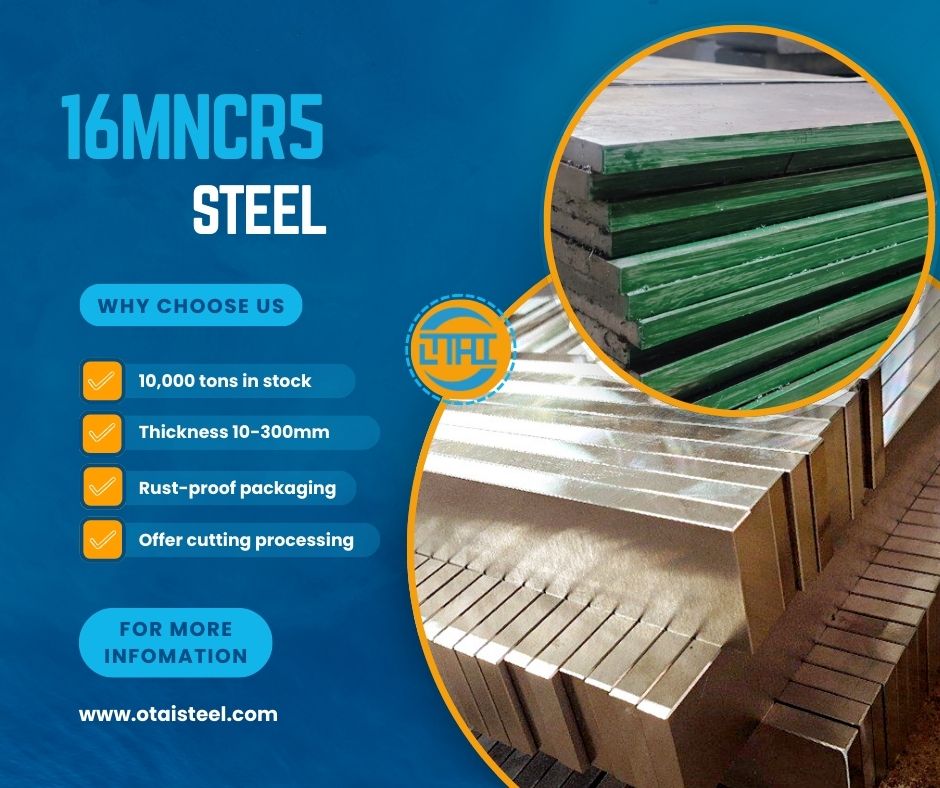
16MnCr5 steel is a low-carbon alloy steel widely used for case hardening. It provides a tough core and a wear-resistant surface after carburizing.

20MnCr5 steel contains slightly higher carbon content, which improves strength and hardness after heat treatment. Manufacturers use it in applications that require higher load capacity.

⚙️ Chemical Composition Comparison

The primary difference between 16MnCr5 and 20MnCr5 lies in their carbon content and alloy balance.

Element 16MnCr5 (%) 20MnCr5 (%)
Carbon (C) 0.14 – 0.19 0.17 – 0.22
Silicon (Si) 0.15 – 0.40 0.15 – 0.40
Manganese (Mn) 1.00 – 1.30 1.10 – 1.40
Chromium (Cr) 0.80 – 1.10 1.00 – 1.30
Phosphorus (P) ≤ 0.025 ≤ 0.025
Sulfur (S) ≤ 0.035 ≤ 0.035

The higher carbon content in 20MnCr5 steel increases hardness and strength after carburizing.

🔧 Mechanical Properties Comparison

The mechanical performance difference between 16MnCr5 and 20MnCr5 becomes clear after heat treatment.

Property 16MnCr5 20MnCr5
Surface Hardness 58–62 HRC 58–63 HRC
Core Strength Moderate Higher
Hardenability Good Better
Toughness Good Slightly lower
Fatigue Strength Good Higher

You should choose 20MnCr5 steel when higher strength and fatigue resistance are required.

🧰 Heat Treatment Differences

Both steels respond well to carburizing, but 20MnCr5 steel offers deeper hardening due to its composition.

Parameter 16MnCr5 20MnCr5
Carburizing Temp 880 – 930°C 880 – 930°C
Case Depth Medium Deeper
Core Hardness Lower Higher
Distortion Control Good Slightly more sensitive

You must carefully control heat treatment when working with 20MnCr5 steel to avoid distortion.

🔩 Application Comparison

The selection between 16MnCr5 and 20MnCr5 depends on load conditions and performance requirements.

Application 16MnCr5 20MnCr5
Automotive Gears Standard load Heavy-duty load
Shafts General machinery High-strength applications
Gearboxes Medium-duty systems High-load systems
Industrial Equipment Cost-effective solutions High-performance components

Use 16MnCr5 steel for cost-sensitive applications. Choose 20MnCr5 steel for higher stress environments.

💡 How to Choose Between 16MnCr5 and 20MnCr5

When deciding between 16MnCr5 and 20MnCr5, consider the following:

  • Select 16MnCr5 steel for better toughness and easier machining
  • Choose 20MnCr5 steel for higher strength and fatigue resistance
  • Evaluate heat treatment capability and distortion control
  • Balance cost with performance requirements

Making the right choice improves durability and reduces maintenance costs.

🌍 Advantages of Each Material

Both 16MnCr5 and 20MnCr5 offer distinct advantages:

  • 16MnCr5 steel: Better machinability, lower cost, stable performance
  • 20MnCr5 steel: Higher strength, deeper hardening, better fatigue resistance

You should match material selection to your specific application needs.

🏆 Company Advantages

At Otai Special Steel, we supply both 16MnCr5 steel and 20MnCr5 steel with consistent quality and fast delivery. Our advantages include:

  • Large Inventory: Over 10,000 tons of alloy steel ready for immediate shipment.
  • Custom Processing: Cutting, heat treatment, and machining services available.
  • Strict Quality Control: Ultrasonic testing (UT) and chemical verification for each batch.
  • Global Supply Experience: Reliable export service for international customers.
  • Competitive Pricing: Cost-effective solutions for both standard and high-performance steels.

🤔 FAQ

Q1: What is the main difference between 16MnCr5 and 20MnCr5?
A1: The main difference is carbon content. 20MnCr5 steel has higher carbon, which increases strength and hardness.

Q2: Which steel is better for heavy-duty gears?
A2: 20MnCr5 steel is better suited for heavy-duty gear applications due to its higher fatigue strength.

Q3: Is 16MnCr5 easier to machine?
A3: Yes, 16MnCr5 steel offers better machinability compared to 20MnCr5 steel.
0 0 Continue Reading →

4140 Steel Properties MatWeb: Data-Driven Insights for Engineering Applications

4140 Steel Properties MatWeb: Data-Driven Insights for Engineering Applications4140 Steel Properties MatWeb: Data-Driven Insights for Engineering Applications

When engineers search for reliable material data, 4140 steel properties MatWeb often becomes a key reference point. It provides standardized mechanical, physical, and thermal data that help professionals select materials with confidence. Understanding these properties allows you to optimize design, machining, and heat treatment processes.

This article summarizes the most important 4140 steel properties MatWeb data and explains how they impact real-world applications.

🛠️ Overview of 4140 Steel

4140 steel is a chromium-molybdenum alloy steel widely used for its excellent strength, toughness, and fatigue resistance. It performs well in both annealed and heat-treated conditions, making it suitable for a wide range of engineering applications.

Manufacturers commonly use 4140 steel for shafts, gears, bolts, and heavy-duty components.

⚙️ 4140 Steel Mechanical Properties

The 4140 steel properties MatWeb database provides typical mechanical values under quenched and tempered conditions:

Property Typical Value
Tensile Strength 850 – 1000 MPa
Yield Strength 650 – 850 MPa
Hardness 28 – 32 HRC
Elongation 20 – 25%
Reduction of Area 45 – 60%

These values demonstrate the excellent balance of strength and ductility in 4140 steel.

🔬 Physical Properties from MatWeb

The 4140 steel properties MatWeb dataset also includes important physical characteristics:

Property Value
Density 7.85 g/cm³
Elastic Modulus 205 GPa
Thermal Conductivity 42 W/m·K
Specific Heat 0.46 J/g·°C

These physical properties help engineers evaluate thermal behavior and structural performance.

🔧 Thermal Properties and Heat Treatment Behavior

The 4140 steel properties MatWeb also highlight thermal response during heat treatment:

Property Typical Value
Austenitizing Temperature 850 – 880°C
Tempering Range 200 – 600°C
Thermal Expansion 12.3 µm/m·°C

These values help control distortion and ensure consistent material performance.

🧰 How MatWeb Data Helps in Engineering

Using 4140 steel properties MatWeb, engineers can:

  • Select appropriate materials for load-bearing applications
  • Predict mechanical performance under stress
  • Optimize machining parameters
  • Design heat treatment processes
  • Ensure compliance with industry standards

Reliable data reduces design errors and improves production efficiency.

🌍 Applications Based on MatWeb Properties

The 4140 steel properties MatWeb support a wide range of applications:

Application Key Property Requirement
Automotive Shafts High strength and fatigue resistance
Gears Wear resistance and toughness
Oil & Gas Components Strength under extreme conditions
Machinery Parts Balanced mechanical properties

These applications rely on the consistent data provided by MatWeb.

💡 Advantages of Using 4140 Steel Data

Relying on 4140 steel properties MatWeb offers several advantages:

  • Provides standardized and verified material data
  • Supports accurate engineering calculations
  • Helps compare materials efficiently
  • Improves design reliability
  • Reduces material selection risks

This makes 4140 steel a trusted material in global industries.

🏆 Company Advantages

At Otai Special Steel, we supply high-quality 4140 steel that meets international standards and verified property data. Our advantages include:

  • Large Inventory: Over 10,000 tons available for fast delivery.
  • Custom Processing: Cutting, heat treatment, and machining services.
  • Strict Quality Control: UT testing and full property verification.
  • Global Supply Experience: Reliable service for international clients.
  • Competitive Pricing: Cost-effective solutions with stable quality.

🤔 FAQ

Q1: What is MatWeb for 4140 steel?
A1: MatWeb is a material database that provides detailed 4140 steel properties MatWeb data, including mechanical and physical properties.

Q2: Are MatWeb values exact?
A2: The 4140 steel properties MatWeb values are typical ranges. Actual values may vary depending on heat treatment and processing.

Q3: Why use MatWeb data for material selection?
A3: It provides reliable and standardized data, helping engineers make accurate decisions.


0 0 Continue Reading →

16MnCr5 Equivalent: International Grades and Material Substitution Guide

16MnCr5 Equivalent: International Grades and Material Substitution Guide16MnCr5 Equivalent: International Grades and Material Substitution Guide

Understanding 16MnCr5 equivalent grades is essential when sourcing materials globally. Different countries use different standards, but many steels offer similar chemical composition and mechanical properties. Knowing the correct 16MnCr5 equivalent helps you avoid procurement risks and ensures consistent performance in your application.

This article explains international equivalents, composition comparisons, and how to select suitable substitutes.

🛠️ What is 16MnCr5 Steel?

16MnCr5 steel is a low-alloy case-hardening steel widely used in Europe under EN 10084. It offers excellent wear resistance after carburizing while maintaining a tough core. Engineers commonly use this steel for gears, shafts, and transmission components.

The balanced composition makes 16MnCr5 steel suitable for high-volume production and precision engineering.

⚙️ 16MnCr5 Equivalent Grades in Different Standards

The most common 16MnCr5 equivalent grades appear across international standards. The table below summarizes key equivalents:

Standard Equivalent Grade
EN / DIN 1.7131 (16MnCr5)
AISI / SAE 5115
JIS SCM415
GB (China) 20CrMnTi (approx.)
ISO 16MnCr5

These 16MnCr5 equivalent grades share similar carburizing characteristics, though slight differences may exist in alloy content.

🔬 Chemical Composition Comparison

Understanding composition differences helps you evaluate 16MnCr5 equivalent materials.

Element 16MnCr5 (%) AISI 5115 (%) SCM415 (%)
Carbon (C) 0.14 – 0.19 0.13 – 0.18 0.13 – 0.18
Manganese (Mn) 1.00 – 1.30 0.70 – 0.90 0.60 – 0.85
Chromium (Cr) 0.80 – 1.10 0.70 – 0.90 0.90 – 1.20
Silicon (Si) 0.15 – 0.40 0.15 – 0.35 0.15 – 0.35

While all 16MnCr5 equivalent steels are suitable for carburizing, variations in manganese and chromium can affect hardenability and strength.

🔧 Mechanical Properties Comparison

Mechanical performance also varies slightly among 16MnCr5 equivalent grades:

Property 16MnCr5 AISI 5115 SCM415
Surface Hardness 58–62 HRC 58–62 HRC 58–62 HRC
Core Strength Good Moderate Good
Hardenability Good Moderate Good
Fatigue Strength Good Moderate Good

You should verify performance requirements before selecting a 16MnCr5 equivalent.

🧰 How to Choose the Right Equivalent

When selecting a 16MnCr5 equivalent, consider these factors:

  • Application Requirements: Match strength, wear resistance, and fatigue performance
  • Heat Treatment Capability: Ensure compatibility with carburizing processes
  • Availability: Choose materials readily available in your region
  • Standards Compliance: Confirm certifications and specifications
  • Cost Efficiency: Balance performance with material cost

Selecting the right 16MnCr5 equivalent ensures reliable performance and reduces production risks.

💡 Common Substitution Scenarios

In practical applications, engineers often replace 16MnCr5 steel with equivalents:

  • Use AISI 5115 for general carburizing applications with moderate loads
  • Choose SCM415 for applications requiring slightly better hardenability
  • Consider 20CrMnTi when additional strength and fatigue resistance are needed

Always confirm technical requirements before substitution.

🌍 Advantages of Using Equivalent Grades

Using 16MnCr5 equivalent materials offers several benefits:

  • Expands sourcing options globally
  • Reduces procurement lead time
  • Improves cost flexibility
  • Maintains similar performance characteristics
  • Supports international manufacturing standards

These advantages help companies operate more efficiently in global markets.

🏆 Company Advantages

At Otai Special Steel, we supply high-quality 16MnCr5 steel and its equivalent grades with reliable performance and global standards compliance. Our advantages include:

  • Large Inventory: Over 10,000 tons of alloy steel available for fast delivery.
  • Custom Processing Services: Cutting, heat treatment, and machining tailored to your needs.
  • Strict Quality Control: UT testing and chemical composition verification for every batch.
  • Global Export Experience: Reliable supply chain for international customers.
  • Competitive Pricing: Cost-effective solutions with consistent quality.

🤔 FAQ

Q1: What is the closest equivalent to 16MnCr5?
A1: The most common 16MnCr5 equivalent is AISI 5115, which offers similar carburizing performance.

Q2: Can SCM415 replace 16MnCr5?
A2: Yes, SCM415 is a widely accepted 16MnCr5 equivalent, especially in Asian markets.

Q3: Are all equivalents exactly the same?
A3: No, 16MnCr5 equivalent grades have similar properties, but slight differences in composition may affect performance. Always verify specifications before use.


0 0 Continue Reading →

4140 Steel Hardness Rockwell C: Understanding HRC Values and Performance

4140 Steel Hardness Rockwell C: Understanding HRC Values and Performance

The 4140 steel hardness Rockwell C rating is one of the most important factors when selecting this alloy for engineering applications. Hardness directly affects strength, wear resistance, machinability, and fatigue performance. By controlling heat treatment, you can adjust the hardness of 4140 steel to meet specific requirements.

This article explains typical HRC values, how heat treatment influences hardness, and how to select the right range for your application.

🛠️ What is Rockwell C Hardness?

The Rockwell C (HRC) scale measures the hardness of hardened steels using a diamond indenter. Engineers use this scale to evaluate resistance to deformation and wear.

For 4140 steel, the Rockwell C hardness varies widely depending on heat treatment and material condition.

⚙️ Typical 4140 Steel Hardness Rockwell C Values

The 4140 steel hardness Rockwell C depends on whether the material is annealed, normalized, or quenched and tempered.

Condition Hardness (HRC) Equivalent HB
Annealed 12 – 18 HRC 197 – 241 HB
Normalized 18 – 22 HRC 200 – 260 HB
Quenched & Tempered 28 – 32 HRC 269 – 302 HB
Hardened 50 – 55 HRC

Most industrial applications use 4140 steel in the 28–32 HRC range because it provides a strong balance between toughness and wear resistance.

🔧 How Heat Treatment Affects Hardness

Heat treatment plays a key role in controlling HRC values. The process includes austenitizing, quenching, and tempering.

Process Step Temperature Range Effect on Hardness
Austenitizing 850 – 880°C Prepares structure for hardening
Quenching Oil cooling Increases hardness significantly
Tempering 200 – 600°C Reduces hardness, improves toughness

Lower tempering temperatures produce higher hardness. Higher tempering temperatures reduce hardness but improve toughness.

🧰 Recommended Hardness for Different Applications

You should select the appropriate 4140 steel hardness Rockwell C based on application requirements.

Application Recommended Hardness (HRC) Reason
Shafts 28 – 32 Good strength and toughness
Gears 30 – 40 Improved wear resistance
Bolts & Fasteners 26 – 34 Balanced strength and ductility
Tooling Components 40 – 50 Higher surface hardness required

Choosing the correct hardness ensures optimal performance and longer service life.

💡 Factors Influencing Hardness in 4140 Steel

Several factors affect the final 4140 steel hardness Rockwell C:

  • Cooling Rate: Faster cooling increases hardness.
  • Tempering Temperature: Higher temperatures reduce hardness.
  • Material Thickness: Thicker sections may not harden uniformly.
  • Alloy Composition: Slight variations can affect hardenability.
  • Heat Treatment Control: Precise processing ensures consistent results.

You should control these variables carefully to achieve desired hardness levels.

🌍 Advantages of Controlling 4140 Steel Hardness

Managing 4140 steel hardness Rockwell C provides several benefits:

  • Improves wear resistance and durability
  • Enhances fatigue strength
  • Balances toughness and brittleness
  • Optimizes machinability
  • Extends component service life

This flexibility makes 4140 steel one of the most widely used alloy steels.

🏆 Company Advantages

At Otai Special Steel, we supply high-quality 4140 steel with precise hardness control and reliable performance. Our advantages include:

  • Large Inventory: Over 10,000 tons available for fast delivery.
  • Custom Heat Treatment: Hardness tailored to your exact requirements.
  • Strict Quality Control: UT testing and hardness inspection for each batch.
  • Global Supply Experience: Reliable service for international customers.
  • Competitive Pricing: Cost-effective solutions with stable quality.

🤔 FAQ

Q1: What is the typical Rockwell C hardness of 4140 steel?
A1: The most common 4140 steel hardness Rockwell C range is 28–32 HRC after quenching and tempering.

Q2: Can 4140 steel reach 50 HRC?
A2: Yes, 4140 steel can reach 50–55 HRC after hardening, but this reduces toughness.

Q3: How does tempering affect hardness?
A3: Higher tempering temperatures lower hardness but improve toughness and ductility.


0 0 Continue Reading →

16MnCr5 Normalizing Temperature: Key Parameters for Microstructure and Performance

16MnCr5 Normalizing Temperature: Key Parameters for Microstructure and PerformanceThe 16MnCr5 normalizing temperature plays a critical role in refining grain structure, improving machinability, and preparing the material for subsequent heat treatment. Engineers often apply normalizing before carburizing or machining to ensure consistent mechanical properties and dimensional stability.

Understanding the correct 16MnCr5 normalizing temperature helps you achieve better performance and avoid defects in production.

🛠️ What is Normalizing in 16MnCr5 Steel?

Normalizing is a heat treatment process that involves heating 16MnCr5 steel above its critical temperature and then cooling it in air. This process refines the grain structure and produces a uniform microstructure.

Compared with annealing, normalizing creates a slightly harder and stronger structure while maintaining good toughness.

⚙️ Recommended 16MnCr5 Normalizing Temperature

You should carefully control the 16MnCr5 normalizing temperature to achieve optimal results.

Parameter Recommended Range
Normalizing Temperature 850 – 880°C
Holding Time 1 hour per 25 mm thickness
Cooling Method Air cooling

Heating within this 16MnCr5 normalizing temperature range ensures complete austenitization and uniform grain refinement.

🔬 Microstructure After Normalizing

The correct 16MnCr5 normalizing temperature produces a refined microstructure that improves performance.

Condition Microstructure Effect
Before Normalizing Coarse grains Lower strength and uneven structure
After Normalizing Fine pearlite + ferrite Improved strength and uniformity

A finer grain structure enhances mechanical properties and prepares the steel for carburizing.

🔧 Mechanical Properties After Normalizing

Applying the correct 16MnCr5 normalizing temperature improves the balance between strength and machinability.

Property Typical Value
Tensile Strength 600 – 800 MPa
Hardness 170 – 230 HB
Toughness Good
Machinability Improved

Normalized 16MnCr5 steel becomes easier to machine while maintaining adequate strength.

🧰 Why Normalizing is Important for 16MnCr5

The 16MnCr5 normalizing temperature ensures consistent quality before further processing.

  • Grain Refinement: Produces a uniform and fine microstructure
  • Stress Relief: Reduces internal stresses from forging or rolling
  • Improved Machinability: Makes cutting operations more stable
  • Better Heat Treatment Response: Prepares material for carburizing
  • Dimensional Stability: Reduces distortion in later processes

You should apply normalizing when working with forged or hot-rolled 16MnCr5 steel.

💡 Common Mistakes and How to Avoid Them

Incorrect control of the 16MnCr5 normalizing temperature can lead to defects:

Issue Cause Solution
Grain Coarsening Excessive temperature Reduce heating temperature
Incomplete Normalizing Low temperature Increase temperature within range
Distortion Uneven cooling Ensure uniform air cooling
Low Strength Improper holding time Maintain adequate soaking time

Precise temperature control ensures consistent results.

🌍 Applications After Normalizing

After applying the correct 16MnCr5 normalizing temperature, the steel is ready for:

  • Gear manufacturing
  • Shaft production
  • Carburized components
  • Automotive transmission parts

These applications benefit from improved uniformity and machinability.

🏆 Company Advantages

At Otai Special Steel, we supply high-quality 16MnCr5 steel with precise heat treatment control, including normalizing processes. Our advantages include:

  • Large Inventory: Over 10,000 tons of alloy steel ready for fast delivery.
  • Custom Heat Treatment Services: Normalizing, carburizing, and quenching tailored to your needs.
  • Strict Quality Control: UT testing and chemical analysis for every batch.
  • Global Export Experience: Reliable supply to international markets.
  • Competitive Pricing: Cost-effective solutions with stable performance.

🤔 FAQ

Q1: What is the normalizing temperature for 16MnCr5 steel?
A1: The recommended 16MnCr5 normalizing temperature is 850–880°C.

Q2: Why is normalizing important before carburizing?
A2: It refines grain structure and ensures uniform response during carburizing.

Q3: Can normalizing improve machinability?
A3: Yes, normalized 16MnCr5 steel offers better machinability and more stable cutting performance.


0 0 Continue Reading →

Feeds and Speeds for Milling 4140 Steel: Optimize Cutting Performance and Tool Life

Feeds and Speeds for Milling 4140 Steel: Optimize Cutting Performance and Tool LifeFeeds and Speeds for Milling 4140 Steel: Optimize Cutting Performance and Tool Life

Choosing the right feeds and speeds for milling 4140 steel directly impacts machining efficiency, surface finish, and tool life. This alloy offers high strength and toughness, which makes it widely used but also more demanding during milling operations. With proper parameter selection and tooling strategy, you can achieve stable cutting and reduce production costs.

🛠️ Understanding 4140 Steel in Milling

4140 steel is a chromium-molybdenum alloy steel known for its excellent strength, fatigue resistance, and toughness. Its machinability depends heavily on its heat treatment condition.

Condition Hardness Machinability
Annealed 197–241 HB Good
Pre-hardened (Q&T) 28–32 HRC Moderate
Hardened > 35 HRC Difficult

As hardness increases, you must reduce cutting speed and adjust feed rates accordingly.

⚙️ Recommended Feeds and Speeds for Milling 4140 Steel

You should select feeds and speeds for milling 4140 steel based on tool material, coating, and cutting conditions. The table below provides practical starting values:

Tool Type Cutting Speed (SFM) Feed per Tooth (IPT)
HSS End Mill 70 – 100 0.0015 – 0.003
Carbide End Mill 200 – 350 0.002 – 0.006
Coated Carbide Tool 250 – 400 0.003 – 0.008

Start at the lower range for harder material and increase gradually after confirming stable cutting.

🔧 How to Calculate RPM and Feed Rate

To apply correct feeds and speeds for milling 4140 steel, use these formulas:

  • RPM = (SFM × 3.82) ÷ Tool Diameter (inch)
  • Feed Rate (IPM) = RPM × Number of Teeth × IPT

Example:

Using a 0.5-inch carbide end mill at 250 SFM:

  • RPM = (250 × 3.82) ÷ 0.5 = 1910 RPM
  • Feed = 1910 × 4 flutes × 0.003 IPT = 22.92 IPM

These calculations help you set precise machining parameters.

🧰 Tool Selection for Milling 4140 Steel

Tool choice plays a major role in achieving optimal feeds and speeds for milling 4140 steel:

  • HSS Tools: Suitable for light-duty operations and lower speeds.
  • Carbide Tools: Provide better wear resistance and allow higher speeds.
  • Coated Tools (TiAlN, AlTiN): Improve heat resistance and extend tool life.

Use rigid setups and high-quality tool holders to maintain stability.

💡 Key Tips to Improve Milling Performance

You can improve machining results when applying feeds and speeds for milling 4140 steel by following these tips:

  • Maintain Consistent Chip Load: Avoid tool rubbing by keeping a steady feed rate.
  • Use Climb Milling: This reduces heat and improves surface finish.
  • Apply Coolant or Dry Cutting Strategy: Use coolant for heavy cuts or coated tools for dry machining.
  • Reduce Tool Overhang: Increase rigidity and minimize vibration.
  • Optimize Depth of Cut: Balance material removal rate with tool life.

🌍 Common Milling Problems and Solutions

While working with feeds and speeds for milling 4140 steel, you may encounter common issues:

Problem Cause Solution
Rapid Tool Wear Excessive speed or heat Reduce speed, improve cooling
Poor Surface Finish Vibration or low rigidity Increase stability, adjust feed
Built-up Edge Low speed or improper cutting Increase speed, use coated tools
Chatter Improper parameters or setup Reduce depth, improve clamping

Adjusting cutting conditions helps resolve these problems efficiently.

🏆 Company Advantages

At Otai Special Steel, we supply high-quality 4140 steel for machining and industrial applications. Our advantages include:

  • Large Inventory: Over 10,000 tons available for fast delivery.
  • Custom Processing: Cutting, heat treatment, and machining services.
  • Strict Quality Control: UT testing and chemical analysis for every batch.
  • Global Supply Capability: Reliable export experience worldwide.
  • Competitive Pricing: Cost-effective solutions with consistent quality.

🤔 FAQ: Feeds and Speeds for Milling 4140 Steel

Q1: What is the best cutting speed for milling 4140 steel?
A1: Carbide tools typically run at 200–350 SFM, while HSS tools perform best at 70–100 SFM.

Q2: How do I improve tool life when milling 4140 steel?
A2: Use coated carbide tools, apply proper coolant, and maintain stable feed rates.

Q3: Can I mill hardened 4140 steel?
A3: Yes, but you should use carbide tools, reduce cutting speed, and ensure a rigid setup.

0 0 Continue Reading →

16MnCr5 vs 18CrNiMo7-6: Choosing the Right Case Hardening Steel

16MnCr5 vs 18CrNiMo7-6: Choosing the Right Case Hardening Steel16MnCr5 vs 18CrNiMo7-6: Choosing the Right Case Hardening Steel

When selecting alloy steels for heavy-duty components, understanding the differences between 16MnCr5 vs 18CrNiMo7-6 helps engineers make better decisions. Both steels belong to the case-hardening category, but they offer different performance levels in strength, hardenability, and fatigue resistance.

This comparison explains their chemical composition, mechanical properties, and ideal applications so you can choose the most suitable material.

🛠️ Overview of 16MnCr5 and 18CrNiMo7-6

16MnCr5 steel is a widely used carburizing steel with good wear resistance and moderate strength. Manufacturers use it for standard mechanical components that require a hard surface and tough core.

18CrNiMo7-6 steel is a high-performance alloy steel that contains nickel and molybdenum. These elements significantly improve hardenability, toughness, and fatigue strength. Engineers prefer it for highly loaded gear systems and critical components.

⚙️ Chemical Composition Comparison

The chemical composition creates the main difference in performance between 16MnCr5 vs 18CrNiMo7-6.

Element 16MnCr5 (%) 18CrNiMo7-6 (%)
Carbon (C) 0.14 – 0.19 0.15 – 0.21
Silicon (Si) 0.15 – 0.40 0.15 – 0.35
Manganese (Mn) 1.00 – 1.30 0.50 – 0.90
Chromium (Cr) 0.80 – 1.10 1.50 – 1.80
Nickel (Ni) 1.40 – 1.70
Molybdenum (Mo) 0.25 – 0.35

The addition of nickel and molybdenum in 18CrNiMo7-6 steel provides superior hardenability and toughness compared to 16MnCr5 steel.

🔧 Mechanical Properties Comparison

The mechanical performance clearly shows the difference between 16MnCr5 vs 18CrNiMo7-6.

Property 16MnCr5 18CrNiMo7-6
Core Strength Moderate High
Surface Hardness 58–62 HRC (after carburizing) 58–63 HRC (after carburizing)
Hardenability Medium Excellent
Fatigue Strength Good Superior
Toughness Good Excellent

You should select 18CrNiMo7-6 steel when your application requires higher load capacity and longer service life.

🧰 Heat Treatment Differences

Both steels require carburizing, but their response differs due to alloying elements.

Parameter 16MnCr5 18CrNiMo7-6
Carburizing Temp 880–930°C 900–950°C
Hardenability Depth Medium Deep
Core Toughness Good Excellent
Distortion Control Moderate Better stability

18CrNiMo7-6 achieves deeper case hardening and better structural stability during heat treatment.

🔩 Application Comparison

Understanding real-world usage helps clarify the differences between 16MnCr5 vs 18CrNiMo7-6.

Application 16MnCr5 18CrNiMo7-6
Automotive Gears Standard load applications Heavy-duty transmissions
Shafts General machinery High-load industrial shafts
Gearboxes Medium-duty systems Wind power and mining gearboxes
Heavy Equipment Moderate stress components Extreme load environments

Use 16MnCr5 steel for cost-effective solutions in moderate conditions. Choose 18CrNiMo7-6 steel for critical components under high stress.

💡 How to Choose Between 16MnCr5 and 18CrNiMo7-6

When comparing 16MnCr5 vs 18CrNiMo7-6, you should base your decision on performance requirements:

  • Choose 16MnCr5 steel for cost-sensitive projects and standard load conditions.
  • Choose 18CrNiMo7-6 steel for high-load, high-fatigue, and safety-critical components.
  • Consider heat treatment capability and equipment when selecting materials.
  • Evaluate long-term maintenance and replacement costs.

Selecting the right material improves reliability and reduces total lifecycle cost.

🏆 Company Advantages

At Otai Special Steel, we supply both 16MnCr5 steel and 18CrNiMo7-6 steel with consistent quality and fast delivery. Our advantages include:

  • Large Inventory: Over 10,000 tons of alloy steel ready for immediate shipment.
  • Custom Processing: Cutting, heat treatment, and machining services available.
  • Strict Quality Control: Ultrasonic testing (UT) and chemical verification for every batch.
  • Global Supply Experience: Reliable export service to clients worldwide.
  • Competitive Pricing: Cost-effective solutions for both standard and high-performance steels.

🤔 FAQ: 16MnCr5 vs 18CrNiMo7-6

Q1: What is the main difference between 16MnCr5 and 18CrNiMo7-6?
A1: The main difference lies in alloy content. 18CrNiMo7-6 steel contains nickel and molybdenum, which improve strength, toughness, and fatigue resistance.

Q2: Which steel is better for heavy-duty gears?
A2: 18CrNiMo7-6 steel performs better in heavy-duty gear applications due to its superior hardenability and fatigue strength.

Q3: Is 16MnCr5 more cost-effective?
A3: Yes, 16MnCr5 steel offers a more economical solution for applications with moderate performance requirements.


0 0 Continue Reading →

Steel Grade 4140 Chemical Composition: Elements, Roles, and Performance Impact

Steel Grade 4140 Chemical Composition: Elements, Roles, and Performance ImpactSteel Grade 4140 Chemical Composition: Elements, Roles, and Performance Impact

Understanding the steel grade 4140 chemical composition is essential for engineers, buyers, and machinists who require consistent performance in demanding applications. Each alloying element in 4140 steel plays a specific role in defining strength, hardness, toughness, and wear resistance.

This article explains the composition in detail and shows how it influences real-world performance.

🛠️ What is 4140 Steel?

4140 steel is a chromium-molybdenum alloy steel widely used in industries that demand high strength and fatigue resistance. Manufacturers rely on this grade for components such as shafts, gears, bolts, and heavy-duty machinery parts.

The balanced composition of steel grade 4140 allows it to perform well in both heat-treated and pre-hardened conditions.

⚙️ Steel Grade 4140 Chemical Composition

The steel grade 4140 chemical composition follows strict standards such as ASTM A29 and SAE J404. The table below shows the typical composition range:

Element Content (%)
Carbon (C) 0.38 – 0.43
Silicon (Si) 0.15 – 0.35
Manganese (Mn) 0.75 – 1.00
Chromium (Cr) 0.80 – 1.10
Molybdenum (Mo) 0.15 – 0.25
Phosphorus (P) ≤ 0.035
Sulfur (S) ≤ 0.040

This carefully controlled steel grade 4140 chemical composition ensures stable mechanical properties and reliable performance across different applications.

🔬 Role of Each Element in 4140 Steel

Each element in the steel grade 4140 chemical composition contributes to specific material properties:

  • Carbon (C): Increases hardness and strength. Higher carbon improves wear resistance but reduces ductility.
  • Chromium (Cr): Enhances hardenability, corrosion resistance, and wear resistance.
  • Molybdenum (Mo): Improves strength at high temperatures and increases resistance to softening during tempering.
  • Manganese (Mn): Boosts hardenability and tensile strength while improving toughness.
  • Silicon (Si): Strengthens the steel and improves resistance to deformation.
  • Phosphorus (P) and Sulfur (S): Present in small amounts. Excess levels can reduce toughness and weldability.

This combination makes 4140 steel suitable for high-stress environments.

🔧 Mechanical Properties Influenced by Composition

The steel grade 4140 chemical composition directly affects mechanical performance. The table below shows typical properties after heat treatment:

Property Typical Value
Tensile Strength 850 – 1000 MPa
Yield Strength 650 – 850 MPa
Hardness 28 – 32 HRC (Q&T)
Elongation 20 – 25%
Impact Toughness High

These properties make 4140 steel a reliable choice for structural and mechanical components.

🧰 Heat Treatment and Its Effect on Composition

Heat treatment enhances the benefits of the steel grade 4140 chemical composition. The alloy responds well to quenching and tempering.

Process Temperature Range Effect
Austenitizing 850 – 880°C Prepares structure for hardening
Quenching Oil cooling Increases hardness and strength
Tempering 200 – 600°C Adjusts toughness and hardness

Proper heat treatment allows 4140 steel to achieve a wide range of mechanical properties.

🌍 Applications Based on Chemical Composition

The balanced steel grade 4140 chemical composition supports a wide range of applications:

  • Automotive Components: Shafts, gears, and crankshafts
  • Oil and Gas Industry: Drill collars and tool joints
  • Machinery Manufacturing: Heavy-duty structural parts
  • Construction Equipment: High-strength load-bearing components

These applications require a combination of strength, toughness, and wear resistance.

💡 Advantages of 4140 Steel Composition

Using steel grade 4140 chemical composition offers several benefits:

  • Provides excellent strength-to-weight ratio
  • Supports versatile heat treatment options
  • Delivers consistent mechanical performance
  • Offers good machinability in annealed condition
  • Ensures reliable fatigue resistance

These advantages explain why 4140 steel remains a popular engineering material worldwide.

🏆 Company Advantages

At Otai Special Steel, we supply premium 4140 steel with strictly controlled chemical composition and stable quality. Our advantages include:

  • Large Inventory: Over 10,000 tons of alloy steel available for immediate delivery.
  • Custom Processing: Cutting, heat treatment, and machining services tailored to your needs.
  • Strict Quality Control: Ultrasonic testing (UT) and chemical analysis ensure consistent performance.
  • Global Supply Experience: Reliable export service for international customers.
  • Competitive Pricing: Cost-effective solutions without compromising quality.

🤔 FAQ

Q1: What is the carbon content of 4140 steel?
A1: The steel grade 4140 chemical composition includes 0.38% to 0.43% carbon, which provides strength and hardness.

Q2: Why is molybdenum added to 4140 steel?
A2: Molybdenum improves high-temperature strength and prevents softening during tempering.

Q3: Is 4140 steel suitable for heat treatment?
A3: Yes, the steel grade 4140 chemical composition allows excellent response to quenching and tempering, enabling a wide range of mechanical properties.


0 0 Continue Reading →

16MnCr5 DIN Standard: Specifications, Properties, and Industrial Applications

16MnCr5 DIN Standard: Specifications, Properties, and Industrial Applications

The 16MnCr5 DIN standard defines one of the most widely used case-hardening steels in Europe. Engineers and manufacturers rely on this standard to ensure consistent chemical composition, mechanical properties, and performance in demanding applications. Understanding the 16MnCr5 DIN standard helps buyers select the right material and avoid quality risks in global sourcing.

🛠️ What is 16MnCr5 According to DIN Standard?

The 16MnCr5 DIN standard refers to steel grade 1.7131 under the German DIN EN 10084 specification. This steel belongs to the case-hardening category and is designed for carburizing treatment. It develops a hard, wear-resistant surface while maintaining a tough and ductile core.

Manufacturers widely use 16MnCr5 steel in automotive and mechanical engineering because it offers excellent strength, wear resistance, and fatigue performance.

⚙️ Chemical Composition of 16MnCr5 DIN Standard

The 16MnCr5 DIN standard strictly controls chemical composition to ensure stable performance. The table below shows typical composition ranges:

Element Content (%)
Carbon (C) 0.14 – 0.19
Silicon (Si) 0.15 – 0.40
Manganese (Mn) 1.00 – 1.30
Chromium (Cr) 0.80 – 1.10
Phosphorus (P) ≤ 0.025
Sulfur (S) ≤ 0.035

This composition gives 16MnCr5 steel its excellent hardenability and wear resistance after carburizing.

🔧 Mechanical Properties Under DIN Standard

The 16MnCr5 DIN standard specifies mechanical properties depending on heat treatment conditions. The following table summarizes typical values:

Condition Tensile Strength (MPa) Hardness
Annealed 500 – 700 ≤ 207 HB
Normalized 600 – 800 170 – 230 HB
Carburized + Hardened 900 – 1200 58 – 62 HRC (surface)

After carburizing, 16MnCr5 steel achieves a hard outer layer while maintaining a strong core. This structure improves wear resistance and fatigue life.

🔄 Equivalent Grades of 16MnCr5 DIN Standard

The 16MnCr5 DIN standard corresponds to several international grades. Understanding equivalents helps in global procurement:

Standard Equivalent Grade
EN 1.7131
AISI/SAE 5115
BS 16MnCr5 equivalent (close match)
ISO 16MnCr5

Although these grades share similar properties, slight variations may exist. Always verify technical requirements before substitution.

🧰 Heat Treatment Requirements

The 16MnCr5 DIN standard is designed for carburizing processes. Proper heat treatment ensures optimal performance.

Process Temperature Range Purpose
Carburizing 880 – 930°C Increase surface carbon content
Quenching Oil or gas cooling Harden the surface
Tempering 150 – 200°C Reduce stress and improve toughness

A controlled heat treatment process enhances the durability of 16MnCr5 steel components.

🌍 Typical Applications Under DIN Standard

The 16MnCr5 DIN standard suits components that require high surface hardness and core toughness. Common applications include:

Component Application Benefit
Gears High wear resistance and fatigue strength
Shafts Capable of withstanding high rotating loads
Bushings Improved surface durability
Pins Resistance to repeated stress

These applications rely on the consistent quality defined by the 16MnCr5 DIN standard.

💡 Key Advantages of 16MnCr5 DIN Standard

Using the 16MnCr5 DIN standard provides several benefits:

  • Ensures consistent chemical composition and quality
  • Supports excellent carburizing performance
  • Delivers high wear resistance and fatigue strength
  • Suitable for mass production and precision components
  • Compatible with international equivalents

These advantages make 16MnCr5 steel a preferred choice for engineers worldwide.

🏆 Company Advantages

At Otai Special Steel, we supply high-quality 16MnCr5 steel that fully complies with DIN standards. Our strengths include:

  • Extensive Inventory: Over 10,000 tons of alloy steel available for fast delivery.
  • Custom Processing: Cutting, heat treatment, and machining services tailored to your needs.
  • Strict Quality Control: Ultrasonic testing (UT) and chemical composition verification for each batch.
  • Global Supply Experience: Reliable export service with consistent quality standards.
  • Competitive Pricing: Cost-effective solutions with stable material performance.

🤔 FAQ

Q1: What is the DIN number for 16MnCr5 steel?
A1: The DIN designation for 16MnCr5 DIN standard is 1.7131 under EN 10084.

Q2: Is 16MnCr5 suitable for carburizing?
A2: Yes, the 16MnCr5 steel is specifically designed for carburizing applications.

Q3: Can 16MnCr5 replace AISI 5115?
A3: Yes, 16MnCr5 steel is considered equivalent to AISI 5115, but you should always verify specifications before replacement.


0 0 Continue Reading →

Feeds and Speeds for Drilling 4140 Steel: Practical Parameters for Better Machining

Feeds and Speeds for Drilling 4140 Steel: Practical Parameters for Better MachiningFeeds and Speeds for Drilling 4140 Steel: Practical Parameters for Better Machining

Selecting the correct feeds and speeds for drilling 4140 steel directly affects tool life, surface finish, and machining efficiency. Many machinists struggle with this alloy because of its strength and hardenability. However, you can achieve stable and efficient drilling results by applying the right parameters and tooling strategy.

🛠️ Understanding 4140 Steel Before Drilling

4140 steel is a chromium-molybdenum alloy steel known for high strength, toughness, and good fatigue resistance. These properties make it ideal for shafts, gears, and structural parts. However, they also increase cutting resistance during drilling.

The hardness of 4140 steel varies depending on its condition:

Condition Hardness Range
Annealed 197–241 HB
Normalized 200–260 HB
Pre-hardened (Q&T) 28–32 HRC

Higher hardness requires lower cutting speeds and more rigid setups. Always confirm the material condition before setting drilling parameters.

⚙️ Recommended Feeds and Speeds for Drilling 4140 Steel

You should adjust feeds and speeds for drilling 4140 steel based on tool material and cutting conditions. The table below provides practical starting values:

Tool Type Cutting Speed (SFM) Feed Rate (IPR)
HSS Drill 60–90 0.005–0.012
Cobalt Drill 70–110 0.006–0.015
Carbide Drill 120–180 0.010–0.025

Use lower values when drilling hardened material. Increase gradually after verifying tool stability and chip control.

🔧 How to Calculate RPM and Feed Rate

To apply the correct feeds and speeds for drilling 4140 steel, you need to convert SFM into spindle speed (RPM).

Use this formula:

  • RPM = (SFM × 3.82) ÷ Drill Diameter (inch)
  • Feed Rate (IPM) = RPM × IPR

Example:

If you use a 0.5-inch drill with 80 SFM:

  • RPM = (80 × 3.82) ÷ 0.5 = 611 RPM
  • Feed (IPM) = 611 × 0.010 = 6.11 IPM

This method helps you apply accurate cutting parameters in real machining operations.

🧰 Tool Selection for Drilling 4140 Steel

Choosing the right tool improves the performance of feeds and speeds for drilling 4140 steel.

  • HSS Drills: Suitable for general-purpose drilling and softer conditions. Use lower speeds to avoid rapid wear.
  • Cobalt Drills: Provide better heat resistance and longer tool life. Ideal for tougher materials.
  • Carbide Drills: Deliver the best performance at high speeds. Use rigid machines to avoid tool breakage.

Always ensure proper tool geometry. A split point design reduces thrust force and improves hole accuracy.

💡 Tips to Optimize Drilling Performance

You can improve results when applying feeds and speeds for drilling 4140 steel by following these practical tips:

  • Use Coolant Properly: Apply cutting fluid to reduce heat and improve chip evacuation.
  • Control Chip Formation: Maintain consistent feed to produce short, manageable chips.
  • Avoid Tool Dwell: Do not pause during drilling, as this can harden the material surface.
  • Use Peck Drilling for Deep Holes: Break chips and reduce heat buildup in deep drilling operations.
  • Ensure Machine Rigidity: A stable setup prevents vibration and extends tool life.

🌍 Common Drilling Problems and Solutions

When working with feeds and speeds for drilling 4140 steel, you may encounter several issues:

Problem Cause Solution
Tool Wear High speed or poor cooling Reduce speed, improve lubrication
Built-up Edge Low speed, high friction Increase speed slightly, add coolant
Poor Surface Finish Incorrect feed or vibration Adjust feed, improve rigidity
Drill Breakage Excessive feed or weak setup Reduce feed, stabilize setup

You can solve most problems by fine-tuning cutting parameters and improving machining conditions.

🏆 Company Advantages

At Otai Special Steel, we supply premium 4140 steel for machining and manufacturing applications. Our strengths include:

  • Large Stock Availability: We maintain over 10,000 tons of 4140 steel to ensure fast delivery.
  • Flexible Processing Services: We offer cutting, heat treatment, and machining support.
  • Reliable Quality Control: We conduct ultrasonic testing and chemical analysis for every batch.
  • Global Supply Experience: We serve international clients with consistent standards.
  • Competitive Pricing: We help you reduce procurement costs without sacrificing quality.

🤔 FAQ: Feeds and Speeds for Drilling 4140 Steel

Q1: What is the best cutting speed for drilling 4140 steel?
A1: You can start with 60–90 SFM for HSS drills and increase up to 180 SFM when using carbide tools.

Q2: How do I reduce tool wear when drilling 4140 steel?
A2: Use proper coolant, reduce cutting speed, and maintain a stable feed rate to extend tool life.

Q3: Can I drill hardened 4140 steel?
A3: Yes, but you should lower speeds and use carbide or cobalt drills for better performance.

0 0 Continue Reading →