5140 Steel Bar: Composition, Properties, Hardness and Uses
🔍 1. What Is 5140 Steel?
5140 steel is a medium-carbon chromium alloy steel commonly used for components that need higher strength and hardenability than plain carbon steel can provide. The grade belongs to the SAE/AISI 5100-series alloy steels, where chromium improves hardenability and supports the response to quenching and tempering.
In international material references, 5140 is associated with UNS G51400. Other cross-reference designations include 41Cr4 and 1.7035 in European material systems, although buyers should verify the applicable standard before treating two grades as interchangeable.
The term “5140 steel bar” normally describes a bar product supplied in a round, square or flat form depending on the producer and applicable specification. The product can undergo hot rolling, forging, machining or heat treatment before it reaches the final component stage.
For engineering applications, the main attraction comes from the balance between carbon and chromium. Carbon supports strength and hardness after heat treatment, while chromium improves hardenability compared with an equivalent plain-carbon steel.
Material condition matters just as much as the grade designation. Annealed 5140 favors machining, normalized material provides a different strength level, and quenched-and-tempered material can deliver substantially higher strength and hardness.
MatWeb lists 5140 under several related specifications and identifies UNS G51400, DIN 1.7035, AFNOR 42 C 4, JIS SCr4H and several SAE/ASTM specifications among its cross-reference information.
Therefore, a professional purchasing inquiry should specify the grade, standard, product dimensions, delivery condition, mechanical requirements and inspection documents instead of requesting only “5140 steel bar.”
🧪 2. 5140 Steel Chemical Composition
The chemical composition of 5140 should be presented as a specified range rather than as one exact analysis. Actual chemistry can vary within the applicable specification, and the final heat analysis appears on the mill test certificate.
A commonly referenced SAE J404 composition range gives carbon at 0.38–0.43%, manganese at 0.70–0.90% and chromium at 0.70–0.90%. The same reference lists silicon at 0.15–0.35%, phosphorus at a maximum of 0.030% and sulfur at a maximum of 0.040%.
| Element | Commonly Referenced Range / Limit | Main Function |
|---|---|---|
| Carbon (C) | 0.38–0.43% | Raises hardness and strength after heat treatment |
| Silicon (Si) | 0.15–0.35% | Supports deoxidation and strength |
| Manganese (Mn) | 0.70–0.90% | Improves strength and hardenability |
| Phosphorus (P) | ≤0.030% | Controlled impurity |
| Sulfur (S) | ≤0.040% | Controlled impurity; influences machinability |
| Chromium (Cr) | 0.70–0.90% | Improves hardenability and wear resistance |
MatWeb provides a 5140 reference with the same core chemistry ranges: carbon 0.38–0.43%, chromium 0.70–0.90%, manganese 0.70–0.90%, silicon 0.15–0.30%, phosphorus up to 0.035% and sulfur up to 0.040%.
The small differences between published limits illustrate an important purchasing point: the applicable material specification controls the accepted chemistry. A supplier should therefore quote against the customer’s specified standard rather than mix composition limits from different references.
A steelmaker may also publish a typical analysis. That value represents a representative production heat and does not replace the permitted range. For procurement, the actual MTC remains the most relevant document because it identifies the chemical analysis of the supplied heat.
Chromium contributes particularly strongly to hardenability. Meanwhile, carbon determines much of the achievable hardness after quenching. Together, these elements make 5140 suitable for components that require a stronger heat-treated condition than ordinary mild steel.
⚙️ 3. 5140 Steel Properties and Mechanical Performance
5140 steel provides a practical balance of strength, toughness, machinability and hardenability. Its final performance depends heavily on the delivery condition and heat-treatment process.
In annealed condition, MatWeb reports a reference hardness of 167 HB, tensile strength of 570 MPa and yield strength of 295 MPa. The same reference reports 28.6% elongation in 50 mm.
A normalized 25 mm round reference shows a different result: 229 HB hardness, 793 MPa tensile strength, 470 MPa yield strength and 22.7% elongation. These figures demonstrate why engineers should always identify the material condition when discussing 5140 mechanical properties.
| Condition / Reference | Hardness | Tensile Strength | Yield Strength | Elongation |
|---|---|---|---|---|
| Annealed, 830°C reference | 167 HB | 570 MPa | 295 MPa | 28.6% |
| Normalized, 25 mm round | 229 HB | 793 MPa | 470 MPa | 22.7% |
| Q&T, 25 mm round reference | 293 HB / 31 HRC | 972 MPa | 841 MPa | 18.5% |
The quenched-and-tempered reference above uses oil quenching from 845°C followed by tempering at 540°C. MatWeb reports 293 HB, approximately 31 HRC, 972 MPa tensile strength and 841 MPa yield strength for that specific 25 mm round specimen.
These numbers are reference test data for specific conditions and specimen sizes, not universal guaranteed properties for every 5140 steel bar. Section size, cooling rate and tempering temperature can all change the final mechanical performance.
For design work, engineers should use certified data for the actual material condition whenever the component has a critical strength or fatigue requirement.
🔥 4. 5140 Steel Bar Heat Treatment
Heat treatment gives 5140 its main engineering advantage. The process can move the material from a relatively soft machining condition to a substantially stronger quenched-and-tempered condition.
A commonly referenced hardening cycle uses an austenitizing temperature around 845°C, followed by oil quenching. One MatWeb reference then tempers the 25 mm round specimen at 540°C and records approximately 31 HRC hardness.
| Process | Reference Temperature | Typical Purpose |
|---|---|---|
| Annealing | Around 830°C in one MatWeb reference | Lower hardness and improve machinability |
| Normalizing | Around 870°C in one reference | Refine structure and establish a normalized condition |
| Hardening | 845°C reference | Create a hardenable austenitic structure before quenching |
| Quenching | After austenitizing | Increase hardness through rapid cooling |
| Tempering | 540°C reference | Balance hardness, strength and toughness |
The exact heat-treatment cycle should not rely on one temperature copied from a general datasheet. Section diameter or thickness, furnace loading, heating rate, quenching medium and required final hardness all affect the appropriate process.
Holding time also requires engineering control. A large 5140 steel bar needs more time to reach a uniform core temperature than a small section. For this reason, a fixed “30-minute” or “one-hour” rule does not apply universally.
Quenching presents another important trade-off. Faster cooling can increase hardness, but excessive thermal stress can raise the risk of distortion or cracking. Oil quenching often provides a different cooling severity from water, so the selected medium should match the component geometry and required properties.
Tempering follows quenching to reduce excessive brittleness and establish the desired combination of hardness and toughness. Lower tempering temperatures generally retain more hardness, while higher temperatures normally reduce hardness and increase toughness.
📏 5. 5140 Steel Hardness
There is no single hardness value for all 5140 steel bars. The delivery condition and heat-treatment route determine the actual hardness.
For example, MatWeb reports 167 HB for an annealed 5140 reference. A normalized 25 mm round specimen reaches 229 HB, while a specific oil-quenched and tempered specimen reaches 293 HB, equivalent to approximately 31 HRC.
| Condition | Reference Hardness | What It Means for Buyers |
|---|---|---|
| Annealed | 167 HB | Suitable reference condition for machining |
| Normalized, 25 mm round | 229 HB / approx. 19 HRC | Higher strength than the annealed reference |
| Oil quenched + tempered, 25 mm round | 293 HB / approx. 31 HRC | Higher strength and hardness after Q&T |
Hardness measurements also require attention to location. A large bar can develop different hardness levels from the surface toward the center because the surface cools faster during quenching.
For production purchasing, specify the hardness condition clearly. “5140 steel bar” identifies the alloy, but “5140, quenched and tempered, 28–32 HRC” communicates a much more precise requirement.
When the customer plans induction hardening, the supplier should also understand that the final surface hardness belongs to the finished component rather than the untreated incoming bar.
🔧 6. Machining, Welding and Surface Hardening
Annealed 5140 generally offers better machinability than hardened material. MatWeb gives a machinability reference of approximately 65%, based on its stated comparison method using AISI 1212 steel as 100%.
Machining strategy should follow the actual hardness rather than the grade name alone. A bar supplied in an annealed condition can require very different cutting parameters from the same alloy after quenching and tempering.
Dimensional control becomes increasingly important when the component will undergo heat treatment after rough machining. Manufacturers commonly leave suitable machining allowance so that final grinding or machining can compensate for dimensional changes.
Grinding can provide tighter final dimensions, but excessive grinding heat may affect the hardened surface. Controlled feed rates, suitable wheels and adequate cooling help maintain the required surface condition.
Welding requires more care because 5140 contains approximately 0.4% carbon. The combination of carbon and alloying elements can increase hardening in the heat-affected zone, which may raise cracking risk if the welding procedure does not control thermal conditions.
For critical welded components, engineers should establish a qualified welding procedure that considers preheating, heat input, interpass temperature and any required post-weld heat treatment.
Surface hardening offers another route when a component needs a harder working surface without making the entire section equally hard. Induction hardening can rapidly heat the selected surface and then quench it.
This approach can work well for shafts, gears and other components exposed to repeated contact or wear. The final process should specify the required surface hardness and hardening depth instead of simply requesting “hardened 5140.”
🏭 7. 5140 Steel Applications
5140 steel bar suits mechanical components that need a useful combination of strength, toughness and hardenability. Engineers can machine the material into individual components and then apply heat treatment according to the service requirements.
Common application areas include:
- Automotive components
- Machine shafts
- Axles and axle-related components
- Gears and transmission components
- Drive components
- Pinions
- Bolts and high-strength mechanical parts
- Induction-hardened components
- General machinery components
The appropriate condition depends on the application. A machined shaft may require a relatively soft starting condition before final heat treatment, while a finished transmission component may need a defined quenched-and-tempered condition.
Component size also affects the selection. Small sections generally respond differently to quenching than large sections because the cooling rate through the cross-section changes.
Surface loading provides another selection factor. When the component experiences concentrated contact or repeated friction, an induction-hardening process may provide a harder surface while retaining a tougher interior.
For this reason, application-based material selection should consider load, section size, required hardness, heat-treatment route, machining allowance and service environment together.
🔄 8. 5140 Steel Equivalent Grades and Comparisons
“5140 steel equivalent” is a common purchasing search because different markets use different grade designations. However, an equivalent designation should never replace technical verification.
| Grade / Designation | System | Relationship | Buyer Check |
|---|---|---|---|
| 5140 / G51400 | SAE / UNS | Primary 5140 reference | Confirm the required SAE specification |
| 41Cr4 / 1.7035 | EN / European | Common international comparison | Compare chemistry and standard requirements |
| SCr440 | JIS | Frequently compared Japanese grade | Verify the exact JIS grade and condition |
| 42CrMo4 | EN | Higher-alloy comparison grade | Check molybdenum content and strength requirements |
MatWeb lists 41Cr4, DIN 1.7035, AFNOR 42 C 4 and JIS SCr4H among the cross-reference information associated with AISI 5140.
These references are useful when a buyer searches for a local designation, but they do not automatically prove interchangeability for every application. Standards can differ in chemistry limits, product dimensions, mechanical requirements and delivery conditions.
42CrMo4 deserves particular attention because it contains molybdenum and belongs to a different alloy design. Therefore, buyers should not treat 42CrMo4 as simply another name for 5140.
When replacing 5140 with another grade, compare chemical composition → applicable standard → product form → heat-treatment condition → mechanical properties → inspection requirements.
🛒 9. How to Buy 5140 Steel Bar
Buying 5140 for an industrial project requires more information than the grade name. A professional RFQ should tell the supplier exactly what the finished project requires.
For a 5140 steel bar inquiry, specify:
- 5140 grade and applicable standard
- Required product form
- Diameter, width, thickness or other dimensions
- Required length
- Total quantity or weight
- Delivery condition
- Hardness requirement
- Mechanical-property requirements
- Dimensional tolerance
- Surface condition
- Material test certificate requirements
- Ultrasonic testing requirements when applicable
- Third-party inspection requirements when applicable
- Packaging and export requirements
Material condition deserves special attention. If the customer plans CNC machining before final heat treatment, an annealed or machinable condition may make more sense than ordering fully hardened material.
On the other hand, a component that requires immediate mechanical service may need a defined quenched-and-tempered condition. The supplier should confirm the required hardness and mechanical properties before quotation.
For international procurement, the MTC should identify the heat number and report the actual chemical analysis. Buyers can then compare the supplied material against the agreed specification instead of relying on a generic online composition table.
Dimensional tolerance can also affect total project cost. When the customer needs precision-cut material, the supplier should confirm the cutting tolerance, machining allowance and final dimensions before production.
Finally, buyers should confirm the actual available product form. A supplier may list 5140 as a general alloy-steel grade while holding only certain forms or dimensions at the time of inquiry.
🏢 10. Why Choose Otai for 5140 Steel?
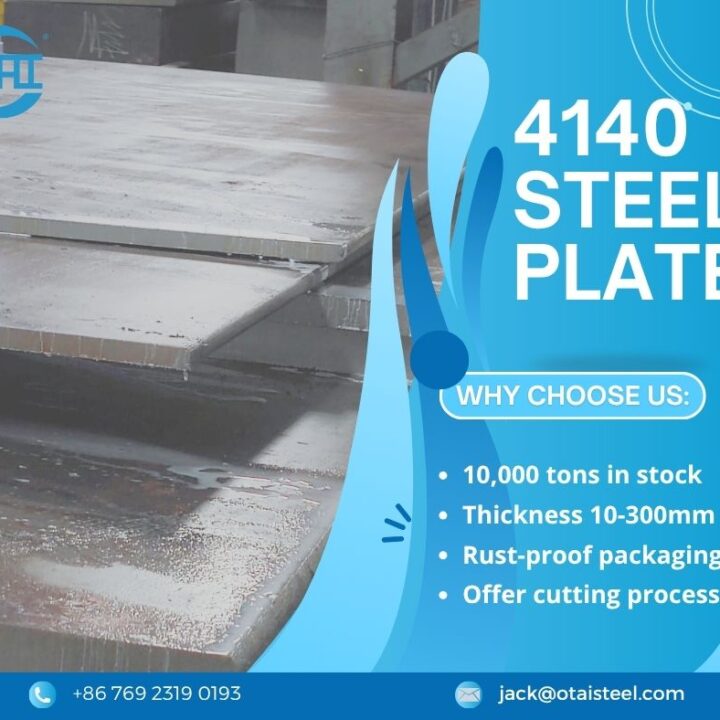
- 5140 / 41Cr4 steel plate in stock: Otai currently has 5140 / 41Cr4 steel plate available in 4–300 mm thickness.
- 10,000+ tons of total steel stock: Large inventory supports industrial sourcing and export orders.
- 20 saw cutting machines: Otai can provide cutting services according to customer-specified dimensions.
- Custom size and tolerance: Buyers can discuss required dimensions and machining allowances before shipment.
- CNC and grinding: Additional processing can support projects that require closer dimensional control.
- One-stop service: Cutting, machining, inspection, packaging and export coordination can be arranged through one supplier.
- International export experience: Otai has exported steel to 54+ countries since 1999.
- Inspection support: Material certificates, ultrasonic testing and third-party inspection can be arranged according to project requirements.
- Export packaging: Anti-rust protection, bundled packaging and wooden box packaging can support international shipments.
For a 5140 steel inquiry, send the required dimensions, quantity, applicable standard, delivery condition and inspection requirements. Otai can then confirm the available 5140 / 41Cr4 steel plate stock and discuss cutting or additional processing requirements.
❓ FAQ
1. What is 5140 steel bar?
5140 steel bar is a medium-carbon chromium alloy steel used for shafts, axles, gears, machine components and other parts that need useful strength and hardenability. The grade is commonly identified as SAE/AISI 5140 and UNS G51400.
2. What is the chemical composition of 5140 steel?
A commonly referenced SAE J404 composition gives 0.38–0.43% carbon, 0.70–0.90% manganese and 0.70–0.90% chromium, with silicon at 0.15–0.35%, phosphorus up to 0.030% and sulfur up to 0.040%. The actual heat chemistry should come from the supplier’s MTC.
3. What is the hardness of 5140 steel?
Hardness depends on the delivery condition. One annealed reference shows 167 HB, a normalized 25 mm round reference shows 229 HB, and an oil-quenched plus tempered 25 mm reference shows 293 HB or approximately 31 HRC.
4. What temperature is used for 5140 steel heat treatment?
One published reference uses 845°C for austenitizing, oil quenching and 540°C tempering. The exact cycle depends on section size, furnace conditions, quenching medium and the required final properties.
5. Is 5140 equivalent to 41Cr4?
5140 and 41Cr4 / 1.7035 frequently appear as international comparison grades. However, buyers should verify the applicable standard, chemistry, product form, heat-treatment condition and mechanical requirements before approving them as substitutes.