 How Strong Is 4140 Steel? Strength, Hardness and Engineering Performance
📑 Table of Contents
🔥 1. Introduction: How Strong Is 4140 Steel?
⚙️ 2. What Makes 4140 Steel Strong?
📊 3. 4140 Steel Tensile Strength and Yield Strength
🔥 4. 4140 Steel Hardness After Heat Treatment
🔬 5. Factors Affecting 4140 Steel Strength
🏭 6. Applications That Require 4140 Steel Strength
🔍 7. Choosing the Right 4140 Steel Condition
🏭 Otai Special Steel Advantages
❓ FAQ About 4140 Steel Strength
🔥 1. Introduction: How Strong Is 4140 Steel?
When engineers need a reliable alloy steel for high-stress components, 4140 steel is one of the most widely selected materials.
The question how strong is 4140 steel is common because this steel grade combines high strength, good toughness, excellent fatigue resistance, and strong wear performance.
4140 steel belongs to the chromium-molybdenum alloy steel family. Its balanced chemical composition allows it to achieve excellent mechanical properties through heat treatment.
Unlike ordinary carbon steels, 4140 steel can maintain high strength even when components experience heavy loads, repeated stress, and impact forces.
The strength of 4140 steel depends on several factors, including:
- Heat treatment condition
- Material thickness
- Hardness level
- Manufacturing process
- Final application requirements
For example, annealed 4140 steel has moderate strength and excellent machinability, while quenched and tempered 4140 steel can reach much higher strength levels.
Basic Strength Characteristics of 4140 Steel
| Property | Typical Value |
|---|---|
| Tensile Strength | Approximately 655–1900 MPa depending on heat treatment |
| Yield Strength | Approximately 415–1700 MPa depending on condition |
| Hardness | About 170–600 HB |
| Fatigue Resistance | Excellent |
| Toughness | Very Good |
This wide performance range explains why 4140 steel is used in automotive parts, oil and gas equipment, machinery components, and structural applications.
Understanding 4140 steel strength properties helps engineers select the correct material condition for their projects.
⚙️ 2. What Makes 4140 Steel Strong?
The excellent strength of 4140 steel comes from its alloy composition and heat treatment capability.
The main alloying elements are chromium and molybdenum, which improve hardenability, toughness, and resistance to mechanical stress.
4140 Steel Chemical Composition
| Element | Typical Content (%) | Effect on Strength |
|---|---|---|
| Carbon (C) | 0.38–0.43 | Provides hardness and strength |
| Chromium (Cr) | 0.80–1.10 | Improves hardenability and wear resistance |
| Molybdenum (Mo) | 0.15–0.25 | Improves toughness and high-temperature strength |
| Manganese (Mn) | 0.75–1.00 | Improves strength and hardening response |
| Silicon (Si) | 0.15–0.35 | Improves steel strength |
Role of Alloy Elements in 4140 Strength
| Element | Strength Contribution |
|---|---|
| Carbon | Increases hardness and tensile strength |
| Chromium | Improves wear resistance and hardening depth |
| Molybdenum | Improves toughness and prevents brittleness |
| Manganese | Improves overall mechanical strength |
The combination of chromium and molybdenum gives 4140 steel a major advantage over many standard carbon steels.
For example, compared with A36 or 1045 steel, 4140 provides much higher strength after proper heat treatment.
This is why 4140 alloy steel strength makes it suitable for components that must withstand severe working conditions.
📊 3. 4140 Steel Tensile Strength and Yield Strength
Tensile strength and yield strength are two of the most important measurements when evaluating steel performance.
Tensile strength shows the maximum stress a material can withstand before breaking, while yield strength indicates the point where permanent deformation begins.
4140 Steel Mechanical Properties
| Condition | Tensile Strength | Yield Strength | Hardness |
|---|---|---|---|
| Annealed | 655–850 MPa | 415–550 MPa | 170–220 HB |
| Normalized | 850–1000 MPa | 650–800 MPa | 240–280 HB |
| Quenched and Tempered | 900–1900 MPa | 700–1700 MPa | 280–600 HB |
The table shows that heat treatment has a major influence on the final strength of 4140 steel.
A properly heat-treated 4140 component can achieve strength levels several times higher than common mild steels.
4140 Steel Strength Compared with Common Steels
| Steel Grade | Tensile Strength Range | Strength Level |
|---|---|---|
| A36 Steel | 400–550 MPa | Low |
| 1045 Steel | 570–700 MPa | Medium |
| 4140 Steel | 900–1900 MPa | High |
| 4340 Steel | 1000–2000 MPa | Very High |
This comparison explains why 4140 steel is widely used in demanding mechanical applications.
Its combination of strength and toughness provides a better balance than many higher-carbon steels that may become too brittle.
🔥 4. 4140 Steel Hardness After Heat Treatment
When discussing how strong is 4140 steel, hardness is one of the most important factors because it directly affects wear resistance, load capacity, and service life.
4140 steel can achieve a wide range of hardness levels depending on the heat treatment process.
The same 4140 steel grade can have completely different mechanical performance in annealed, normalized, quenched, or tempered conditions.
4140 Steel Hardness by Heat Treatment Condition
| Heat Treatment Condition | Typical Hardness | Application Performance |
|---|---|---|
| Annealed 4140 | 170–220 HB | Excellent machinability, moderate strength |
| Normalized 4140 | 240–280 HB | Improved strength and toughness |
| Quenched and Tempered 4140 | 28–55 HRC | High strength and fatigue resistance |
| High Hardness 4140 | 50–60 HRC | Maximum wear resistance applications |
Effect of Heat Treatment on 4140 Steel Strength
| Process | Purpose | Strength Effect |
|---|---|---|
| Annealing | Reduce hardness and improve machinability | Lowers strength but improves processing |
| Normalizing | Refine grain structure | Improves strength and toughness |
| Quenching | Create hard martensitic structure | Significantly increases hardness |
| Tempering | Reduce brittleness after quenching | Balances strength and toughness |
For most industrial applications, quenched and tempered 4140 steel is preferred because it provides an excellent combination of strength and toughness.
The material can withstand heavy mechanical loads while still resisting cracking and sudden failure.
Why 4140 Steel Has High Hardness Potential
The high hardness capability of 4140 steel comes from its chromium-molybdenum alloy design.
- Chromium improves hardening depth.
- Molybdenum increases toughness and prevents temper brittleness.
- Carbon creates a strong martensitic structure after quenching.
- Manganese improves overall hardenability.
Because of this alloy balance, 4140 steel hardness after heat treatment can reach levels suitable for demanding industrial components.
🔬 5. Factors Affecting 4140 Steel Strength
The strength of 4140 steel is not determined only by chemical composition.
Manufacturing process, heat treatment, size, and operating conditions also influence the final performance.
1. Heat Treatment Condition
Heat treatment is the most important factor affecting 4140 steel strength.
A properly quenched and tempered 4140 steel component can achieve much higher strength compared with untreated material.
| Condition | Strength Performance |
|---|---|
| Cold Worked | Moderate improvement |
| Normalized | Good strength and toughness |
| Quenched & Tempered | Highest engineering performance |
2. Material Thickness
The thickness of 4140 steel can influence hardening depth.
Large sections require sufficient alloy content to achieve uniform hardness throughout the material.
| Material Size | Strength Consideration |
|---|---|
| Small Sections | Easy to achieve full hardness |
| Medium Sections | Good hardening response |
| Large Sections | Require proper heat treatment control |
3. Manufacturing Quality
Steel quality also affects the final strength of 4140 components.
Factors such as inclusions, internal defects, and improper heat treatment may reduce fatigue life and reliability.
High-quality 4140 steel should include:
- Controlled chemical composition
- Good internal cleanliness
- Ultrasonic testing when required
- Reliable heat treatment process
4. Working Environment
The actual application environment also determines whether 4140 steel strength is sufficient.
| Working Condition | Required Property |
|---|---|
| High Impact Loads | Toughness |
| Repeated Loading | Fatigue Strength |
| Sliding Contact | Wear Resistance |
| Heavy Compression | Yield Strength |
This explains why engineers evaluate more than just tensile strength when selecting 4140 steel.
The complete performance of 4140 steel strength properties depends on the relationship between hardness, toughness, and application requirements.
📈 4140 Steel Strength in Different Conditions
One reason 4140 steel is so popular is its ability to provide different strength levels for different applications.
| 4140 Condition | Tensile Strength | Main Application |
|---|---|---|
| Annealed 4140 | 655–850 MPa | Machining parts and general fabrication |
| Normalized 4140 | 850–1000 MPa | Structural components |
| Q&T 4140 (28–35 HRC) | 900–1200 MPa | Shafts and mechanical parts |
| Q&T 4140 (40–50 HRC) | 1200–1600 MPa | High-stress components |
| High Strength 4140 | 1600+ MPa | Special engineering applications |
Therefore, the answer to how strong is 4140 steel depends on the exact condition of the material.
A properly selected 4140 steel grade can provide outstanding strength while maintaining enough toughness for safe operation.
🏭 6. Applications That Require 4140 Steel Strength
The excellent strength-to-toughness balance of 4140 steel makes it one of the most widely used alloy steels in demanding industries.
When engineers ask how strong is 4140 steel, they usually want to know whether this material can handle heavy loads, repeated stress, and harsh operating conditions.
In many cases, heat-treated 4140 steel provides the strength required for critical mechanical components.
Common Applications of 4140 Steel
| Industry | Components | Why 4140 Steel Is Selected |
|---|---|---|
| Automotive | Axles, shafts, gears, connecting parts | High fatigue resistance and strength |
| Oil and Gas | Drill collars, tool joints, equipment parts | Excellent toughness under heavy loads |
| Construction Machinery | Hydraulic components, pins, shafts | High wear resistance and impact strength |
| Industrial Machinery | Gear shafts, rollers, machine parts | Reliable performance under repeated stress |
| Tool Manufacturing | Fixtures, holders, tooling components | Good hardness and dimensional stability |
4140 Steel Strength in Mechanical Components
| Component | Required Property | 4140 Performance |
|---|---|---|
| Shafts | High tensile strength and fatigue resistance | Excellent |
| Gears | Wear resistance and toughness | Excellent after heat treatment |
| Bolts | High yield strength | Very Good |
| Pins | Impact resistance | Excellent |
| Machine Parts | Balanced strength and machinability | Excellent |
Compared with ordinary carbon steel, 4140 provides significantly higher mechanical performance.
For example, components made from mild steel may deform under heavy loads, while properly heat-treated 4140 steel can maintain structural integrity.
Why Industries Prefer 4140 Steel
- High strength after heat treatment
- Excellent resistance to fatigue failure
- Good combination of hardness and toughness
- Reliable machinability before hardening
- Wide availability in different sizes and conditions
These advantages make 4140 alloy steel strength suitable for both standard industrial parts and high-performance engineering applications.
🔍 7. Choosing the Right 4140 Steel Condition
Selecting the correct 4140 steel condition is important because the same grade can provide different strength levels depending on processing.
Engineers should consider the required hardness, machining requirements, and service environment before choosing the material condition.
4140 Steel Condition Selection Guide
| Material Condition | Main Features | Recommended Applications |
|---|---|---|
| Annealed 4140 | Soft, easy to machine | Machined parts requiring further heat treatment |
| Normalized 4140 | Improved strength and toughness | General engineering components |
| 4140 Q&T | High strength and excellent toughness | Shafts, gears, heavy machinery parts |
| Pre-hardened 4140 | Ready-to-use hardness | Molds, tooling, precision components |
4140 Steel vs 1045 Steel Strength Comparison
| Property | 4140 Steel | 1045 Steel |
|---|---|---|
| Steel Type | Chromium-molybdenum alloy steel | Medium carbon steel |
| Tensile Strength | 900–1900 MPa depending on condition | 570–700 MPa |
| Hardenability | Excellent | Limited |
| Toughness | Very Good | Moderate |
| Heavy Load Applications | Suitable | Limited |
This comparison shows why many engineers choose 4140 instead of ordinary carbon steel when strength and reliability are critical.
The correct grade selection improves component life and reduces unexpected failures.
🏭 Otai Special Steel Advantages
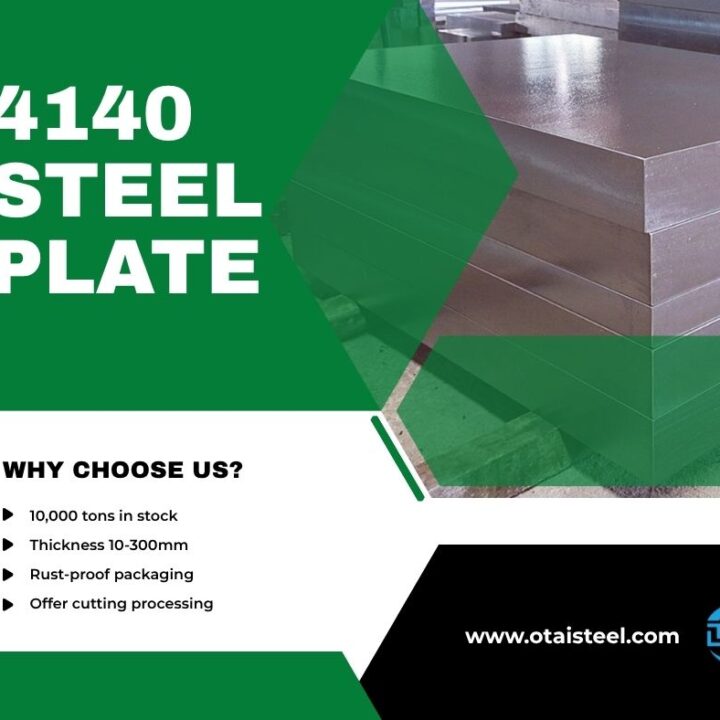
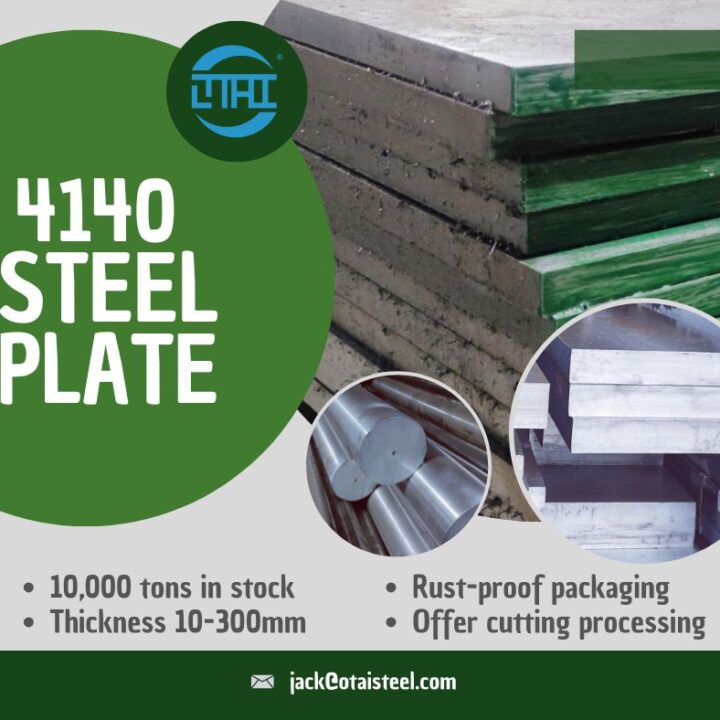
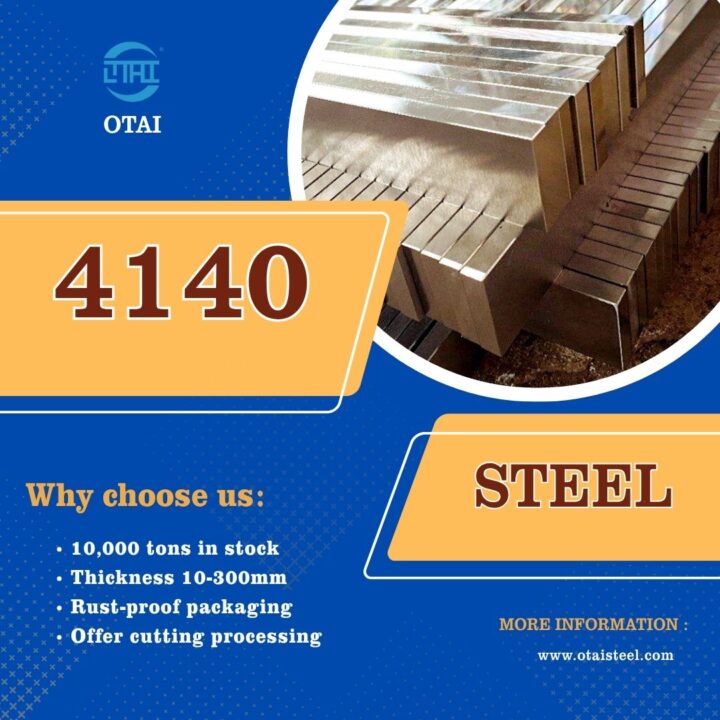
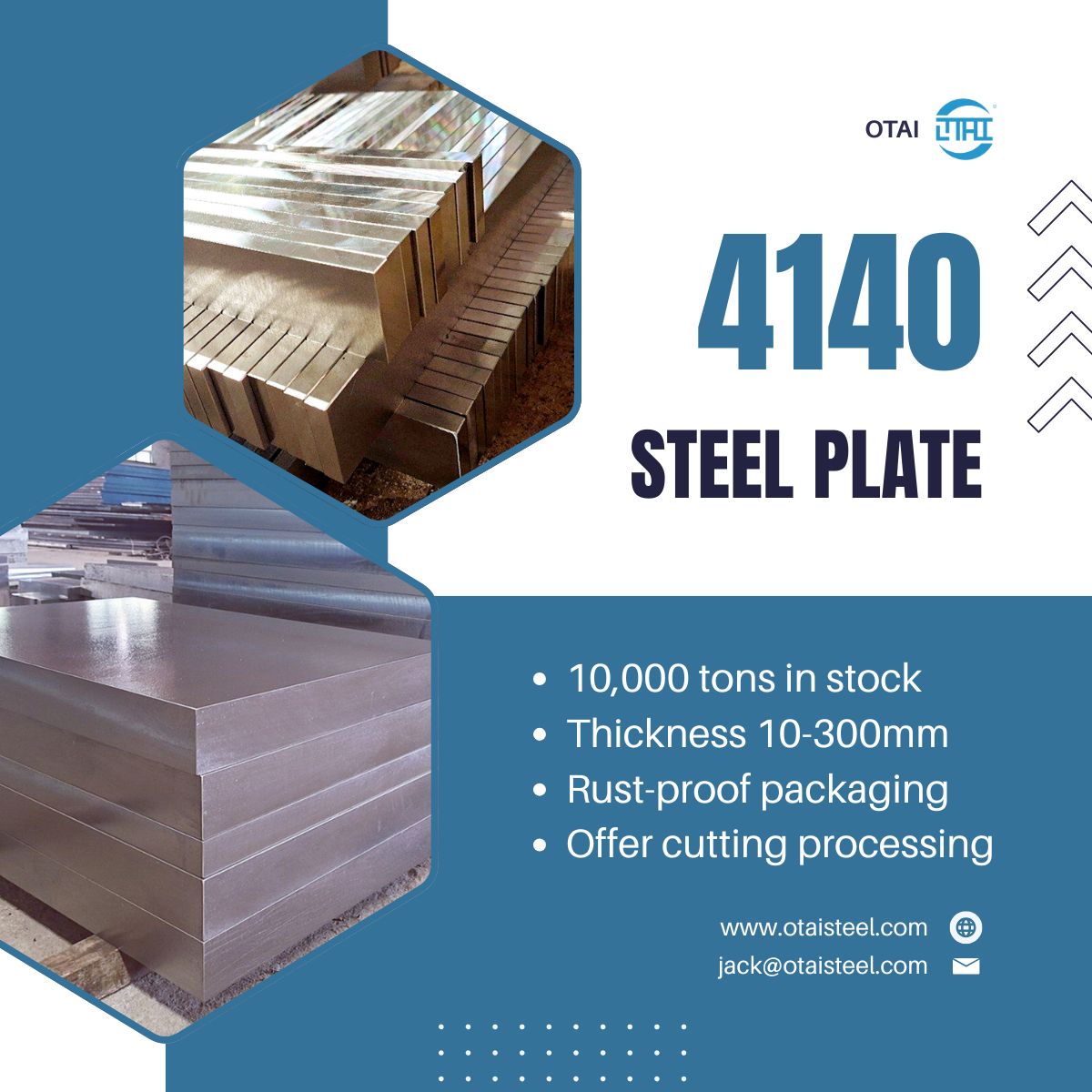
Otai Special Steel is a professional supplier specializing in 4140 alloy steel plates and other engineering steel materials.
- Large inventory: Otai maintains approximately 10,000 tons of steel stock with different sizes available for customer requirements.
- Wide size availability: Different thicknesses and dimensions of 4140 alloy steel plates are available for urgent production needs.
- Professional processing services: Cutting, machining, heat treatment support, and customized processing services are available.
- Quality assurance: Ultrasonic testing and third-party inspection services can be provided according to customer requirements.
- Global supply experience: Otai has supplied steel materials to Fortune Global 500 companies and understands strict technical requirements.
- Export packaging: Anti-rust packaging, steel strapping, and wooden box packaging ensure safe international delivery.
Whether customers need 4140 steel plates, alloy steel bars, or customized processing solutions, Otai provides reliable material support.
❓ FAQ About 4140 Steel Strength
Q1: How strong is 4140 steel compared with regular steel?
4140 steel is much stronger than common carbon steels such as A36 and 1045. After heat treatment, it can reach tensile strengths above 1000 MPa.
Q2: What is the tensile strength of 4140 steel?
The tensile strength of 4140 steel depends on heat treatment. Typical values range from about 655 MPa in annealed condition to more than 1900 MPa in high-strength conditions.
Q3: Is 4140 steel stronger than 1045 steel?
Yes. 4140 steel generally provides higher strength, better hardenability, and better toughness compared with 1045 carbon steel.
Q4: Can 4140 steel be used for heavy-duty applications?
Yes. Properly heat-treated 4140 steel is widely used for shafts, gears, oil field equipment, and heavy machinery components.
Q5: What makes 4140 steel strong?
Its chromium-molybdenum alloy composition and heat treatment capability provide high strength, toughness, and wear resistance.
Q6: Does Otai supply 4140 steel plates?
Yes. Otai supplies 4140 alloy steel plates with inventory, cutting services, inspection options, and global export experience.