 4140 Steel Elements – Chemical Composition and Roles
The topic of 4140 steel elements is essential for engineers and buyers because the performance of 4140 alloy steel is directly controlled by its chemical composition. Each element plays a specific role in hardenability, strength, toughness, and wear resistance.
Understanding 4140 steel elements helps in heat treatment design, machining planning, and final application selection. Therefore, this article breaks down every key element and explains how it influences real-world industrial performance.
🔬 1. What Are the Key 4140 Steel Elements?
4140 steel is a chromium-molybdenum alloy steel. Its properties come from a balanced combination of elements rather than a single component. In general, 4140 steel elements include carbon, manganese, chromium, molybdenum, silicon, phosphorus, and sulfur.
Each element contributes differently. Meanwhile, the interaction between these elements determines final mechanical performance after quenching and tempering.
- Carbon (C) – Controls hardness and strength
- Chromium (Cr) – Improves hardenability and wear resistance
- Molybdenum (Mo) – Enhances toughness and reduces temper brittleness
- Manganese (Mn) – Increases hardenability and tensile strength
- Silicon (Si) – Improves deoxidation and strength stability
Therefore, 4140 steel elements must always be evaluated as a system rather than individually.
⚙️ 2. Detailed Chemical Composition of 4140 Steel
| Element | Typical Range | Function in 4140 Steel |
|---|---|---|
| Carbon (C) | 0.38–0.43% | Provides hardness and strength after heat treatment |
| Chromium (Cr) | 0.80–1.10% | Improves hardenability and wear resistance |
| Manganese (Mn) | 0.75–1.00% | Enhances toughness and strength |
| Molybdenum (Mo) | 0.15–0.25% | Improves high-temperature strength and toughness |
| Silicon (Si) | 0.15–0.30% | Improves strength and oxidation resistance |
These 4140 steel elements are carefully balanced to achieve high performance under quenching and tempering conditions. In addition, small variations in composition can significantly affect hardness and fatigue resistance.
🔥 3. How Each Element Affects Mechanical Properties
The performance of 4140 steel is not determined by a single element. Instead, 4140 steel elements interact during heat treatment to create final mechanical properties.
For example, carbon increases hardness, but too much carbon reduces toughness. Chromium improves wear resistance, while molybdenum prevents brittleness during tempering.
- Higher carbon → higher hardness but lower ductility
- Higher chromium → better wear resistance and deeper hardening
- Molybdenum addition → improved fatigue strength
- Manganese balance → improved machinability and strength
Therefore, engineers must evaluate 4140 steel elements as a combined system rather than isolated factors.
🧪 4. Microstructure Changes Driven by Steel Elements
Before heat treatment, 4140 steel has a ferrite-pearlite structure. After quenching and tempering, 4140 steel elements support the formation of tempered martensite.
This transformation is critical for industrial applications. Chromium and molybdenum increase hardenability, allowing deeper martensitic transformation even in thick sections.
Meanwhile, carbon determines the final hardness level, while molybdenum reduces the risk of temper embrittlement.
As a result, 4140 steel achieves a strong balance between strength and toughness.
⚙️ 5. Heat Treatment Response of 4140 Steel Elements
Heat treatment is where 4140 steel elements fully reveal their engineering value. The typical process includes quenching and tempering.
- Quenching temperature: 840–870°C
- Cooling medium: oil or polymer solution
- Tempering temperature: 450–650°C
During this process, carbon contributes to hardness, while chromium and molybdenum improve depth and stability of hardening.
Therefore, proper heat treatment is essential to fully activate the potential of 4140 steel elements.
🏭 6. Mechanical Properties Based on Steel Elements
| Property | Typical Range |
|---|---|
| Tensile Strength | 850–1100 MPa |
| Yield Strength | 650–950 MPa |
| Hardness | 28–32 HRC (quenched & tempered) |
| Impact Toughness | High (process dependent) |
These values clearly show how 4140 steel elements determine final performance after heat treatment. The combination of strength and toughness makes 4140 widely used in structural and mechanical components.
🚗 7. Industrial Applications of 4140 Steel Elements
Because of its balanced composition, 4140 steel is widely used in heavy-duty industrial environments. The role of 4140 steel elements ensures stable performance under high stress conditions.
- Automotive crankshafts and axle shafts
- Oil and gas drilling components
- Machine tool spindles
- High-strength bolts and fasteners
- Hydraulic equipment parts
In all these applications, the synergy of 4140 steel elements provides resistance to fatigue, wear, and impact loading.
🏢 8. Material Supply Capability – Otai Special Steel
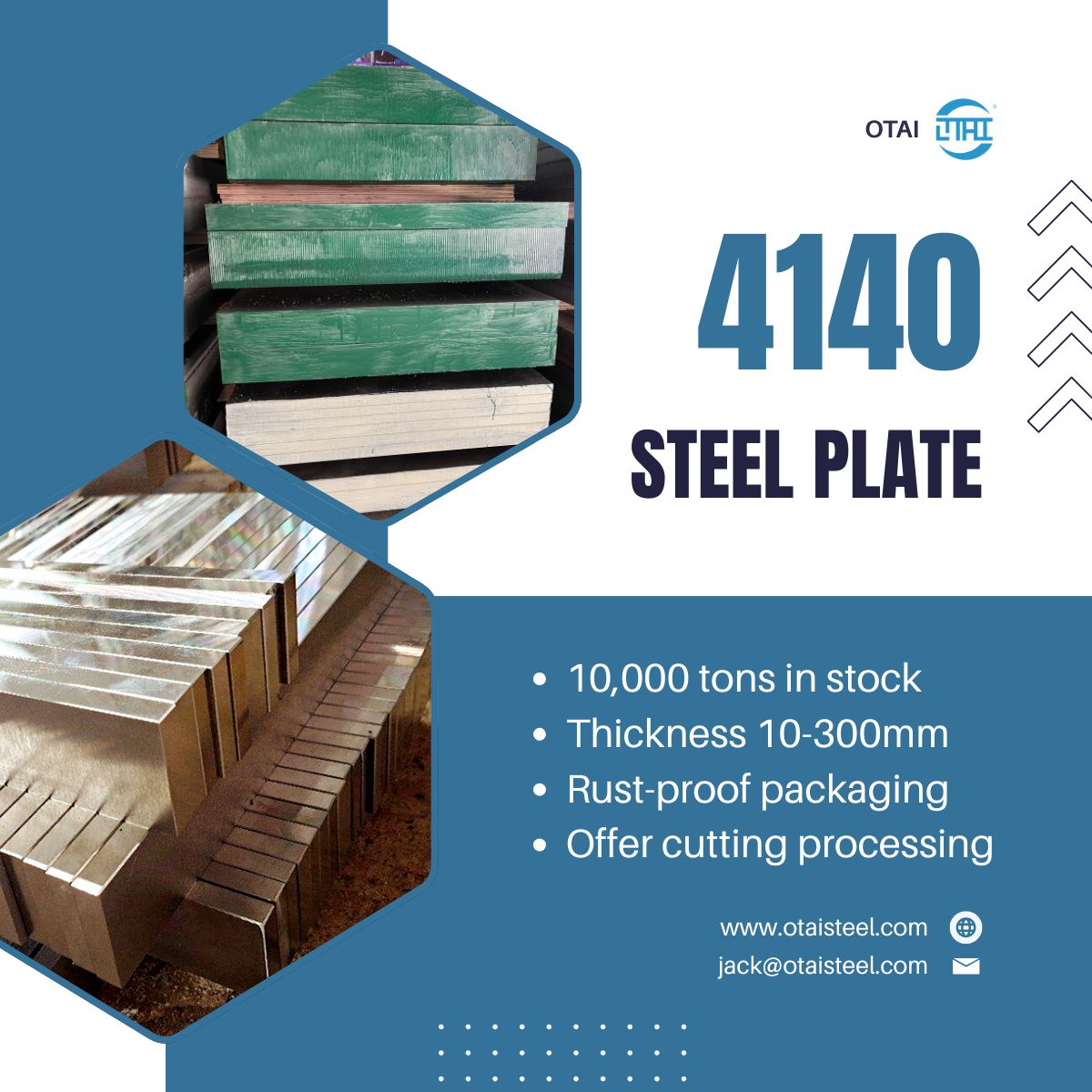
Otai Special Steel supplies high-quality 4140 steel with stable composition control and strict quality inspection.
- Large stock availability for fast delivery
- Cutting, machining, and heat treatment services
- Ultrasonic testing before shipment
- Consistent chemical composition control
- Export experience to global industrial markets
❓ FAQ
Q1: What are the main elements in 4140 steel?
Carbon, chromium, manganese, molybdenum, and silicon.
Q2: Why is molybdenum important?
It improves toughness and reduces temper brittleness.
Q3: What element improves hardness most?
Carbon is the primary hardness contributor.
Q4: Is 4140 steel suitable for heat treatment?
Yes, it is designed for quenching and tempering.
Q5: Where is 4140 steel mainly used?
In shafts, gears, fasteners, and high-stress mechanical parts.