 Pounds Per Square Inch of 4140 Steel – PSI Strength and Mechanical Properties
Understanding the pounds per square inch of 4140 steel is essential for engineers, machinists, and manufacturers working with high-strength alloy steel components. PSI, or pounds per square inch, measures stress and pressure resistance in imperial units and is commonly used in the United States for evaluating the tensile strength, yield strength, and pressure-bearing capability of steel materials.
4140 steel is one of the most widely used chromium-molybdenum alloy steels because it combines:
- High tensile strength
- Excellent toughness
- Good fatigue resistance
- Reliable wear resistance
- Strong heat-treatment response
Because of these characteristics, industries such as automotive, oil & gas, aerospace, tooling, and heavy machinery frequently use 4140 steel in critical load-bearing applications.
🔍 What Does PSI Mean for 4140 Steel?
PSI (pounds per square inch) represents the amount of force applied to one square inch of area. In steel engineering, PSI usually refers to:
- Tensile strength
- Yield strength
- Shear strength
- Pressure resistance
For 4140 steel, these values depend heavily on the heat treatment condition.
📊 Typical PSI Values of 4140 Steel
The mechanical strength of 4140 steel varies significantly between annealed and quenched-tempered conditions.
| Property | Annealed Condition | Quenched & Tempered Condition |
|---|---|---|
| Tensile Strength | 95,000 – 120,000 psi | 150,000 – 180,000 psi |
| Yield Strength | 60,000 – 90,000 psi | 130,000 – 160,000 psi |
| Shear Strength | 75,000 – 95,000 psi | 95,000 – 120,000 psi |
| Hardness | 197 – 229 HB | 28 – 35 HRC |
These high PSI values make 4140 steel suitable for components exposed to:
- Heavy impact loading
- Rotational stress
- Cyclic fatigue
- High-pressure environments
Engineering Insight: Heat-treated 4140 steel can achieve tensile strengths above 180,000 psi while still maintaining good toughness, which explains its popularity in high-performance machinery applications.
⚗️ Chemical Composition of 4140 Steel
The excellent PSI strength of 4140 steel comes from its alloy composition.
| Element | Content (%) | Function |
|---|---|---|
| Carbon (C) | 0.38 – 0.43 | Increases hardness and tensile strength |
| Silicon (Si) | 0.15 – 0.35 | Improves strength and oxidation resistance |
| Manganese (Mn) | 0.75 – 1.00 | Enhances toughness and hardenability |
| Chromium (Cr) | 0.80 – 1.10 | Improves wear resistance and hardening response |
| Molybdenum (Mo) | 0.15 – 0.25 | Enhances strength at high temperatures |
| Phosphorus (P) | ≤ 0.035 | Controlled impurity |
| Sulfur (S) | ≤ 0.040 | Improves machinability |
🔹 Why Chromium and Molybdenum Matter
Chromium and molybdenum significantly improve the ability of 4140 steel to maintain high PSI values after heat treatment. These alloying elements:
- Increase hardenability
- Improve fatigue strength
- Enhance wear resistance
- Reduce brittleness during quenching
This combination gives 4140 steel a superior balance between strength and toughness compared with plain carbon steels.
🔥 Heat Treatment and PSI Strength
The heat treatment process directly controls the PSI performance of 4140 steel.
| Heat Treatment Process | Temperature Range | Effect on Strength |
|---|---|---|
| Annealing | 815 – 870°C | Reduces hardness and improves machinability |
| Normalizing | 870 – 925°C | Refines grain structure |
| Quenching | 845 – 870°C | Forms hard martensite |
| Tempering | 200 – 650°C | Adjusts toughness and final PSI strength |
🔹 Quenched and Tempered 4140 Steel
After quenching and tempering, 4140 steel develops a tempered martensitic structure that offers:
- High tensile strength
- Excellent fatigue resistance
- Improved impact toughness
- Stable mechanical performance
For example:
- Lower tempering temperatures increase hardness and PSI strength
- Higher tempering temperatures improve ductility and toughness
Practical Tip: Tempering around 540°C often provides an excellent balance between tensile strength and impact resistance for shafts and gears.
⚙️ PSI and Pressure Resistance Applications
Because of its high PSI capability, 4140 steel is widely used in pressure-resistant applications.
| Industry | Components | Why 4140 is Selected |
|---|---|---|
| Oil & Gas | Drill collars, valves | High pressure and fatigue resistance |
| Automotive | Axles, crankshafts, gears | Excellent torsional strength |
| Aerospace | Landing gear components | High strength-to-weight performance |
| Industrial Machinery | Shafts, couplings | Reliable wear resistance |
🔹 Example: Hydraulic Shaft Application
A hydraulic shaft made from quenched and tempered 4140 steel may experience:
- Continuous rotational stress
- High pressure loading
- Repeated fatigue cycles
The high tensile PSI of 4140 steel prevents:
- Shaft deformation
- Fatigue cracking
- Surface wear failures
This significantly improves service life in industrial systems.
📐 Tensile Strength Conversion: PSI to MPa
Many international engineers use MPa instead of PSI.
| PSI | MPa |
|---|---|
| 100,000 psi | 689 MPa |
| 150,000 psi | 1034 MPa |
| 180,000 psi | 1241 MPa |
This conversion helps international buyers compare American and metric engineering specifications.
⚙️ Machinability and Weldability
Although 4140 steel offers high PSI strength, manufacturers must carefully consider machining and welding conditions.
🔹 Machining
Annealed 4140 steel machines relatively well because of its balanced hardness. However, hardened material may require:
- Carbide tooling
- Lower cutting speeds
- Controlled coolant application
🔹 Welding
4140 steel can be welded, but preheating is often necessary to prevent cracking. Typical recommendations include:
| Welding Parameter | Recommendation |
|---|---|
| Preheat Temperature | 200 – 300°C |
| Post-Weld Stress Relief | Recommended |
| Filler Material | Low-hydrogen filler |
Proper welding procedures preserve strength and reduce residual stress.
🏭 Company Advantages
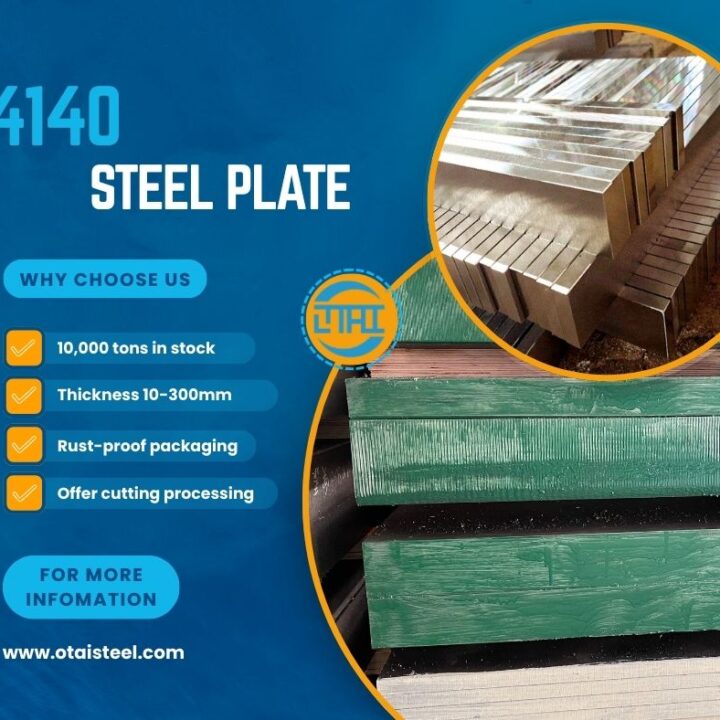
Otai Special Steel supplies premium-quality 4140 alloy steel for demanding engineering applications.
- Large inventory and stable supply
- Custom cutting and heat treatment services
- Ultrasonic testing (UT) and chemical composition verification
- Third-party inspection support (SGS)
- Professional export packaging and logistics support
We support customers in automotive, oil & gas, industrial machinery, aerospace, and tooling industries with reliable quality and technical assistance.
❓ FAQ
Q1: What is the tensile strength of 4140 steel in PSI?
A1: Depending on heat treatment, tensile strength typically ranges from 95,000 psi to 180,000 psi.
Q2: Why does heat treatment affect PSI values?
A2: Heat treatment changes the microstructure, especially martensite formation, which directly affects strength and hardness.
Q3: Is 4140 steel suitable for high-pressure applications?
A3: Yes. Its high PSI strength and fatigue resistance make it ideal for hydraulic systems, shafts, and oil & gas components.
Q4: Can 4140 steel maintain high strength at elevated temperatures?
A4: Yes. Molybdenum improves high-temperature strength and stability.
Q5: What industries commonly use 4140 steel?
A5: Automotive, aerospace, oil & gas, tooling, industrial machinery, and heavy equipment industries widely use 4140 steel.