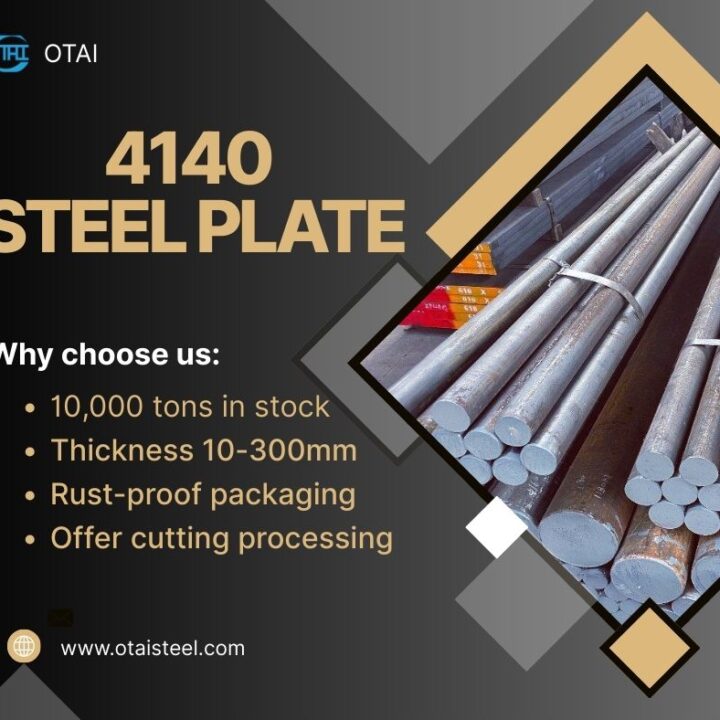
 Poisson’s Ratio of 4140 Steel – Material Properties and Engineering Considerations
Understanding the Poisson’s ratio of 4140 steel is crucial for engineers, designers, and material buyers working in automotive, aerospace, machinery, and structural applications. 4140 steel is a widely used alloy structural steel known for its excellent combination of strength, toughness, wear resistance, and machinability. Knowing its Poisson’s ratio and other mechanical properties helps in stress analysis, component design, and predicting elastic deformation under load.
🔍 What is Poisson’s Ratio?
Poisson’s ratio (ν) is a dimensionless material property that describes the ratio of lateral strain to axial strain when a material is subjected to uniaxial stress. In simple terms:
ν = -lateral strain/axial strain
- A higher Poisson’s ratio indicates the material contracts more in the perpendicular direction when stretched.
- A lower Poisson’s ratio means less lateral contraction and a more rigid response.
For structural and mechanical engineering applications, Poisson’s ratio is critical in:
- Calculating elastic moduli such as Young’s modulus and shear modulus
- Simulating stress-strain behavior in finite element analysis (FEA)
- Designing components subjected to multi-axial loading
🧪 Poisson’s Ratio of 4140 Steel
4140 steel, also known as chromium-molybdenum alloy steel, has typical mechanical properties after proper heat treatment. Its Poisson’s ratio is generally reported as:
| Condition | Poisson’s Ratio (ν) | Notes |
|---|---|---|
| Annealed | 0.27 – 0.30 | Soft state, easier to machine |
| Quenched & Tempered | 0.28 – 0.30 | Achieves higher tensile strength while maintaining ductility |
Practical insight: In design and FEA simulations, use a Poisson’s ratio of 0.29 as a standard value for tempered 4140 steel to accurately model elastic deformation.
📊 Mechanical Properties of 4140 Steel
Beyond Poisson’s ratio, other mechanical properties are essential for engineers:
| Property | Annealed | Quenched & Tempered | Typical Units |
|---|---|---|---|
| Tensile Strength | 655 – 850 | 950 – 1200 | MPa |
| Yield Strength | 415 – 550 | 785 – 1000 | MPa |
| Elongation | 20 – 25 | 12 – 16 | % |
| Hardness | 197 – 229 | 285 – 321 | HB |
| Modulus of Elasticity | 205 | 205 | GPa |
| Poisson’s Ratio | 0.27 – 0.30 | 0.28 – 0.30 | – |
🔹 Engineering Implications
- Elastic Design: Poisson’s ratio affects the lateral strain, which is crucial for shafts, gears, and cylindrical components under axial load.
- Fatigue Analysis: Understanding Poisson’s ratio improves stress concentration predictions.
- Multi-Axial Loading: In torsion and bending, lateral contraction influences stress distribution and component life.
🔥 Heat Treatment Considerations
4140 steel responds well to a variety of heat treatments, which influences Poisson’s ratio and other mechanical properties:
| Process | Temperature | Effect on Properties |
|---|---|---|
| Annealing | 820 – 860°C | Reduces hardness, improves machinability |
| Normalizing | 840 – 900°C | Refines grain structure, balances strength and toughness |
| Quenching | 800 – 850°C in oil | Increases hardness and tensile strength |
| Tempering | 400 – 600°C | Reduces brittleness, adjusts Poisson’s ratio slightly |
Engineering tip: Tempering at around 550°C after quenching ensures optimal balance of tensile strength, ductility, and Poisson’s ratio stability, suitable for critical shafts and high-stress machinery components.
⚙️ Applications Considering Poisson’s Ratio
Understanding the Poisson’s ratio of 4140 steel helps in designing components subjected to complex loading and torsion:
| Industry | Typical Components | Relevance of Poisson’s Ratio |
|---|---|---|
| Automotive | Drive shafts, crankshafts, gears | Influences lateral strain during torque and bending |
| Aerospace | Landing gear, actuators | Critical for high-stress structural components |
| Heavy Machinery | Rollers, spindles, shafts | Predicts dimensional changes under load |
| Tooling | Dies, punches, molds | Ensures accurate elastic deformation during use |
Insight: For example, in precision gear manufacturing, ignoring Poisson’s ratio may lead to dimensional errors after load application, affecting gear meshing and service life.
🏭 Company Advantages
Otai Special Steel supplies high-quality 4140 steel with consistent properties suitable for high-stress engineering applications:
- Large inventory year-round
- Custom cutting, heat treatment, and surface finishing services
- Ultrasonic testing (UT) and chemical composition verification
- Third-party inspection support (SGS)
- Export-ready packaging for international shipment
We serve automotive, aerospace, industrial machinery, and tooling industries, ensuring reliable mechanical properties including Poisson’s ratio, tensile strength, and hardness.
❓ FAQ
Q1: What is the typical Poisson’s ratio of 4140 steel?
A1: For quenched and tempered 4140 steel, the Poisson’s ratio is generally 0.28–0.30.
Q2: Why is Poisson’s ratio important for 4140 steel applications?
A2: It helps engineers predict lateral strain, optimize stress analysis, and prevent dimensional errors in components under load.
Q3: Does heat treatment affect Poisson’s ratio?
A3: Yes, annealing slightly reduces Poisson’s ratio (0.27–0.28), while quenching and tempering stabilize it around 0.28–0.30.
Q4: Can 4140 steel’s Poisson’s ratio change under high stress?
A4: In the elastic range, it remains stable. Plastic deformation can alter the effective lateral strain.
Q5: How do I use Poisson’s ratio in FEA or structural design?
A5: Input a Poisson’s ratio of 0.29 for tempered 4140 steel for accurate modeling of axial and lateral strain, particularly for shafts, gears, and pressure-bearing components.