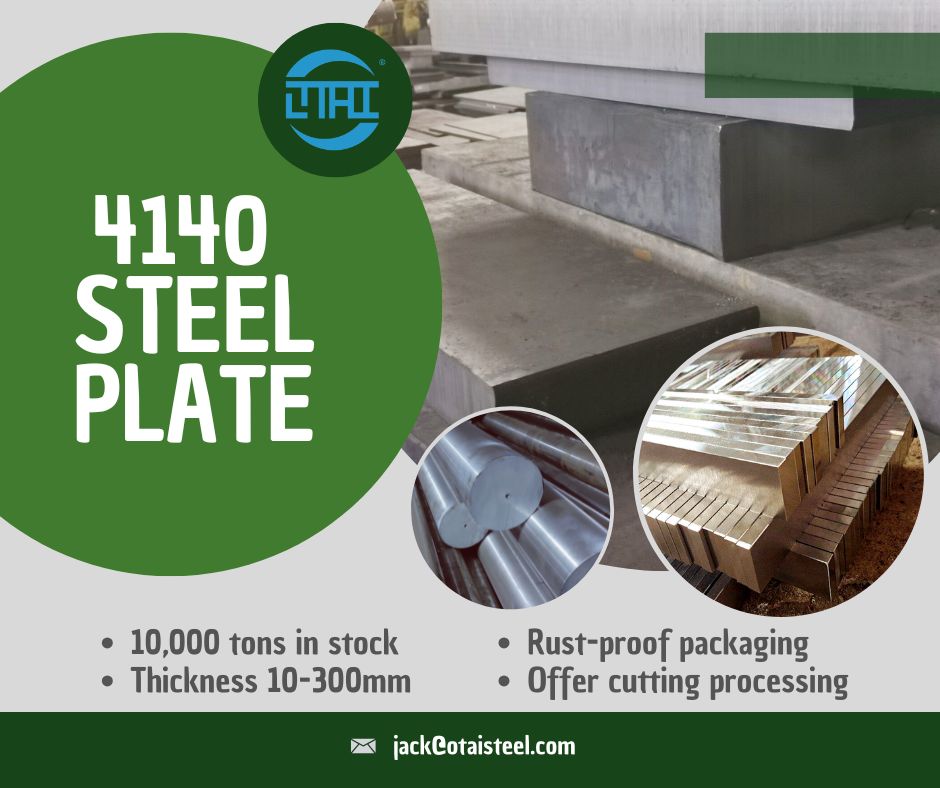
Tensile Strength of Heat Treated 4140 Steel: What Buyers and Engineers Really Need to Know When customers ask about the tensile strength of heat treated 4140 steel, they rarely want a textbook explanation. In real projects, they want clear answers to practical questions: How strong will it be after heat treatment? Which condition fits my part? Will it machine well? And will it hold up in service without driving up costs? This article focuses on real-world performance, not theory. It explains how heat treatment changes the tensile strength of 4140 steel, how engineers actually select strength levels, and how buyers avoid common mistakes when sourcing this alloy. πŸ” Why Tensile Strength Matters for Heat Treated 4140 Steel Tensile strength directly affects how a component behaves under load. For shafts, gears, hydraulic parts, and structural components, it determines: How much load the part can carry before failure How well the steel resists fatigue and shock How thin or compact the design can be How stable the part remains during long-term service 4140 steel stands out because heat treatment allows precise control of tensile strength. Instead of switching materials, engineers often adjust heat treatment to hit the exact performance window they need. πŸ”₯ Common Heat Treatment Conditions for 4140 Steel Heat treatment does not simply β€œmake steel stronger.” Each condition creates a different balance between strength, toughness, and machinability. The most common conditions include: Annealed Normalized Quenched and Tempered (Q&T) Pre-hardened (QT stock) Each condition delivers a very different tensile strength range. πŸ“Š Tensile Strength of Heat Treated 4140 Steel (Typical Ranges) Heat Treatment Condition Tensile Strength (MPa) Tensile Strength (ksi) Typical Hardness Annealed ~655 MPa ~95 ksi 18–22 HRC Normalized ~850–965 MPa 123–140 ksi 24–28 HRC Quenched & Tempered (Low) ~950–1100 MPa 138–160 ksi 26–30 HRC Quenched & Tempered (Mid) ~1100–1300 MPa 160–190 ksi 30–35 HRC Quenched & Tempered (High) ~1400–1600 MPa 203–232 ksi 40–45 HRC πŸ‘‰ Key takeaway: Heat treated 4140 steel does not have one tensile strength. It offers a controlled range, which gives engineers flexibility without changing material grades. βš™οΈ How Engineers Choose the Right Tensile Strength Level In practice, engineers rarely chase the highest tensile strength. Instead, they balance strength with toughness and machinability. πŸ›  Shaft and Axle Applications Most shafts perform best at 30–35 HRC, delivering: Tensile strength around 1100–1300 MPa Good fatigue resistance Reasonable machining costs πŸ— Structural and Load-Bearing Parts For parts with steady loads and limited shock: Normalized or low Q&T conditions work well Tensile strength around 850–1000 MPa Better toughness and dimensional stability πŸ”© Tooling and High-Stress Components For parts that must resist wear and deformation: Higher Q&T levels reach 1400 MPa and above Machining requires carbide tools Designers must control stress concentration carefully 🚫 Common Mistakes Buyers Make When Specifying Tensile Strength Many purchasing problems come from over-specifying strength. ❌ Mistake 1: Ordering the Highest Strength β€œJust in Case” Higher tensile strength increases: Machining difficulty Tool wear Risk of cracking Often, 30–35 HRC performs better than 40+ HRC in real service. ❌ Mistake 2: Ignoring Section Size Thick sections cool more slowly during quenching. As a result: Surface tensile strength looks good Core strength drops Always match heat treatment to actual part dimensions. ❌ Mistake 3: Forgetting Stress Relief After Machining Heat treated 4140 steel holds residual stress. Without stress relief: Parts warp Cracks appear later in service πŸ”§ Machining Behavior at Different Tensile Strength Levels Tensile Strength Level Machinability Typical Recommendation ≀ 850 MPa Excellent Rough machining, forging 950–1100 MPa Good Shafts, axles, general parts 1100–1300 MPa Moderate Carbide tools recommended β‰₯ 1400 MPa Difficult Finish machining only πŸ‘‰ Many customers choose pre-hardened 4140 QT steel to avoid post-machining distortion and reduce total lead time. 🏭 Typical Applications by Tensile Strength Range 900–1000 MPa β†’ Structural parts, machine frames 1100–1300 MPa β†’ Drive shafts, gears, hydraulic rods 1400 MPa+ β†’ Heavy-duty tooling, wear-prone components This flexibility explains why heat treated 4140 steel appears in oil & gas, automotive, mining, and heavy machinery projects worldwide. πŸ… Company Advantages – Why Customers Choose Otai Special Steel Choosing the correct tensile strength matters, but material consistency matters more. Otai Special Steel supports customers with: Large Inventory: Over 10,000 tons of 4140 steel plates, bars, and blocks Controlled Heat Treatment: Precise Q&T ranges to match target tensile strength Processing Support: Cutting, rough machining, and stress relief services Quality Assurance: UT testing, chemical analysis, and third-party inspection Global Trust: Long-term supplier to Thyssenkrupp, Borealis, and Schlumberger We help customers select the right strength level, not just the strongest one. ❓ FAQ Q1: What is the typical tensile strength of quenched and tempered 4140 steel? Most Q&T 4140 steel falls between 950 and 1600 MPa, depending on hardness and tempering temperature. Q2: Does higher tensile strength always mean better performance? No. Excessive strength reduces toughness and machinability. Many applications perform better at moderate strength levels. Q3: Can I specify tensile strength instead of hardness? Yes. Many engineers specify both to ensure consistent performance. Q4: Does section thickness affect tensile strength? Yes. Thick sections require adjusted heat treatment to maintain core strength. Q5: Is pre-hardened 4140 steel reliable for critical parts? Yes. When sourced from a controlled supplier, pre-hardened 4140 QT steel delivers stable tensile strength and reduces processing risk.