 What is the Hardness of 4140 Steel?
When engineers, machinists, or buyers select a material for high-performance applications, one of the first questions they ask is: what is the hardness of 4140 steel? Hardness defines not only wear resistance but also machinability, durability, and performance under load. Let’s take a detailed look at the hardness of 4140 steel under different conditions, how it changes with heat treatment, and what it means for real-world applications.
🔎 Understanding Hardness in Steel
Hardness in metallurgy refers to the material’s resistance to deformation, indentation, or wear. For 4140 alloy steel, hardness varies significantly depending on whether the steel is annealed, normalized, quenched, or tempered. Engineers measure hardness with scales such as Rockwell C (HRC), Brinell (HB), or Vickers (HV).
🧪 Typical Hardness of 4140 Steel
Here’s a breakdown of 4140 steel hardness values under different heat treatment conditions:
| Condition | Rockwell Hardness (HRC) | Brinell Hardness (HB) | Notes |
|---|---|---|---|
| Annealed 4140 Steel | 18 – 22 HRC | ~197 – 217 HB | Soft, excellent machinability |
| Normalized 4140 Steel | 28 – 32 HRC | ~277 – 302 HB | Higher strength, moderate machinability |
| Quenched & Tempered | 28 – 55 HRC | ~285 – 600 HB | Wide range, depends on tempering temp. |
| Nitrided Surface | Up to 60+ HRC | >650 HB | Extreme surface hardness, core remains tough |
This wide range of hardness values makes 4140 steel hardness Rockwell ratings adaptable for many industries.
⚡ Heat Treatment and Hardness of 4140 Steel
The hardness of 4140 alloy steel depends heavily on heat treatment processes:
-
Annealing → Reduces hardness to ~20 HRC for easy machining.
-
Normalizing → Refines grain structure, giving ~30 HRC with improved toughness.
-
Quenching and Tempering → Provides a hardness range of 28–55 HRC, balancing toughness and wear resistance.
-
Nitriding → Produces a hardened surface of up to 60–62 HRC, while keeping the core ductile.
This versatility allows engineers to select the exact 4140 steel hardness after heat treatment required for each application.
📏 Hardness vs. Strength in 4140 Steel
Hardness often correlates with tensile and yield strength. For 4140 steel, the relationship looks like this:
| Hardness (HRC) | Tensile Strength (MPa) | Typical Application |
|---|---|---|
| 18 – 22 HRC | ~655 MPa | Easy machining, pre-heat-treatment stock |
| 28 – 32 HRC | ~965 MPa | Shafts, gears, machine parts |
| 40 – 45 HRC | ~1250 MPa | Oilfield tools, pressure components |
| 50 – 55 HRC | ~1600 MPa | Dies, wear parts, heavy-duty equipment |
By aligning 4140 steel hardness vs tensile strength, engineers balance strength and ductility for performance.
🏗️ Applications Based on Hardness
Different hardness ranges serve different applications:
-
Low Hardness (20 HRC) → Machinability is excellent; often used before heat treatment.
-
Medium Hardness (30–40 HRC) → Ideal for automotive shafts, gears, and couplings.
-
High Hardness (45–55 HRC) → Suited for aerospace landing gear, drill collars, and high-load equipment.
-
Surface Hardened (60 HRC+) → Used in bushings, bearings, and wear-resistant components.
Thus, asking “what is the hardness of 4140 steel” is not a single-answer question—it depends on the application.
🔧 Practical Engineering Considerations
-
Machinability vs Hardness: In the annealed state, machinists prefer 4140 steel for its low hardness (~20 HRC). Once hardened above 30 HRC, carbide tooling becomes necessary.
-
Weldability: Preheating and post-weld treatment are required because higher hardness increases the risk of cracking.
-
Heat Treatment Control: Precise tempering temperatures allow engineers to fine-tune hardness for strength or wear resistance.
-
Surface vs Core Properties: Nitriding creates a hard shell while preserving a tough, shock-resistant core.
🛡️ Benefits of 4140 Steel’s Adjustable Hardness
-
Customizable → Can range from machinable soft (~20 HRC) to wear-resistant hard (~55 HRC).
-
Toughness → Maintains impact resistance even at high hardness.
-
Versatility → Suitable for oil & gas, aerospace, automotive, and tooling industries.
-
Extended Service Life → Nitrided or tempered parts last longer under stress.
This flexibility makes 4140 steel hardness HRC values a key advantage over plain carbon steels.
💡 Company Advantages – Why Buy 4140 Steel from Otai Special Steel?
-
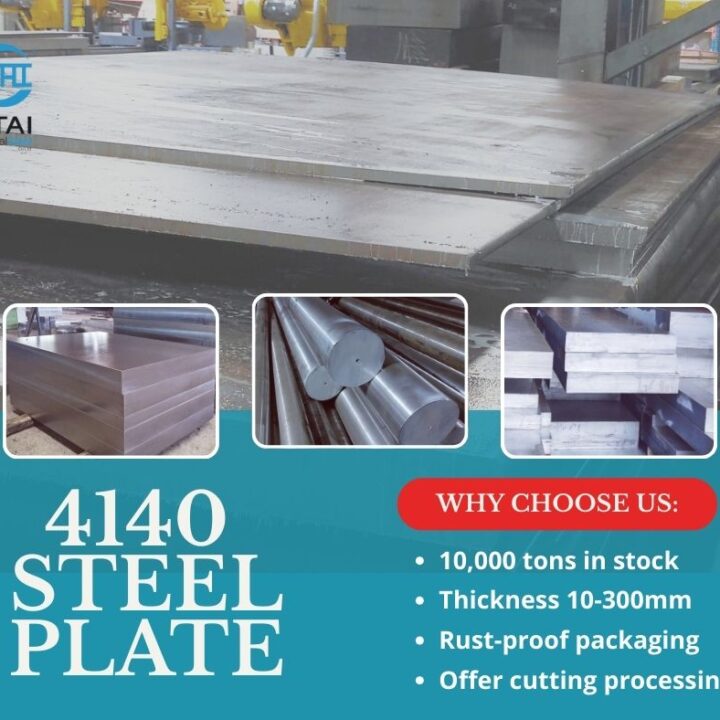
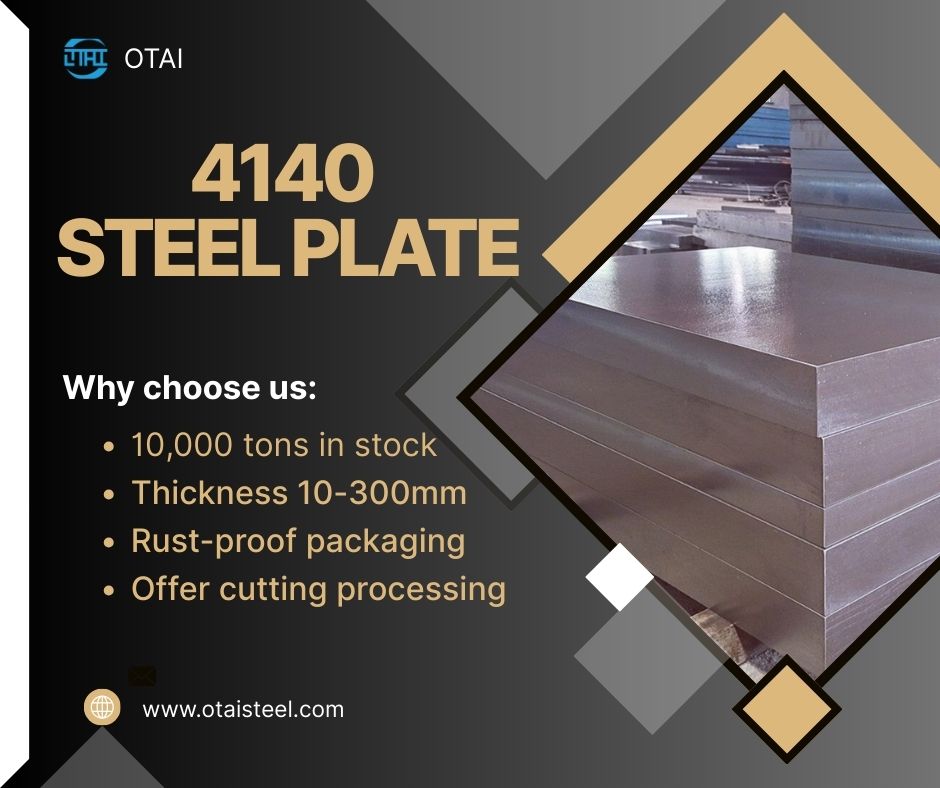
Large Inventory: 10,000+ tons of 4140 steel in plates, bars, and tubes.
-
Custom Processing: Heat treatment, machining, and cutting tailored to hardness requirements.
-
Certified Quality: Ultrasonic testing (UT), chemical analysis, and SGS inspection available.
-
Global Trust: Long-term supplier to companies like Thyssenkrupp, Borealis, and Schlumberger.
-
One-Stop Service: From hardness testing to logistics, Otai ensures reliable delivery worldwide.
❓ FAQ
Q1: What is the maximum hardness of 4140 steel?
When quenched and tempered, it reaches 55 HRC. With nitriding, surface hardness can exceed 60 HRC.
Q2: What is the hardness of annealed 4140 steel?
Typically 18–22 HRC, making it easy to machine.
Q3: How does hardness affect machinability?
The softer it is, the easier to machine. Above 30 HRC, cutting tools need to be more advanced (like carbide).
Q4: Is higher hardness always better?
Not necessarily—too high hardness reduces toughness. Engineers choose hardness based on the balance of wear resistance and impact strength.
Q5: Does hardness affect weldability?
Yes. Higher hardness makes welding more difficult and increases the risk of cracks unless preheating and stress-relieving are applied.